Guide to German Konjunktiv II

The German Konjunktiv II, also called Konjunktiv 2 or German subjunctive II, is the mood of the unreal. It expresses wishes, hypothetical or impossible situations, polite requests and counterfactual past events. German learners encounter it in everyday conversations, newspapers and formal writing, making it essential for accurate and natural German.
In English, we often use would, could, or would have, but German distinguishes between special verb forms and the widely used würde-Form.
Example:
English: If I were rich, I would travel more.
German: Wenn ich reich wäre, würde ich mehr reisen.
This guide covers Konjunktiv II formation, usage rules, Konjunktiv II examples and practical exercises.
At a Glance: Quick Reference
Use this section as a fast lookup for Konjunktiv II uses, examples and conjugations.
Core Uses with Examples
Use | German Sentence | English |
|---|---|---|
Wish | Ich wünschte, ich hätte mehr Zeit. | I wish I had more time. |
Unreal Condition | Wenn ich Zeit hätte, würde ich kommen. | If I had time, I would come. |
Polite Request | Könnten Sie mir helfen? | Could you help me? |
Reported Speech Fallback | Er sagte, er wäre müde. | He said he was (would be) tired. |
Conditional Past | Er hätte kommen können. | He could have come. |
Most Frequent Forms
German Verb | Konjunktiv II | English Translation |
|---|---|---|
haben | hätte | would have |
sein | wäre | would be |
werden | würde | would (become) / would |
geben | gäbe | would give |
kommen | käme | would come |
tun | täte | would do |
können | könnte | could |
müssen | müsste | would have to / must (conditional) |
dürfen | dürfte | could / may (conditional) |
sollen | sollte | should / ought to (conditional) |
mögen | möchte | would like |
What Is Konjunktiv II
Konjunktiv II expresses situations that are not real: imagined states, hypothetical conditions, wishes, polite or softened statements and unreal past events. It is used when the speaker distances the statement from reality – either socially (politeness) or factually (impossibility).
In English these meanings often correspond to would, could, might or would have. German, however, uses either special verb forms (e.g., wäre, hätte, könnte) or the very common würde + infinitive construction, especially in spoken language.
Short Examples by Function
Wish:
Ich wünschte, ich wäre am Strand. –"I wish I were at the beach."Unreal Present / Hypothetical:
Wenn sie mehr Zeit hätte, würde sie mehr lesen. – "If she had more time, she would read more."Unreal Past (counterfactual):
Wenn er früher gegangen wäre, hätte er den Zug erwischt. –"If he had left earlier, he would have caught the train."Polite Request:
Würden Sie mir bitte sagen, wo der Ausgang ist? –"Would you please tell me where the exit is?"Conditional Past (ability/possibility):
Sie hätten gewinnen können. – "They could have won."
Konjunktiv II appears in everyday conversation, academic writing, fiction and frequent polite interactions, making it a high-frequency, high-value grammar topic for learners.
How to Form Konjunktiv II
German offers two different formation routes for Konjunktiv II:
the original subjunctive forms, and
the würde + infinitive construction.
Both are correct – but each has its place, and knowing how to choose between them is one of the biggest leaps toward natural-sounding German.
🧩 Two Formation Routes (Original Subjunctive vs. würde + Infinitive)
1. The Original Konjunktiv II Forms
These forms come from the Präteritum stem of the verb plus subjunctive endings, and in strong verbs they often undergo umlaut changes (a → ä, o → ö, u → ü).
Examples:
geben → gab → gäbe
kommen → kam → käme
sehen → sah → sähe
Strong, irregular, modal, and auxiliary verbs usually have clear, recognizable Konjunktiv II forms – so German speakers use them frequently.
2. The würde + Infinitiv Construction
For many regular (weak) verbs, the Konjunktiv II looks identical to the Präteritum, causing ambiguity:
ich machte (Präteritum)
ich machte (Konjunktiv II)
Because of this clash native speakers prefer the structure:
➡️ ich würde machen – I would do
➡️ wir würden arbeiten – We would work
➡️ sie würden reisen – They would travel
Rule of thumb:
If the Konjunktiv II form = Präteritum form, use würde.
If the verb has a distinct, recognizable Konjunktiv II form (especially strong/modals), use the original form.
This is why ich hätte, ich wäre, ich könnte sound normal and frequent, but ich würde machen is preferred over the identical-looking ich machte.
German Subjunctive II Conjugation Tables
1. Regular Verbs (Weak Verbs) – Use würde
Regular verbs have no distinct Konjunktiv II form, so würde is strongly recommended.
Verb | Präteritum | "Konjunktiv II" Form | Natural Choice |
|---|---|---|---|
machen | ich machte | ich machte (ambiguous) | ich würde machen |
arbeiten | ich arbeitete | ich arbeitete (ambiguous) | ich würde arbeiten |
lernen | ich lernte | ich lernte (ambiguous) | ich würde lernen |
2. Strong / Irregular Verbs – Use Original Forms
These have clear umlaut-marked Konjunktiv II forms.
Verb | Präteritum | Konjunktiv II | English |
|---|---|---|---|
geben | gab | gäbe | would give |
kommen | kam | käme | would come |
sehen | sah | sähe | would see |
finden | fand | fände | would find |
sprechen | sprach | spräche | would speak |
These forms sound natural in both spoken and written German.
3. Auxiliaries & Modal Verbs – Always Distinct Forms
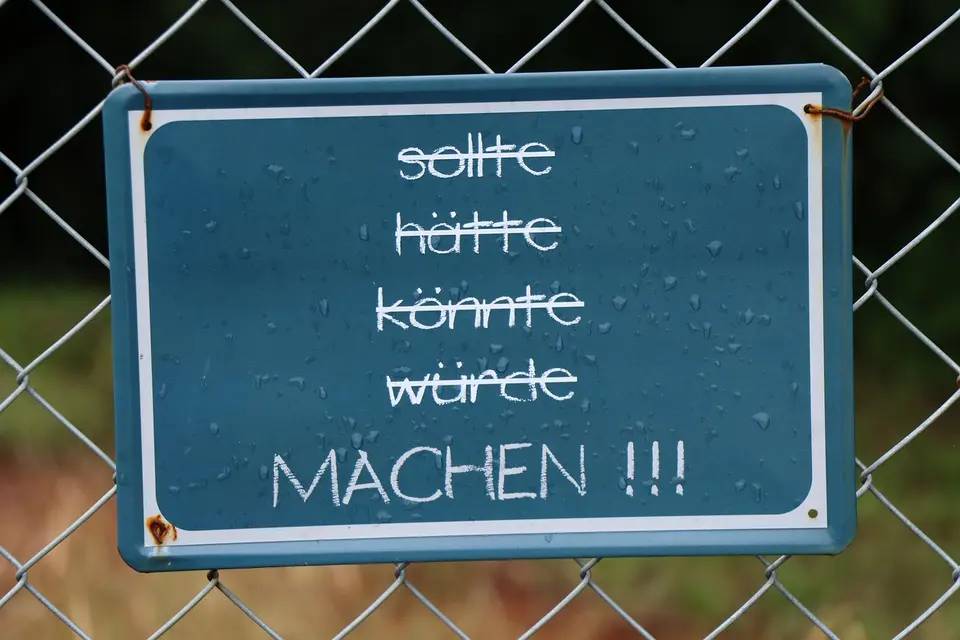
These verbs are among the most frequently used Konjunktiv-II forms in the language.
Verb | Konjunktiv II | English |
|---|---|---|
haben | hätte | would have |
sein | wäre | would be |
werden | würde | would (used for the Würde-Form) |
können | könnte | could / would be able to |
müssen | müsste | would have to / would need to |
dürfen | dürfte | might / would be allowed to |
sollen | sollte | should / ought to (Konjunktiv II often overlaps with conditional meaning) |
mögen | möchte / möge (context-dependent) |
|
Because these forms are instantly recognizable, German speakers use them instead of würde in most cases.
Forming the Past / Unreal Past (Konjunktiv II Perfekt)
To express counterfactual past meaning ("would have…", "could have…", "should have…"), German uses:
Konjunktiv II of the auxiliary (haben/sein) + Participle II
Examples:
Er hätte das gesagt. – "He would have said that."
Er wäre gegangen. – "He would have left."
Sie hätten gewinnen können. – "They could have won."
Choose sein for verbs of movement or change of state (gehen, kommen, fahren) and haben for most others.
Würde + Perfect Infinitive Variant
German also allows:
➡️ würde + Partizip II + haben/sein
Example:
Er würde gegangen sein. – "He would have gone."
This structure is grammatically valid but much less common.
It sounds more formal, sometimes overly heavy, and is mainly used when speakers want to avoid double Konjunktiv forms or maintain clarity in longer sentences. In everyday language hätte/wäre + Partizip is overwhelmingly preferred.
When to Choose Original Konjunktiv II vs. würde
Choosing between original Konjunktiv II forms (wäre, hätte, könnte, ginge) and the würde + infinitive construction is partly a matter of grammar and partly a matter of style.
Key Rules
If the Konjunktiv II form is identical to the Präteritum → use würde.
Regular (weak) verbs have identical past-tense and subjunctive forms:ich machte (Präteritum) vs. ich machte (Konjunktiv II → ambiguous)
→ ich würde machen (preferred)
This rule ensures clarity for the listener or reader.
Use original forms with modal verbs, auxiliaries, and many strong verbs.
Because their Konjunktiv II forms are morphologically distinct, they are widely used and sound natural:könnte, müsste, dürfte, sollte, hätte, wäre, käme, fände, ginge
Register difference: spoken German prefers würde, written/literary German prefers original forms.
In everyday speech, würde forms dominate except with the very common hätte/wäre/könnte/müsste.
In novels, newspaper, and formal writing, original forms appear more frequently.Some original forms sound formal, elevated, or slightly archaic.
Pairs such as ginge / würde gehen or täte / würde tun show this nuance.Ich ginge sofort, wenn ich Zeit hätte. → literary/formal
Ich würde sofort gehen, wenn ich Zeit hätte. → neutral, normal in speech
Frequency: würde gehen is far more common in modern usage; ginge appears mostly in structured or literary text.
Example Pairs Showing Register Differences
Neutral spoken: Ich würde bleiben, wenn du mich brauchst. – "I would stay if you need me."
More literary: Ich bliebe, wenn du mich brauchtest. – "I would stay if you need me."(Note: Both verbs shift into the hypothetical past in German.)
Neutral spoken: Er würde es tun. – "He would do it."
More formal/rare: Er täte es. – "He would do it."(Same meaning; täte sounds literary or old-fashioned.)
Neutral spoken: Wir würden kommen, wenn es ginge. – "We would come if it were possible."
Literary: Wir kämen, wenn es ginge. – "We would come if it were possible."(Kämen adds a more formal or stylistic tone.)
👉 In general:
Choose würde when the original form is unusual, ambiguous or archaic-sounding.
FAQ: Quick Konjunktiv II Answers
Is Konjunktiv II the same as the conditional in English?
Overlaps heavily: both express hypotheticals; German conditional = Konjunktiv II + conditions.When must I use original forms, not Würde?
Use original forms for clarity: modal verbs, auxiliaries, strong verbs (hätte, wäre, könnte, müsste).How do I form the past unreal (Konjunktiv II Perfekt)?
Formula: hätte/wäre + Partizip II → Er hätte das nicht getan.Is Konjunktiv II used in spoken German?
Yes; würde is preferred for weak verbs, originals for common irregulars.Is Konjunktiv II the same as Konjunktiv I?
No, Konjunktiv I is mainly used for reported speech, while Konjunktiv II expresses hypothetical, unreal, or polite meanings.
How can I recognize Konjunktiv II if I’m not sure?
Look for würde + infinitive, umlauted strong forms or forms ending in -e, -est, -en, -et. Context (hypothetical, polite, unreal) also signals Konjunktiv II.

Sophia is a certified German language expert (Goethe & telc) with over eight years of experience helping learners master German. She specializes in creating high-quality digital learning materials and writing informative articles, while teaching German and preparing students for exams – bringing practical, real-world language skills to every lesson.