telc B1 Speaking Part 2: How to Talk About a Topic
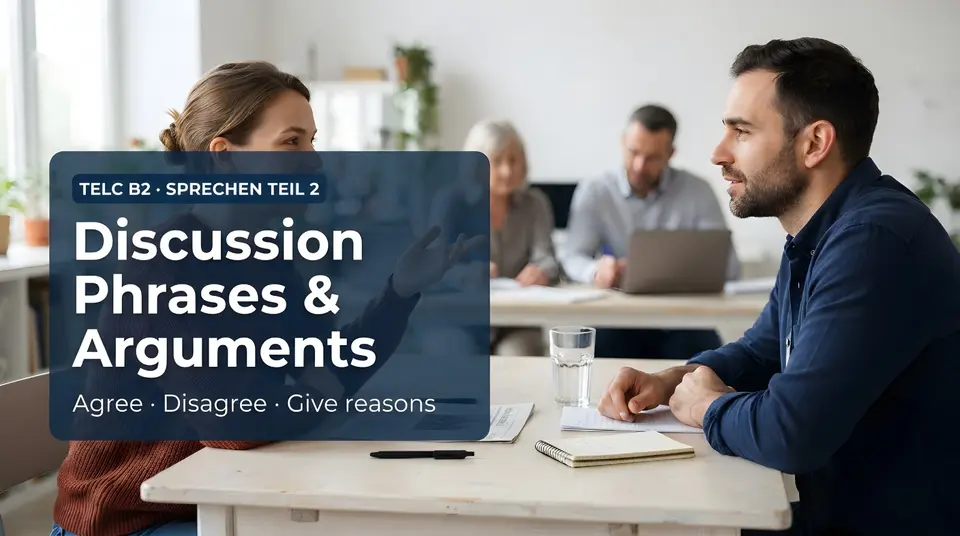
Part 2 of the telc Deutsch B1 speaking exam (Sprechen, Teil 2: Gespräch über ein Thema) is where you show that you can talk about an everyday topic, say what other people think and give your own opinion. Many candidates know enough German for it, but they get nervous, read their notes aloud or forget to talk with their partner. This guide shows you what happens in Teil 2, a simple plan for your turn and the German phrases (Redemittel) you need.
What Happens in Teil 2
You take the oral exam with a partner. In Part 2 you both get a short text on the same topic, for example Briefe und Nachrichten, Sport or Wohnen in der Stadt. But each of you gets a different text: usually the opinion of one person, with their name, age and job. You read your text in the preparation time before the exam and can make notes.
In the exam itself you:
say what your topic is and tell your partner what the person in your text thinks,
listen while your partner presents the other text,
talk about the topic together: your own opinion and your own experiences,
react to what your partner says and ask questions.
This part takes about 6 minutes for both of you. The examiners usually don't take part and only help if the conversation stops. Formats can be updated, so check the current official telc model test (Übungstest) before your exam.
What the Examiners Are Listening For
There is no "correct" opinion. The examiners want to hear that you can:
Report the text: say clearly what the person in your text thinks.
Give your opinion: and say why, with a short reason or example.
Talk about your experience: how it is for you or in your home country.
Talk with your partner: listen, react and ask questions, not just give a speech.
Speak correctly enough: mistakes are normal, but your partner and the examiners must understand you.
That's also why reading your notes aloud doesn't work. Write only keywords in the preparation time, not full sentences, and speak freely.
Step 1: Present Your Text
Start with your topic and the person in your text. Then say in two or three sentences what this person thinks. You don't need to repeat every detail. The main idea and one or two reasons are enough.
Starting
Mein Thema ist „Briefe und Nachrichten“. - My topic is "Letters and Messages".
Mein Thema ist auch „Briefe und Nachrichten“. - My topic is also "Letters and Messages". (for the second speaker)
Ich habe die Meinung von Laura Schmidt gelesen. - I read the opinion of Laura Schmidt.
Sie ist 37 Jahre alt und Journalistin von Beruf. - She is 37 years old and works as a journalist.
Saying what the person thinks
Er / Sie sagt, dass … - He / She says that …
Sie findet, dass … - She thinks that …
Er / Sie denkt, dass … - He / She thinks that …
Sie / Er ist der Meinung, dass … - She / He is of the opinion that …
Ihrer / Seiner Meinung nach muss / sollte man … - In her / his opinion, you have to / should … (verb comes next)
Adding a second point
Außerdem sagt sie, dass … - She also says that …
Sie meint auch, dass … - She also thinks that …
How to build the sentence
To say what another person thinks, use a dass clause with the normal present tense. The important thing is the word order: in a dass clause, the verb goes to the end.
Example:
Text: „Ich schreibe keine Briefe mehr. Nachrichten sind schneller.“
You: Sie sagt, dass sie keine Briefe mehr schreibt. Sie findet, dass Nachrichten schneller sind.
(She says that she doesn't write letters any more. She thinks that messages are faster.)
Four rules that make it easy
The verb goes to the end. Er sagt, dass er jeden Tag Nachrichten schreibt. With two verbs, the conjugated one comes last: …, dass man mehr Briefe schreiben sollte.
Change the pronouns. The person's ich becomes er / sie, and mein becomes sein / ihr: „Ich rufe meine Mutter jeden Tag an.“ → Sie sagt, dass sie ihre Mutter jeden Tag anruft.
Separable verbs join together at the end. Er ruft seine Freunde an. → …, dass er seine Freunde anruft.
Past events: the auxiliary goes last. „Ich habe früher viele Briefe geschrieben.“ → Er sagt, dass er früher viele Briefe geschrieben hat.
Tip: Don't use sagt, dass in every sentence. Switch between sagt, findet, meint and ist der Meinung, and link your points with außerdem or auch. Getting the word order right matters more than using difficult words.
Step 2: Give Your Opinion and Your Experience
After both texts, talk about the topic yourselves. A simple plan for every turn:
Opinion: Ich finde, dass …
Reason: …, weil …
Experience: Ich zum Beispiel … / In meinem Heimatland …
Question to your partner: Und wie ist das bei dir?
Example: Ich finde, dass Nachrichten sehr praktisch sind, weil sie schnell ankommen. Ich schreibe zum Beispiel jeden Tag mit meiner Familie in der Ukraine. Und wie ist das bei dir?
(I think messages are very practical because they arrive quickly. For example, I write to my family in Ukraine every day. And how is it for you?)
You don't need all four steps every time. A short reaction like Das stimmt, aber … is fine too. But if you get stuck, this plan always gives you something to say.
Essential Phrases (Redemittel) by Function
Giving your opinion
Ich finde / glaube / denke, dass … - I think / believe that …
Ich bin der Meinung, dass … - I am of the opinion that …
Meiner Meinung nach … - In my opinion … (verb comes next: Meiner Meinung nach ist das …)
Für mich ist wichtig, dass … - For me it's important that …
Talking about your experience
Ich habe die Erfahrung gemacht, dass … - My experience is that …
Bei mir ist das so: … - For me it's like this: …
In meinem Heimatland ist es so, dass … - In my home country, it's the case that …
Früher habe ich …, aber heute … - I used to …, but today …
Agreeing
Da hast du recht. - You're right.
Das finde ich auch. - I think so too.
Das sehe ich genauso. - I see it the same way.
Partly agreeing and disagreeing politely
Das stimmt, aber … - That's true, but …
Ja, schon, aber ich finde, dass … - Yes, sure, but I think that …
Ich sehe das ein bisschen anders. - I see that a bit differently.
Da bin ich nicht so sicher. - I'm not so sure about that.
Giving reasons
…, weil … - because … (verb at the end)
…, denn … - because … (normal word order)
Deshalb … - That's why … (verb comes next)
Asking your partner
Und wie ist das bei dir? - And how is it for you?
Was denkst du darüber? - What do you think about it?
Schreibst du auch noch Briefe? - Do you still write letters too? (a direct question about the topic)
Wie ist das in deinem Heimatland? - What's it like in your home country?
When you don't understand or need time
Kannst du das bitte noch einmal sagen? - Can you say that again, please?
Was meinst du mit …? - What do you mean by …?
Hm, das ist eine gute Frage. - Hm, that's a good question.
Ich weiß das Wort nicht auf Deutsch, aber … - I don't know the word in German, but …
Tip: In the exam you normally use du with your partner. Choose two or three phrases from each group and practise them until they come out automatically. Ten phrases you really know are worth more than fifty you half-remember.
Sample Conversation: Briefe und Nachrichten
Here is a short example of how a good Teil 2 sounds. Notice how both speakers react to each other instead of just taking turns.
A: Mein Thema ist „Briefe und Nachrichten“. Ich habe die Meinung von Laura Schmidt gelesen. Sie ist 37 Jahre alt und Journalistin von Beruf. Sie sagt, dass sie keine Briefe mehr schreibt, weil Nachrichten viel schneller sind. Außerdem findet sie, dass man mit dem Handy auch Fotos schicken kann.
(My topic is "Letters and Messages". I read the opinion of Laura Schmidt. She is 37 years old and works as a journalist. She says that she doesn't write letters any more because messages are much faster. She also thinks that you can send photos with your phone too.)
B: Mein Thema ist auch „Briefe und Nachrichten“. Ich habe die Meinung von Klaus Becker gelesen. Er ist 68 Jahre alt und Rentner. Er ist der Meinung, dass ein Brief persönlicher ist als eine Nachricht. Seiner Meinung nach sollte man zum Geburtstag immer eine Karte schreiben.
(My topic is also "Letters and Messages". I read the opinion of Klaus Becker. He is 68 years old and retired. He thinks that a letter is more personal than a message. In his opinion, you should always write a card for a birthday.)
A: Ich finde, dass Nachrichten sehr praktisch sind. Ich schreibe zum Beispiel jeden Tag mit meiner Familie. Und wie ist das bei dir? Schreibst du noch Briefe?
(I think messages are very practical. For example, I write to my family every day. And how is it for you? Do you still write letters?)
B: Nicht oft, aber ich bekomme gern Briefe. Das stimmt, Nachrichten sind schneller, aber ich glaube, dass Herr Becker recht hat. Eine Karte zum Geburtstag ist etwas Besonderes, denn man kann sie lange aufheben.
(Not often, but I like getting letters. That's true, messages are faster, but I think Mr Becker is right. A birthday card is something special because you can keep it for a long time.)
Common Mistakes to Avoid
Reading your notes aloud. Write only keywords and speak freely.
Retelling the whole text. Two or three sentences about what the person thinks are enough. The conversation is the main part.
Wrong word order after dass and weil. Sie sagt, dass sie schreibt keine Briefe is wrong. The verb goes to the end: …, dass sie keine Briefe schreibt.
Forgetting to change the pronouns. Sie sagt, dass ich keine Briefe schreibe sounds as if it's about you. Say …, dass sie keine Briefe schreibt.
Mixing up your view and the person's. Make it clear: Sie meint, dass … Ich finde aber, dass …
Opinions without reasons. Ich finde das gut. on its own isn't enough. Add a weil or an example.
Not listening to your partner. If you never react to what your partner said, it's two speeches, not a conversation.
How to Prepare
Speak out loud. Reading phrases silently isn't the same as saying them. Practise full answers aloud every day.
Practise the opening. Mein Thema ist … Ich habe die Meinung von … gelesen. Er / Sie ist … Jahre alt und … von Beruf. If you know these sentences, the start is easy.
Practise with a partner. Ideally with someone who's also preparing for B1, so you both get used to reacting spontaneously.
Use the same phrases on different topics. Talk about letters and messages, sport, living in the city or shopping online with the same Redemittel. That's how they become automatic.
Work through official model tests. The telc practice materials show you the exact type of texts and topics you'll get.
Quick Checklist for Exam Day
Start: Mein Thema ist … Ich habe die Meinung von … gelesen.
Report the person's view in 2–3 sentences: Sie sagt, dass … Außerdem findet sie, dass … (verb at the end!)
Opinion → reason → experience → question.
React to your partner: Das stimmt, aber … / Das finde ich auch.
Ask questions: Und wie ist das bei dir?
Viel Erfolg bei der Prüfung! (Good luck with your exam!)

Sophia is a certified German language expert (Goethe & telc) with over eight years of experience helping learners master German. She specializes in creating high-quality digital learning materials and writing informative articles, while teaching German and preparing students for exams – bringing practical, real-world language skills to every lesson.