Die Projektpräsentation im Team · Giving a presentation in German at work · B2

Click the scene or press Space to continue, use the number keys to choose an answer. Tap a word to see its translation. Want to read along? Read the whole dialogue in German with English translation below.

What happens in the story

You have analysed the customer survey, and at the Tuesday team meeting you present the results to your team leader, Frau Petersen, and your colleague Felix. You open with a clear structure, explain the bar chart, and then Felix interrupts: are the results even meaningful? You answer, propose a call-back service and explain what has to be done by when. If it goes well, Frau Petersen takes your idea to the management.

The story is written for B2 level learners and takes about 5 minutes. It follows Salary negotiation in German.

Phrases you will learn

  • Ich möchte Ihnen heute die Ergebnisse unserer Kundenumfrage vorstellen. – Today I'd like to present the results of our customer survey.
  • Zuerst zeige ich die Zahlen, danach die Probleme und zum Schluss unsere Vorschläge. – First the figures, then the problems and finally our proposals.
  • Wie Sie auf der Folie sehen, wird die Wartezeit als größtes Problem genannt. – As you can see on the slide, the waiting time is named as the biggest problem.
  • Darauf komme ich gleich noch zurück. – I'll come back to that in a moment.
  • Die Wartezeit kann verkürzt werden, indem ein Rückrufservice eingeführt wird. – The waiting time can be cut by introducing a call-back service.
  • Zusammenfassend lässt sich sagen: … – To sum up: …

Grammar tip: the Passiv with modal verbs

In presentations and reports, the Passiv puts the focus on what happens, not on who does it: Die Wartezeit wird genannt (werden + participle). With a modal verb, the modal comes second and the participle + werden go to the end: Die Software muss angepasst werden, Das könnte bis März erledigt werden. Use the participle, not the infinitive: muss verkürzt werden, not muss verkürzen werden.

When a clause or an adverb opens the sentence, the verb still comes second: Wie Sie sehen, wird die Wartezeit …, Zunächst muss die Software ….

How to play

Click the scene or press Space to read on. When it is your turn, choose an answer with the mouse or the number keys. Natural answers earn points; a wrong answer is never a dead end, your colleagues repeat the right form and the meeting goes on.

Tap any word to see its translation and hear it pronounced. Save new words to your personal learn list, and find more B2 vocabulary in the German B2 word list.
Read the dialogue

The whole story in German with English translation, every answer you can choose

Scene: A meeting room in an office

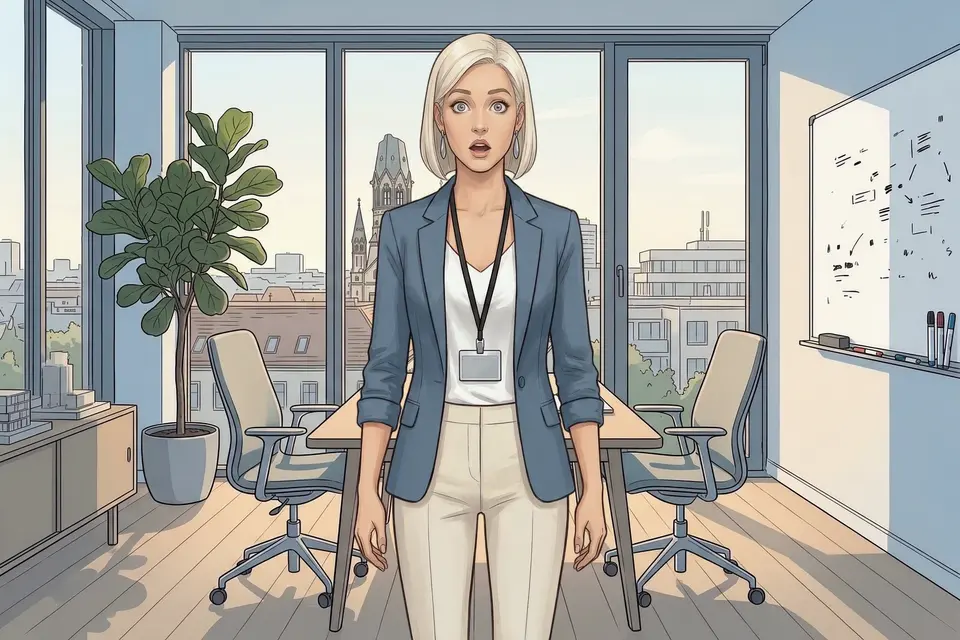
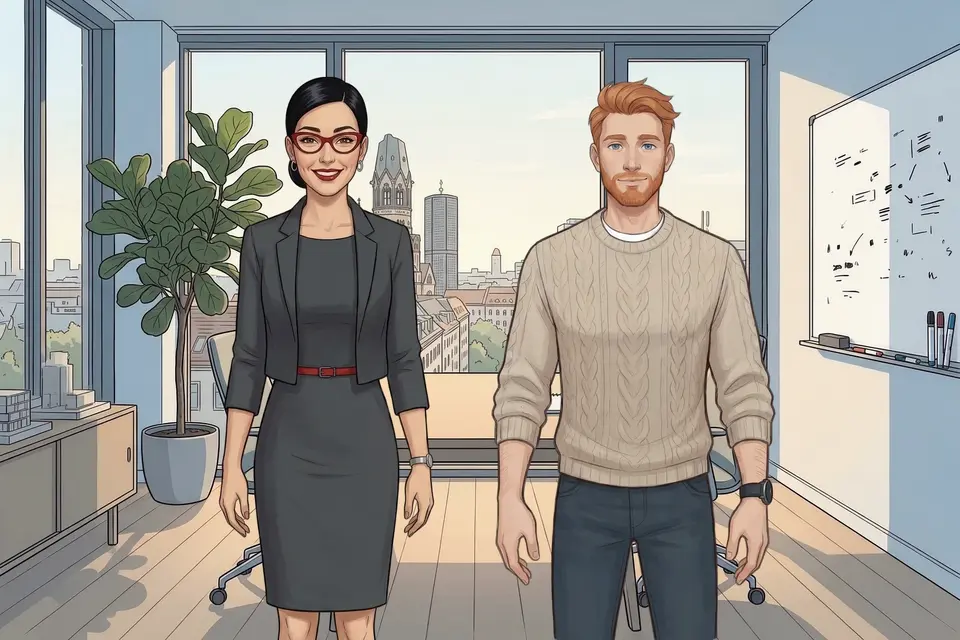
Dienstag, zehn Uhr, Teambesprechung. Du hast die Ergebnisse der Kundenumfrage ausgewertet und sollst sie heute vorstellen. Der Beamer läuft, Frau Petersen und Felix sitzen dir gegenüber.

Tuesday, ten o'clock, team meeting. You've analysed the results of the customer survey and are presenting them today. The projector is on, Frau Petersen and Felix are sitting opposite you.

Petersen: So, Alex, Sie haben das Wort.

Right, Alex, over to you.

Your answer

  1. Good answer

    Danke. Ich möchte Ihnen heute die Ergebnisse unserer Kundenumfrage vorstellen. Zuerst zeige ich die Zahlen, danach die Probleme und zum Schluss unsere Vorschläge.

    Thank you. Today I'd like to present the results of our customer survey to you. First I'll show the figures, then the problems and finally our proposals.

    Felix: Sehr strukturiert. Da kann ja nichts schiefgehen.

    Very structured. Nothing can go wrong then.

  2. Good answer

    Okay, dann fange ich mal an. Es geht um die Kundenumfrage.

    Okay, I'll get started then. It's about the customer survey.

    Petersen: Gut. Sagen Sie vielleicht noch kurz, wie Sie vorgehen.

    Good. Maybe say briefly how you're going to proceed.

    Du: Zuerst zeige ich die Zahlen, danach die Probleme und zum Schluss unsere Vorschläge.

    First I'll show the figures, then the problems and finally our proposals.

  3. Mistake: "von" takes the dative: von unserer Kundenumfrage; better still the genitive: die Ergebnisse unserer Kundenumfrage

    Danke. Ich möchte Ihnen heute die Ergebnisse von unsere Kundenumfrage vorstellen.

    Thank you. Today I'd like to present the results of our customer survey to you.

    Petersen: Die Ergebnisse unserer Umfrage, sehr gut. Erzählen Sie, wie Sie vorgehen.

    The results of our survey, very good. Tell us how you're going to proceed.

    Du: Zuerst zeige ich die Zahlen, danach die Probleme und zum Schluss unsere Vorschläge.

    First I'll show the figures, then the problems and finally our proposals.

Du klickst auf die nächste Folie: ein Balkendiagramm mit fünf Balken. Der höchste heißt „Wartezeit am Telefon“.

You click to the next slide: a bar chart with five bars. The tallest one says "Waiting time on the phone".

Your answer

  1. Good answer

    Wie Sie auf der Folie sehen, wird die Wartezeit am Telefon als größtes Problem genannt.

    As you can see on the slide, the waiting time on the phone is named as the biggest problem.

    Petersen: Das überrascht mich nicht.

    That doesn't surprise me.

  2. Good answer

    Die meisten Kunden finden, dass sie am Telefon zu lange warten müssen.

    Most customers think they have to wait too long on the phone.

    Petersen: Das überrascht mich nicht.

    That doesn't surprise me.

  3. Mistake: after a clause at the start, the verb comes first in the main clause: Wie Sie sehen, wird die Wartezeit …

    Wie Sie sehen, die Wartezeit wird als größtes Problem genannt.

    As you can see, the waiting time is named as the biggest problem.

    Petersen: Ja, wie wir sehen, wird die Wartezeit am häufigsten genannt. Das überrascht mich nicht.

    Yes, as we can see, the waiting time is mentioned most often. That doesn't surprise me.

Felix: Darf ich kurz unterbrechen? Wie viele Kunden haben denn überhaupt mitgemacht? Bei zwanzig Antworten wäre das ja nicht sehr aussagekräftig.

May I interrupt for a second? How many customers actually took part? With twenty answers it wouldn't say very much.

Your answer

  1. Good answer

    Gute Frage. Es haben knapp zwölfhundert Kunden teilgenommen, das ist ungefähr jeder fünfte. Die Ergebnisse sind also durchaus aussagekräftig.

    Good question. Just under twelve hundred customers took part, that's about one in five. So the results are definitely meaningful.

    Felix: Okay, überzeugt.

    Okay, I'm convinced.

  2. Good answer

    Darauf komme ich gleich noch zurück, das steht auf der nächsten Folie.

    I'll come back to that in a moment, it's on the next slide.

    Du klickst weiter. Knapp zwölfhundert Antworten, ungefähr jeder fünfte Kunde.

    You click on. Just under twelve hundred answers, about one in five customers.

    Felix: Okay, überzeugt.

    Okay, I'm convinced.

  3. Mistake: the participle of teilnehmen is irregular: teilgenommen

    Gute Frage. Es haben knapp zwölfhundert Kunden teilgenehmt.

    Good question. Just under twelve hundred customers took part.

    Felix: Zwölfhundert haben teilgenommen? Okay, das ist eine Menge. Überzeugt.

    Twelve hundred took part? Okay, that's a lot. I'm convinced.

Petersen: Und was schlagen Sie vor? Wie bekommen wir die Wartezeit in den Griff?

And what do you propose? How do we get the waiting time under control?

Your answer

  1. Good answer

    Die Wartezeit kann deutlich verkürzt werden, indem ein Rückrufservice eingeführt wird. Dann muss kein Kunde mehr in der Warteschleife hängen.

    The waiting time can be cut significantly by introducing a call-back service. Then no customer has to hang on hold any more.

    Petersen: Ein Rückrufservice. Das gefällt mir.

    A call-back service. I like that.

  2. Good answer

    Wir sollten einen Rückrufservice einführen.

    We should introduce a call-back service.

    Petersen: Ein Rückrufservice. Das gefällt mir.

    A call-back service. I like that.

  3. Mistake: in the Passiv you need the participle: muss verkürzt werden

    Die Wartezeit muss verkürzen werden, und dafür brauchen wir einen Rückrufservice.

    The waiting time must be shortened, and for that we need a call-back service.

    Petersen: Sie muss verkürzt werden, da haben Sie recht. Ein Rückrufservice gefällt mir.

    It must be shortened, you're right. I like the idea of a call-back service.

Petersen: Was müsste dafür konkret gemacht werden? Und bis wann wäre das realistisch?

What would have to be done for that, specifically? And by when would that be realistic?

Your answer

  1. Good answer

    Zunächst muss die Telefonsoftware angepasst werden. Das könnte bis Ende März erledigt werden. Zusammenfassend lässt sich sagen: weniger Wartezeit, zufriedenere Kunden.

    First the phone software has to be adapted. That could be done by the end of March. To sum up: less waiting time, happier customers.

    Petersen: Klar, gut begründet und mit einem realistischen Zeitplan. Genau so möchte ich das sehen.

    Clear, well argued and with a realistic schedule. That's exactly how I like to see it.

  2. Good answer

    Als Erstes muss die IT die Telefonsoftware anpassen. Das dauert ungefähr bis März.

    First, IT has to adapt the phone software. That will take until about March.

    Petersen: Gut, mit einem realistischen Zeitplan. So möchte ich das sehen.

    Good, with a realistic schedule. That's how I like to see it.

  3. Mistake: after "zunächst" at the start, the verb comes next: Zunächst muss die Telefonsoftware angepasst werden

    Zunächst die Telefonsoftware muss angepasst werden.

    First the phone software has to be adapted.

    Petersen: Zunächst muss sie angepasst werden, verstehe. Und das ginge bis Ende März?

    First it has to be adapted, I see. And that would be possible by the end of March?

    Du: Ja, das könnte bis Ende März erledigt werden.

    Yes, that could be done by the end of March.

    Petersen: Gut, mit einem realistischen Zeitplan. So möchte ich das sehen.

    Good, with a realistic schedule. That's how I like to see it.

Petersen: Bereiten Sie das bitte bis Freitag als kurzes Konzept vor, dann stelle ich es nächste Woche der Geschäftsführung vor.

Please prepare it as a short concept by Friday, then I'll present it to the management next week.

Felix: Siehst du, ich hab doch gesagt, da kann nichts schiefgehen. Mittagessen? Ich lade dich ein.

See, I told you nothing could go wrong. Lunch? It's on me.

Deine erste große Präsentation auf Deutsch: klar aufgebaut, gut verteidigt und mit einem Auftrag von der Chefin. Glückwunsch!

Your first big presentation in German: clearly structured, well defended and with a task from the boss. Congratulations!