Halloween German Vocabulary
Learn spooky German the fun way!
Get ready to master over 100 Halloween-themed German words and phrases – from creepy costumes 🧛 to haunted houses 👻. This guide gives you everything you need to bring Halloween to life in German: useful Halloween vocabulary, flashcards for quick practice and example Halloween dialogs with translations.
Whether you’re teaching beginners or brushing up your own vocabulary before the spooky season, this all-in-one resource helps you speak, listen and learn confidently.
Quick Cheat Sheet – Halloween German Words at a Glance 🕷️
Need Halloween words in German fast? Here’s your instant reference table with the 30–40 most-searched spooky words and phrases — complete with translations and short example sentences to help you sound natural right away.
German | Plural | English | Example Sentence |
|---|---|---|---|
der Kürbis | die Kürbisse | pumpkin 🎃 | Ich schnitze einen Kürbis. (I’m carving a pumpkin.) |
die Kerze | die Kerzen | candle 🕯️ | Die Kerze brennt auf dem Tisch. (The candle is burning on the table.) |
das Kostüm | die Kostüme | costume 👗 | Ich trage ein gruseliges Kostüm. (I’m wearing a creepy costume.) |
die Maske | die Masken | mask 😷 | Ich setze meine Maske auf. (I put on my mask.) |
das Gespenst | die Gespenster | ghost 👻 | Ein Gespenst spukt im Haus. (A ghost is haunting the house.) |
die Hexe | die Hexen | witch 🧙♀️ | Die Hexe reitet auf ihrem Besen. (The witch rides on her broom.) |
der Zauberer | die Zauberer | wizard 🧙♂️ | Der Zauberer macht einen Trick. (The wizard performs a trick.) |
der Vampir | die Vampire | vampire 🧛 | Der Vampir hat rote Augen. (The vampire has red eyes.) |
der Zombie | die Zombies | zombie 🧟 | Ein Zombie wankt durch die Straße. (A zombie staggers down the street.) |
die Spinne | die Spinnen | spider 🕷️ | Eine Spinne krabbelt über den Tisch. (A spider crawls across the table.) |
das Skelett | die Skelette | skeleton 💀 | Das Skelett tanzt auf dem Tisch. (The skeleton dances on the table.) |
die Süßigkeiten | – | candies 🍬 | Kinder lieben Süßigkeiten. (Children love candies.) |
Süßes oder Saures! | – | Trick or treat! | Die Kinder rufen: "Süßes oder Saures!"(The children shout: “Trick or treat!”) |
Ich habe Angst! | – | I’m scared! 😱 | Ich habe Angst vor dem Spukhaus. (I’m scared of the haunted house.) |
Fröhliches Halloween! | – | Happy Halloween! 🎃 | Wir rufen: "Fröhliches Halloween!" (We shout: “Happy Halloween!”) |
Get into the Halloween spirit while improving your German vocabulary! In this video you’ll learn 10 creepy and fun German words with English translations and pronunciation!
🇩🇪✨ Improve your German vocabulary and get ready for Halloween the fun way!
50 Halloween German Words – Download Free PDF
Halloween is full of fun, creepy and magical traditions, and learning the right words makes it even more exciting.
In order to get into the Halloween spirit and boost your vocabulary, we’ve compiled a list of 50 essential German words for the spooky season.
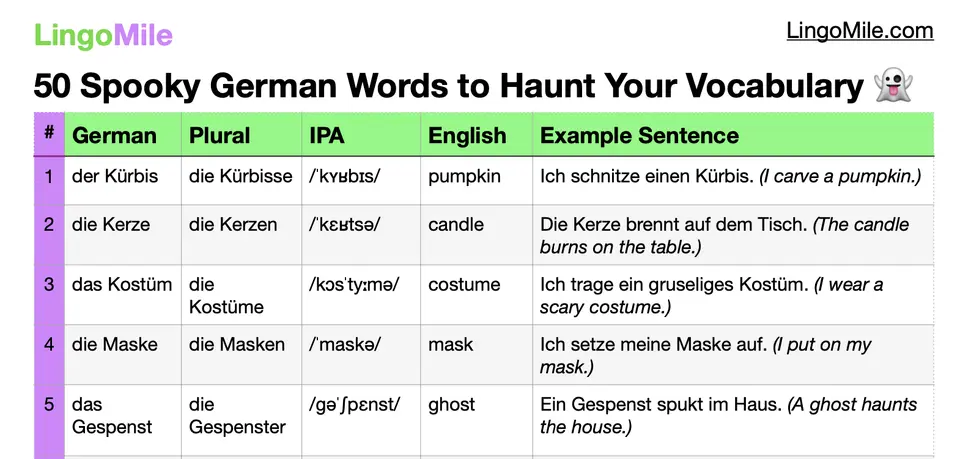
From der Kürbis (pumpkin) and die Hexe (witch) to der Zombie (zombie) and der Sarg (coffin), these 50 essential words cover everything you need to talk about costumes, decorations, monsters and Halloween activities.
Sample Words from the List
🎁 Downloadable PDF
For convenient offline practice, you can download a free PDF of all 50 Halloween German words. The PDF includes:
Example sentences
English translations
Plural forms
This makes it ideal for classroom use, flashcards or personal study.
Celebrate the spooky season while expanding your German skills!
Download Your Halloween German Vocabulary PDF 🎃
Vocabulary by Category – Learn Halloween Words in Context 🕸️
Explore Halloween vocabulary by theme!
Each category helps you learn words through short example sentences and translations.
Monsters & Characters 🧟
Learn how to name and describe the spooky stars of Halloween.
German Word | Plural | English Translation | Example Sentence |
|---|---|---|---|
die Hexe | die Hexen | witch | Die Hexe fliegt auf dem Besen. (The witch flies on the broom.) |
der Vampir | die Vampire | vampire | Der Vampir trinkt kein Wasser. (The vampire doesn’t drink water.) |
der Werwolf | die Werwölfe | werewolf | Der Werwolf heult zum Mond. (The werewolf howls at the moon.) |
das Gespenst | die Gespenster | ghost | Das Gespenst ist durchsichtig. (The ghost is transparent.) |
der Zombie | die Zombies | zombie | Ein Zombie wankt langsam. (A zombie staggers slowly.) |
das Skelett | die Skelette | skeleton | Das Skelett tanzt in der Nacht. (The skeleton dances in the night.) |
der Teufel | die Teufel | devil | Der Teufel trägt rote Hörner. (The devil wears red horns.) |
die Mumie | die Mumien | mummy | Die Mumie kommt aus Ägypten. (The mummy comes from Egypt.) |
der Dämon | die Dämonen | demon | Der Dämon flüstert im Dunkeln. (The demon whispers in the dark.) |
Geist vs. Gespenst: What’s the Difference?
🧠 "Der Geist" – the spirit / ghost / mind
Meaning:
A Geist is a spirit, soul, or even intellect.
It can refer to something supernatural, but also to mental or abstract ideas like "spirit" or "mind".
Examples:
👻 Ein Geist spukt im Schloss. – A ghost is haunting the castle.
💭 Der menschliche Geist ist stark. – The human mind is strong.
🎓 Der Geist der Aufklärung – The spirit of the Enlightenment.
👻 "Das Gespenst" – the ghost / apparition
Meaning:
A Gespenst is specifically a ghostly figure or apparition – the thing that appears in haunted houses or scary stories.
It’s more visual and story-oriented, used when you talk about something frightening that you can see.
Examples:
👻 Das Gespenst war weiß wie Schnee. – The ghost was white as snow.
🏚️ In diesem Haus lebt ein Gespenst. – A ghost lives in this house.
😱 Ich habe ein Gespenst gesehen! – I saw a ghost!
🎃 Quick Tip for Learners
If you’re talking about Halloween, haunted houses or spooky stories, use "das Gespenst" 👻.
If you’re talking about souls, spirits or the mind, use "der Geist" 💭.
Decorations & Objects 🕯️
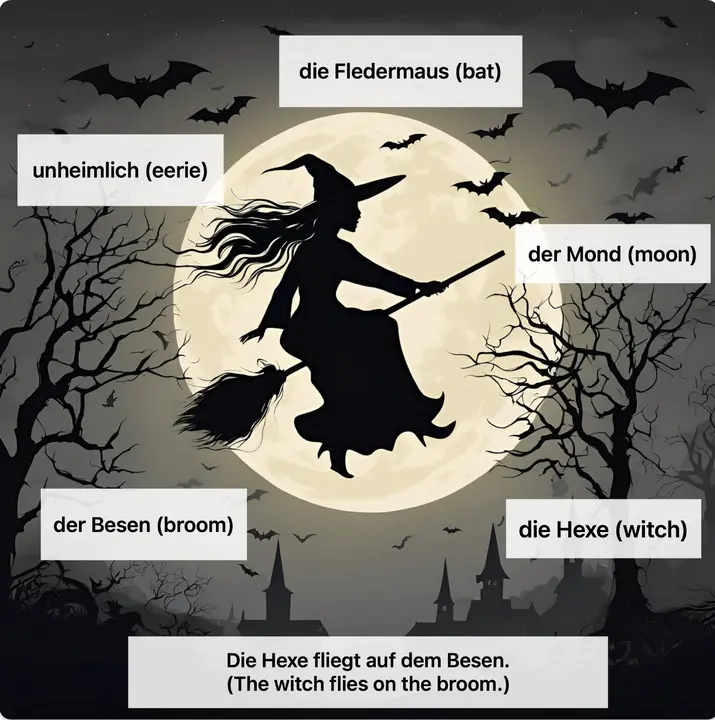
Use these words to describe haunted houses, spooky rooms.
German Word | Plural | English | Example Sentence |
|---|---|---|---|
der Kürbis | die Kürbisse | pumpkin | Ich schnitze einen Kürbis. (I’m carving a pumpkin.) |
die Kürbislaterne | die Kürbislaternen | jack-o’-lantern | Die Kürbislaterne leuchtet hell. (The jack-o’-lantern shines brightly.) |
das Spinnennetz | die Spinnennetze | spiderweb | Das Spinnennetz hängt an der Wand. (The spiderweb hangs on the wall.) |
der Grabstein | die Grabsteine | gravestone | Der Grabstein ist alt. (The gravestone is old.) |
die Kerze | die Kerzen | candle | Die Kerze brennt im Fenster. (The candle burns in the window.) |
die Maske | die Masken | mask | Ich trage eine gruselige Maske. (I’m wearing a scary mask.) |
der Besen | die Besen | broom | Die Hexe fliegt auf dem Besen. (The witch flies on the broom.) |
das Grab | die Gräber | grave | Das Grab ist auf dem Friedhof. (The grave is in the cemetery.) |
das Blut | – | blood | Das Blut tropft vom Tisch. (The blood drips from the table.) |
die Kette | die Ketten | chain | Die Kette klirrt laut. (The chain rattles loudly.) |
Activities & Verbs 🧹
Talk about what happens on Halloween – dressing up, collecting sweets, and having fun!
German Word / Expression | English | Example Sentence |
|---|---|---|
sich verkleiden | to dress up | Ich verkleide mich als Vampir. (I’m dressing up as a vampire.) |
einen Kürbis schnitzen | to carve a pumpkin | Wir schnitzen Kürbisse zusammen. (We carve pumpkins together.) |
klingeln | to ring (a bell) | Die Kinder klingeln an der Tür. (The children ring the doorbell.) |
naschen | to nibble sweets | Kinder naschen gern Schokolade. (Children love to snack on chocolate.) |
spuken | to haunt | Es spukt im alten Haus. (It’s haunted in the old house.) |
erschrecken | to scare | Ich erschrecke meine Freunde. (I scare my friends.) |
feiern | to celebrate | Wir feiern Halloween jedes Jahr. (We celebrate Halloween every year.) |
tanzen | to dance | Die Kinder tanzen beim Fest. (The children dance at the party.) |
laufen | to walk/run | Die Kinder laufen von Haus zu Haus. (The kids go from house to house.) |
sammeln | to collect | Wir sammeln Süßigkeiten. (We collect candies.) |
Adjectives & Feelings 😨
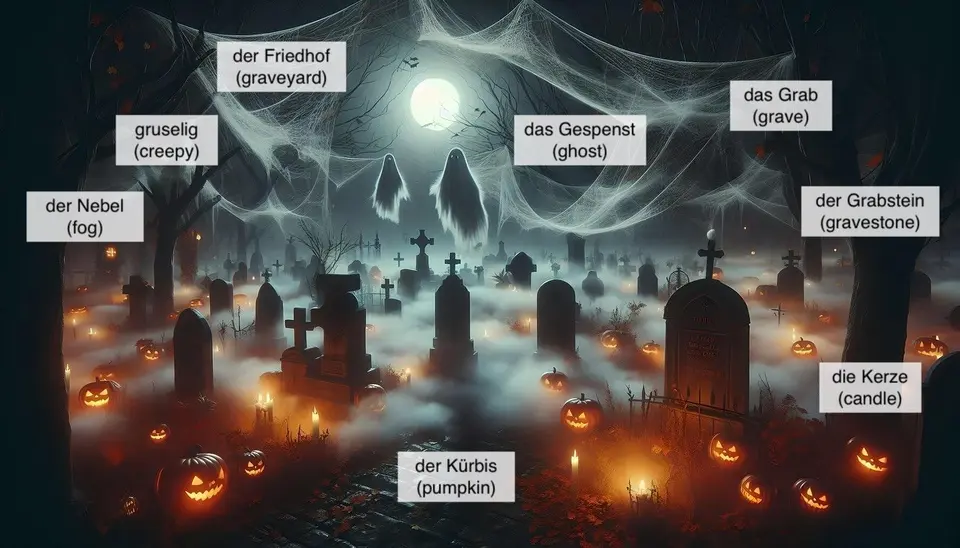
Describe how things look or feel – spooky, scary or fun!
German Word | English | Example Sentence |
|---|---|---|
gruselig | creepy | Das Haus ist sehr gruselig. (The house is very creepy.) |
unheimlich | eerie | Die Stimmung ist unheimlich. (The atmosphere is eerie.) |
schaurig | chilling | Eine schaurige Geschichte! (A chilling story!) |
beängstigend | frightening | Das Geräusch ist beängstigend. (The noise is frightening.) |
lustig | funny | Das Kostüm ist lustig, nicht gruselig. (The costume is funny, not creepy.) |
dunkel | dark | Es ist dunkel im Wald. (It’s dark in the forest.) |
hell | bright | Die Kerzen machen es hell. (The candles make it bright.) |
mutig | brave | Der Junge ist sehr mutig. (The boy is very brave.) |
Party & Phrases 🥳
Use these for greetings, signs and party conversations.
German Word / Expression | Plural | English | Example Sentence |
|---|---|---|---|
Süßes oder Saures! | – | trick or treat | Die Kinder rufen: "Süßes oder Saures!" (The children shout: "Trick or treat!") |
Frohes Halloween! | – | Happy Halloween! | Frohes Halloween, alle zusammen! (Happy Halloween, everyone!) |
das Kostümfest | die Kostümfeste | costume party | Wir gehen zum Kostümfest. (We’re going to the costume party.) |
die Einladung | die Einladungen | invitation | Ich habe eine Einladung bekommen. (I received an invitation.) |
der Eintritt | die Eintritte | entry / admission | Der Eintritt ist frei. (Admission is free.) |
die Musik | – | music | Die Musik ist laut. (The music is loud.) |
der Spaß | – | fun | Halloween macht Spaß! (Halloween is fun!) |
tanzen gehen | – | to go dancing | Wir gehen tanzen im Kostüm. (We go dancing in costume.) |
Candy & Food 🍬
Sweet treats and snacks – the best part of Halloween!
German Word | Plural | English Gloss | Example Sentence |
|---|---|---|---|
die Süßigkeit | die Süßigkeiten | sweet, candy | Ich liebe Süßigkeiten. (I love sweets.) |
das Bonbon | die Bonbons | candy (piece) | Ich esse ein Bonbon. (I’m eating a candy.) |
die Schokolade | – | chocolate | Kinder mögen Schokolade. (Children like chocolate.) |
der Lutscher | die Lutscher | lollipop | Der Lutscher ist rot. (The lollipop is red.) |
der Keks | die Kekse | cookie | Ich backe gruselige Kekse. (I bake spooky cookies.) |
das Popcorn | – | popcorn | Wir essen Popcorn beim Film. (We eat popcorn during the movie.) |
der Apfel | die Äpfel | apple | Ich esse einen Apfel mit Karamell. (I’m eating a caramel apple.) |
der Saft | die Säfte | juice | Der Saft ist süß. (The juice is sweet.) |
das Getränk | die Getränke | drink | Ich bringe Getränke zur Party. (I’m bringing drinks to the party.) |
Phrases & Dialogues – Speak German This Halloween 🎭
Learning vocabulary is great – but speaking it makes it real!
Here are three practical Halloween conversations and everyday phrases you can use with friends, classmates or students.
Each dialogue includes short, clear sentences you can listen to, repeat and even act out in class.
🎃 Trick-or-Treat (Kinder, Eltern & Hausbewohner)
A fun and simple exchange – perfect for role play with kids!
German Dialogue | English Translation |
|---|---|
Kind 1: Süßes oder Saures! | Trick or treat! |
Hausbewohner: Oh, wie gruselig ihr ausseht! | Oh, how spooky you look! |
Kind 2: Danke! Ich bin ein Vampir! | Thank you! I’m a vampire! |
Hausbewohner: Hier habt ihr Schokolade und Bonbons. | Here, have some chocolate and candy. |
Elternteil: Sagt schön Danke! | Say thank you nicely! |
Kinder (alle): Danke schön! Frohes Halloween! | Thank you! Happy Halloween! |
🗒️ Ready-to-use phrases:
Süßes oder Saures! – Trick or treat!
Frohes Halloween! – Happy Halloween!
Wie gruselig! – How spooky!
👻 Party Invite & Response (Friends & Classmates)
Two short examples – one informal (friends) and one formal (neighbors or colleagues).
Informal (du-form)
German Dialogue | English Translation |
|---|---|
Lena: Kommst du zu meiner Halloween-Party am Samstag? | Are you coming to my Halloween party on Saturday? |
Jonas: Klar! Soll ich etwas mitbringen? | Sure! Should I bring something? |
Lena: Vielleicht etwas zu trinken. Und zieh ein Kostüm an! | Maybe something to drink. And wear a costume! |
Jonas: Kein Problem, ich komme als Zombie! | No problem, I’ll come as a zombie! |
🗒️ Use these phrases:
Kommst du zur Party? — Are you coming to the party?
Ich komme als Vampir! — I’m coming as a vampire!
Zieh ein Kostüm an! — Put on a costume!
Formal (Sie-form)
German Dialogue | English Translation |
|---|---|
Herr Müller: Guten Tag, Frau Schmidt. Ich möchte Sie zu meiner Halloween-Feier einladen. | Good afternoon, Ms. Schmidt. I’d like to invite you to my Halloween party. |
Frau Schmidt: Vielen Dank! Wann beginnt die Feier? | Thank you very much! When does the party start? |
Herr Müller: Um acht Uhr, bei mir zu Hause. | At eight o’clock, at my house. |
Frau Schmidt: Ich freue mich darauf! | I’m looking forward to it! |
🗒️ Use these phrases:
Ich lade Sie herzlich ein. – I cordially invite you.
Ich freue mich darauf! – I’m looking forward to it!
Wann beginnt die Feier? – When does the party start?
🕯️ At a Halloween Market or Haunted House
Common signs, announcements, and safety phrases you might hear or see at public Halloween events in Germany.
German Phrase / Signage | English Translation |
|---|---|
Achtung! Kein Eintritt unter 12 Jahren. | Attention! No entry under 12 years old. |
Tickets hier kaufen. | Buy tickets here. |
Bitte Abstand halten. | Please keep your distance. |
Fotografieren erlaubt. | Photography allowed. |
Nicht anfassen! | Do not touch! |
Nur mit Kostüm-Eintritt. | Entry only with costume. |
Letzter Einlass um 21 Uhr. | Last entry at 9 p.m. |
Der Ausgang befindet sich links. | The exit is on the left. |
Vorsicht! Nebelmaschine aktiv. | Caution! Fog machine in use. |
Vielen Dank für Ihren Besuch! | Thank you for your visit! |
🗒️ Use these useful expressions:
Wo ist der Eingang? – Where is the entrance?
Wie viel kostet der Eintritt? – How much is the entry fee?
Ich habe Angst! 😱 – I’m scared!
🎃 Cultural Notes & Differences: Halloween vs. Allerheiligen
Halloween's presence in Germany has grown notably since the early 1990s, influenced by American pop culture and commercial interests. Initially introduced through American military communities, it gained wider acceptance, especially in urban areas. By the mid-1990s, Halloween-themed events, parties and decorations began to appear in major cities like Berlin and Frankfurt. However, it's still less prevalent than in countries like the U.S. or the UK.
In contrast Allerheiligen (All Saints' Day) on November 1st is a deeply rooted Catholic tradition in Germany, commemorating saints and martyrs. The following day, Allerseelen (All Souls' Day), is observed to honor all deceased individuals. These days are marked by visits to cemeteries, lighting candles and holding memorial services. In Catholic regions, such as Bavaria, these observances are significant, whereas Protestant areas may not emphasize them as much.
🏙️ Regional Differences
Urban Areas: Cities like Berlin, Munich and Hamburg witness more Halloween activities, including trick-or-treating and themed parties. These events are often organized by schools, community centers, or commercial entities.
Rural Areas: In contrast, rural regions may see less Halloween activity. Some residents might not appreciate door-to-door visitors, and trick-or-treating is less common. It's advisable to check local customs before participating.
🕯️ Traditional Autumn Customs
Germany boasts its own autumn traditions that coincide with Halloween:
Laternelaufen: On November 11th, children celebrate St. Martin's Day by parading with lanterns, singing songs, and reenacting the story of St. Martin sharing his cloak with a beggar.
Rübengeistern: In some regions, children carve turnips into lanterns and go door-to-door, similar to Halloween's trick-or-treating. This tradition is especially prevalent in parts of Bavaria and Austria.
While Halloween continues to grow in popularity, these indigenous customs remain integral to German cultural heritage, offering a unique blend of celebration and remembrance during the autumn season.
Quiz: Halloween German Vocabulary Quiz

Sophia is a certified German language expert (Goethe & telc) with over eight years of experience helping learners master German. She specializes in creating high-quality digital learning materials and writing informative articles, while teaching German and preparing students for exams – bringing practical, real-world language skills to every lesson.