Der Buchclub im Café · Book club in German – talking about a novel and its film · B2

Click the scene or press Space to continue, use the number keys to choose an answer. Tap a word to see its translation. Want to read along? Read the whole dialogue in German with English translation below.

What happens in the story

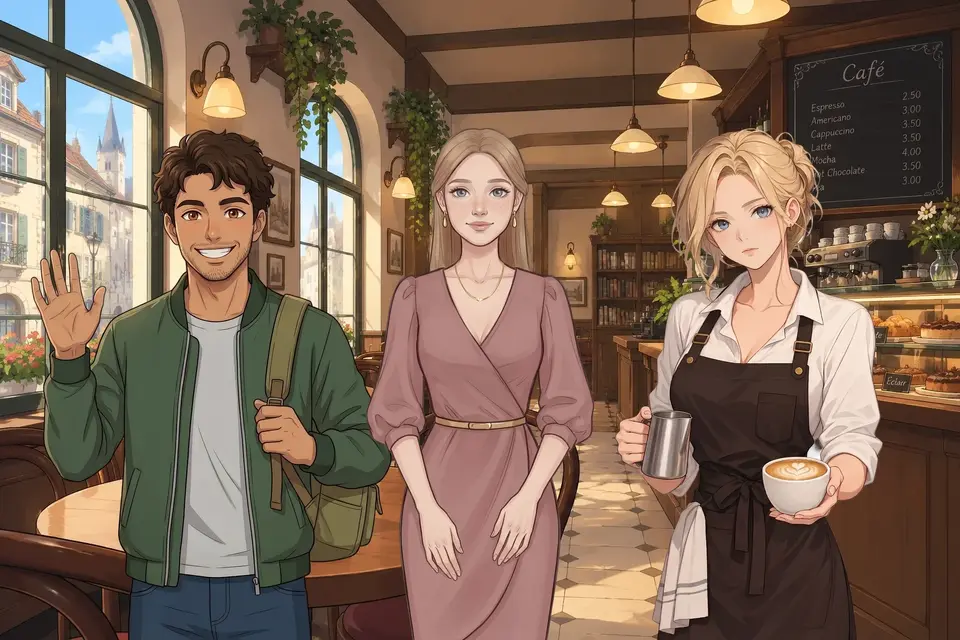
On the first Sunday of the month you meet Lena and Marco in Anna's café for your book club, the same café where you talked about the news in Reported speech in German. This time you all read Die Briefe im Keller (a made-up novel): a young doctor finds letters in her late grandmother's cellar that were never sent. Lena loved the book but hates the open ending, Marco only watched the film, which ends happily. You say what you think, disagree politely, and in the end Anna wants to join in too.

The story is written for B2 level learners and takes about 5 minutes.

Phrases you will learn

  • Am meisten haben mich die nie abgeschickten Briefe berührt. – What moved me most were the letters that were never sent.
  • Ein Happy End hätte nicht zu dieser Geschichte gepasst. – A happy ending wouldn't have suited this story.
  • Da muss ich dir widersprechen. – I have to disagree with you there.
  • Gerade weil so vieles offen bleibt, denkt man tagelang darüber nach. – Precisely because so much stays open, you think about it for days.
  • Die Regisseurin hätte sich mehr an das Buch halten sollen. – The director should have stuck closer to the book.
  • Wie wäre es mit einem Krimi, der in Berlin spielt? – How about a crime novel that's set in Berlin?

Grammar tip: participles as adjectives and Konjunktiv II past

  • A participle can be used as an adjective and takes the normal endings: Die Briefe wurden nie abgeschickt. → die nie abgeschickten Briefe; die verstorbene Großmutter, der viel diskutierte Roman.
  • To judge what could or should have been different, use hätte + participle: Das hätte nicht gepasst.
  • With a modal verb you get two infinitives at the end (the "double infinitive"): Sie hätte sich an das Buch halten sollen, not gesollt.

And: widersprechen takes the dative: Ich widerspreche dir.

Good to know: book clubs in Germany

A Lesekreis or Buchclub is a great way to practise B2 German: you prepare by reading, you have to give and defend opinions, and the regulars become friends. Many public libraries (Stadtbibliotheken) and bookshops run free reading groups, some of them in easy German for learners.

How to play

Click the scene or press Space to read on. When it is your turn, choose an answer with the mouse or the number keys. Natural answers earn points; a wrong answer is never a dead end, your friends repeat the right form and the conversation goes on.

Tap any word to see its translation and hear it pronounced. Save new words to your personal learn list, and find more B2 vocabulary in the German B2 word list.
Read the dialogue

The whole story in German with English translation, every answer you can choose

Scene: Inside the café

Erster Sonntag im Monat: Buchclub in Annas Café. Diesmal habt ihr „Die Briefe im Keller“ von Hanna Wolff gelesen. Darin findet eine junge Ärztin im Keller ihrer verstorbenen Großmutter Briefe, die nie abgeschickt wurden.

First Sunday of the month: book club in Anna's café. This time you read "The Letters in the Cellar" by Hanna Wolff. In it, a young doctor finds letters in her late grandmother's cellar that were never sent.

Lena: Also, ich fange an: Ich las die letzten hundert Seiten in einer Nacht und konnte danach nicht schlafen. Wie hat es dir gefallen, Alex?

Right, I'll start: I read the last hundred pages in one night and couldn't sleep afterwards. How did you like it, Alex?

Your answer

  1. Good answer

    Sehr gut. Am meisten haben mich die nie abgeschickten Briefe der Großmutter berührt.

    Very much. What moved me most were the grandmother's letters that were never sent.

    Lena: Mich auch. Vor allem der letzte Brief, den sie mit achtzig noch geschrieben hat.

    Me too. Especially the last letter, the one she wrote at eighty.

  2. Good answer

    Sehr gut. Die Briefe haben mir am besten gefallen.

    Very much. I liked the letters best.

    Lena: Mir auch. Vor allem der letzte Brief, den sie mit achtzig noch geschrieben hat.

    Me too. Especially the last letter, the one she wrote at eighty.

  3. Mistake: the adjective is made from the participle "abgeschickt": die nie abgeschickten Briefe

    Sehr gut. Am meisten haben mich die nie abschickten Briefe der Großmutter berührt.

    Very much. What moved me most were the grandmother's letters that were never sent.

    Lena: Die nie abgeschickten Briefe, ja! Mich auch. Vor allem der letzte, den sie mit achtzig noch geschrieben hat.

    The letters that were never sent, yes! Me too. Especially the last one, which she wrote at eighty.

Marco: Ich muss etwas gestehen: Ich habe nur den Film gesehen. Aber der war super! Am Ende klingelt Marie an seiner Tür, er macht auf, und sie umarmen sich.

I have to confess something: I only saw the film. But it was great! At the end Marie rings his doorbell, he opens the door and they hug.

Lena: Siehst du, genau das ist das Problem! Im Buch steht sie nur vor der Tür, und dann ist Schluss. Man erfährt nie, ob sie klingelt. Alex, wie fandest du das offene Ende?

You see, that's exactly the problem! In the book she just stands in front of the door, and then it ends. You never find out whether she rings. Alex, what did you think of the open ending?

Your answer

  1. Good answer

    Mir hat es gefallen. Ein Happy End hätte nicht zu dieser Geschichte gepasst.

    I liked it. A happy ending wouldn't have suited this story.

    Marco: Echt? Ich hätte unbedingt wissen wollen, ob sie klingelt!

    Really? I'd have absolutely wanted to know whether she rings!

  2. Good answer

    Ich mag offene Enden.

    I like open endings.

    Marco: Echt? Ich hätte unbedingt wissen wollen, ob sie klingelt!

    Really? I'd have absolutely wanted to know whether she rings!

  3. Mistake: with "hätte" you need the participle: hätte … gepasst

    Mir hat es gefallen. Ein Happy End hätte nicht zu dieser Geschichte passen.

    I liked it. A happy ending wouldn't have suited this story.

    Marco: Es hätte nicht gepasst, meinst du? Echt? Ich hätte unbedingt wissen wollen, ob sie klingelt!

    It wouldn't have suited it, you mean? Really? I'd have absolutely wanted to know whether she rings!

Lena: Ich bin Marcos Meinung. Ein offenes Ende ist für mich einfach feige. Die Autorin traut sich nicht, sich zu entscheiden.

I'm with Marco. For me, an open ending is simply cowardly. The author doesn't dare to make up her mind.

Your answer

  1. Good answer

    Da muss ich dir widersprechen. Gerade weil so vieles offen bleibt, denkt man noch tagelang über das Buch nach.

    I have to disagree with you there. Precisely because so much stays open, you keep thinking about the book for days.

    Lena: Hm. Das stimmt allerdings: Ich denke immer noch darüber nach.

    Hm. That's true, I admit: I'm still thinking about it.

  2. Good answer

    Das sehe ich anders. Ich denke immer noch über das Buch nach.

    I see it differently. I'm still thinking about the book.

    Lena: Hm. Ich ehrlich gesagt auch. Das spricht wohl eher für das Ende.

    Hm. To be honest, so am I. That probably speaks for the ending.

  3. Mistake: "widersprechen" takes the dative: dir widersprechen

    Da muss ich dich widersprechen. Gerade weil so vieles offen bleibt, denkt man noch tagelang über das Buch nach.

    I have to disagree with you there. Precisely because so much stays open, you keep thinking about the book for days.

    Lena: Du willst mir widersprechen? Na gut. Ich gebe zu, ich denke auch immer noch darüber nach.

    You want to disagree with me? All right. I admit I'm still thinking about it too.

Marco: Also ist der Film schlechter als das Buch? Er wurde doch für drei Preise nominiert!

So the film is worse than the book? It was nominated for three awards!

Your answer

  1. Good answer

    Schlecht ist er nicht. Aber die Regisseurin hätte sich beim Ende mehr an das Buch halten sollen.

    It isn't bad. But the director should have stuck closer to the book at the ending.

    Marco: Okay, okay. Dann lese ich das Buch eben doch noch.

    Okay, okay. Then I'll read the book after all.

  2. Good answer

    Der Film ist gut, aber das Ende ist anders als im Buch.

    The film is good, but the ending is different from the book.

    Marco: Okay, okay. Dann lese ich das Buch eben doch noch.

    Okay, okay. Then I'll read the book after all.

  3. Mistake: after "hätte" a modal verb stays in the infinitive: hätte … halten sollen

    Schlecht ist er nicht. Aber die Regisseurin hätte sich beim Ende mehr an das Buch halten gesollt.

    It isn't bad. But the director should have stuck closer to the book at the ending.

    Marco: Sie hätte sich mehr an das Buch halten sollen, meinst du? Okay, okay. Dann lese ich das Buch eben doch noch.

    She should have stuck closer to the book, you mean? Okay, okay. Then I'll read the book after all.

Anna: So, drei Cappuccino für den Buchclub. Und, was lest ihr nächsten Monat? Ich würde gern mitmachen, wenn ich frei habe.

Right, three cappuccinos for the book club. So, what are you reading next month? I'd like to join in when I'm off work.

Your answer

  1. Good answer

    Wie wäre es mit einem Krimi, der in Berlin spielt? Dann könnten wir die Schauplätze danach gemeinsam besuchen.

    How about a crime novel that's set in Berlin? Then we could visit the locations together afterwards.

    Anna: Ein Krimi mit Ausflug? Da bin ich dabei!

    A crime novel with an outing? Count me in!

  2. Good answer

    Vielleicht einen Krimi? Krimis lese ich gern.

    Maybe a crime novel? I like reading crime novels.

    Anna: Ein Krimi, der in Berlin spielt? Da bin ich dabei!

    A crime novel set in Berlin? Count me in!

  3. Mistake: in a relative clause the verb goes to the end: der in Berlin spielt

    Wie wäre es mit einem Krimi, der spielt in Berlin?

    How about a crime novel that's set in Berlin?

    Anna: Ein Krimi, der in Berlin spielt? Da bin ich dabei!

    A crime novel that's set in Berlin? Count me in!

Lena: Abgemacht. Aber diesmal bitte mit einem richtigen Ende!

Deal. But this time with a proper ending, please!

Alle lachten, Anna holte ihren Kalender, und der nächste Termin stand fest. Du hast deine Meinung begründet, höflich widersprochen und den Buchclub sogar um ein Mitglied größer gemacht. Ausgezeichnet!

Everyone laughed, Anna fetched her calendar, and the next date was fixed. You backed up your opinion, disagreed politely and even made the book club one member bigger. Excellent!