Sich vorstellen – dein erster Deutschkurs · Introduce yourself in German – your first German class · A1

Click the scene or press Space to continue, use the number keys to choose an answer. Tap a word to see its translation. Want to read along? Read the whole dialogue in German with English translation below.

What happens in the story

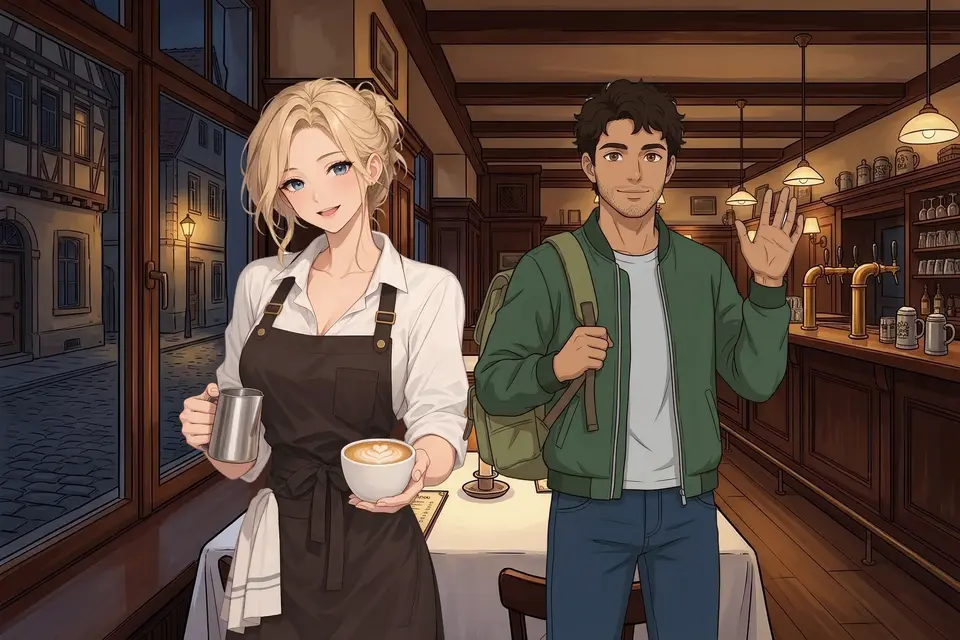
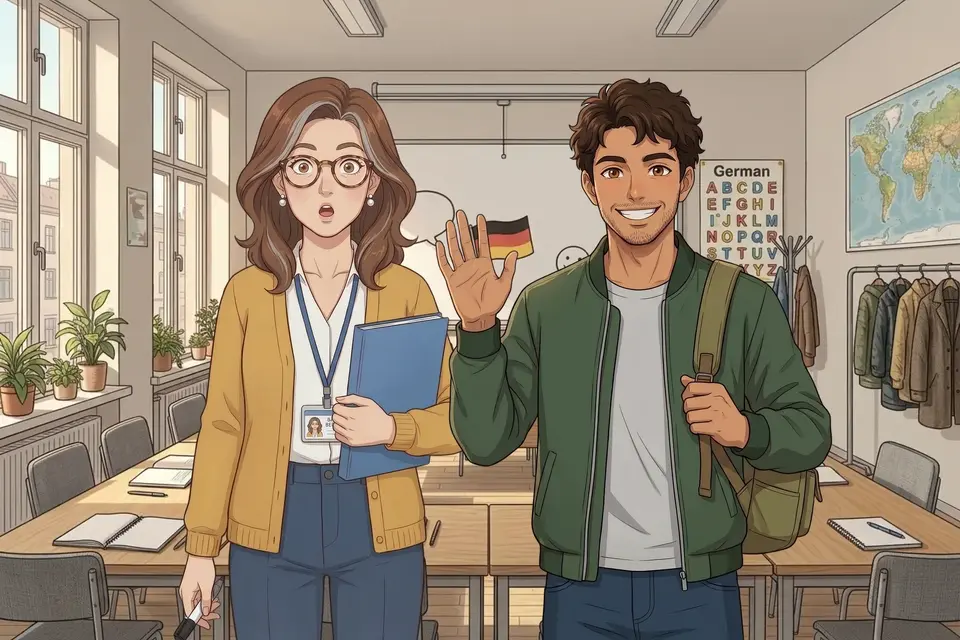
It is your first day at a German class in Berlin. Your teacher, Frau Berger, asks your name and where you are from. Then you talk in pairs with Marco from Rome: you ask where he comes from, tell him how old you are, and introduce him to the class. After the lesson Marco asks you to go for a coffee, and you meet Anna, the barista from An order at the café.

The story is written for A1 level learners and takes about 5 minutes. These are the first questions you hear in any German course, at work or at a party.

Phrases you will learn

  • Wie heißt du? – Ich heiße Alex. – What's your name? – My name is Alex.
  • Mein Name ist Alex. – My name is Alex.
  • Woher kommst du? – Ich komme aus Spanien. – Where are you from? – I'm from Spain.
  • Wie alt bist du? – Ich bin 25 Jahre alt. – How old are you? – I'm 25 years old.
  • Das ist Marco. Er kommt aus Italien. – This is Marco. He's from Italy.
  • Freut mich! – Nice to meet you!
  • Auf Wiedersehen! / Tschüss, bis Donnerstag! – Goodbye! / Bye, see you on Thursday!

Grammar tip: sein, heißen and kommen

To introduce yourself you need three verbs. Their endings change with the person:

  • sein (to be): ich bin, du bist, er/sie ist
  • heißen (to be called): ich heiße, du heißt, er/sie heißt
  • kommen (to come): ich komme, du kommst, er/sie kommt

Two classic beginner mistakes appear in the story. For countries, German uses aus, not von: Ich komme aus Polen. And for your age, German uses sein, not haben: Ich bin 25 Jahre alt, never Ich habe 25 Jahre.

How to play

Click the scene or press Space to read on. When it is your turn, choose an answer with the mouse or the number keys. Correct, natural answers earn points; a wrong answer is never a dead end, your teacher or Marco helps you and you try again.

Tap any word to see its translation and hear it pronounced. Save the new words to your personal learn list and practise them later with flashcards.

Read the dialogue

The whole story in German with English translation, every answer you can choose

Scene: A classroom in a language school

Du bist Alex. Heute ist dein erster Deutschkurs in Berlin.

You are Alex. Today is your first German class in Berlin.

Du bist ein bisschen nervös.

You are a little nervous.

Berger: Guten Morgen! Ich bin Frau Berger, die Lehrerin.

Good morning! I'm Ms Berger, the teacher.

Berger: Im Kurs sagen wir du. Okay?

In the class we say "du". Okay?

Berger: Wie heißt du?

What's your name?

Your answer

  1. Good answer

    Ich heiße Alex.

    My name is Alex.

  2. Good answer

    Mein Name ist Alex.

    My name is Alex.

  3. Mistake: wrong verb ending

    Ich heißt Alex.

    My name is Alex.

    Berger: Fast! Mit „ich“ sagen wir „ich heiße“. Du heißt, aber ich heiße.

    Almost! With "ich" we say "ich heiße". "Du heißt", but "ich heiße".

Your answer

  1. Good answer

    Ich heiße Alex.

    My name is Alex.

Berger: Hallo, Alex! Herzlich willkommen im Kurs.

Hello, Alex! Welcome to the class.

Berger: Woher kommst du?

Where are you from?

Your answer

  1. Good answer

    Ich komme aus Spanien.

    I'm from Spain.

    Berger: Aus Spanien! Toll. Spanien ist sehr schön.

    From Spain! Great. Spain is very beautiful.

  2. Good answer

    Ich komme aus Polen.

    I'm from Poland.

    Berger: Aus Polen! Toll. Polen ist nicht weit.

    From Poland! Great. Poland isn't far.

  3. Good answer

    Ich komme aus Kanada.

    I'm from Canada.

    Berger: Aus Kanada! Toll. Das ist weit weg.

    From Canada! Great. That's far away.

  4. Mistake: wrong preposition

    Ich komme von Spanien.

    I come from Spain.

    Berger: Gute Idee, aber bei Ländern sagen wir „aus“: Ich komme aus Spanien.

    Good idea, but with countries we say "aus": I'm from Spain.

Your answer

  1. Good answer

    Ich komme aus Spanien.

    I'm from Spain.

    Berger: Genau! Aus Spanien. Super.

    Exactly! From Spain. Great.

Berger: Jetzt sprecht ihr zu zweit. Alex, das ist Marco.

Now you talk in pairs. Alex, this is Marco.

Marco: Hallo, Alex! Ich heiße Marco.

Hi, Alex! My name is Marco.

Your answer

  1. Good answer

    Hallo, Marco! Woher kommst du?

    Hi, Marco! Where are you from?

  2. Mistake: wrong verb ending

    Hallo, Marco! Woher komme du?

    Hi, Marco! Where are you from?

    Marco: Du meinst: „Woher kommst du?“ Mit „du“ ist es „kommst“.

    You mean: "Woher kommst du?" With "du" it's "kommst".

  3. Correct German, not the best answer here: he has just told you

    Hallo, Marco! Wie heißt du?

    Hi, Marco! What's your name?

    Marco: Ich heiße immer noch Marco! Und ich komme ...

    My name is still Marco! And I'm from ...

Marco: Ich komme aus Italien, aus Rom.

I'm from Italy, from Rome.

Marco: Wie alt bist du?

How old are you?

Your answer

  1. Good answer

    Ich bin 25 Jahre alt.

    I'm 25 years old.

    Marco: Cool, ich bin auch 25!

    Cool, I'm 25 too!

  2. Mistake: German uses "sein" for age

    Ich habe 25 Jahre.

    I have 25 years.

    Marco: Ha, das sage ich auch immer! Auf Deutsch heißt es: „Ich bin 25 Jahre alt.“

    Ha, I always say that too! In German it's "Ich bin 25 Jahre alt."

Your answer

  1. Good answer

    Ich bin 25 Jahre alt.

    I'm 25 years old.

    Marco: Genau! Und ich bin auch 25.

    Exactly! And I'm 25 too.

Berger: So, die Zeit ist um. Alex, wer ist dein Partner?

Okay, time is up. Alex, who is your partner?

Your answer

  1. Good answer

    Das ist Marco. Er kommt aus Italien.

    This is Marco. He's from Italy.

    Berger: Sehr gut, Alex!

    Very good, Alex!

  2. Good answer

    Er heißt Marco und ist 25 Jahre alt.

    His name is Marco and he's 25 years old.

    Berger: Sehr gut, Alex!

    Very good, Alex!

  3. Mistake: wrong verb ending

    Das ist Marco. Er kommst aus Italien.

    This is Marco. He's from Italy.

    Berger: Fast! Ich komme, du kommst, er kommt. Also: „Er kommt aus Italien.“

    Almost! I come, you come, he comes. So: "He's from Italy."

    Berger: Aber gut gemacht!

    But well done!

Marco: Danke, Alex!

Thanks, Alex!

Berger: Das war es für heute. Bis Donnerstag!

That's it for today. See you on Thursday!

Your answer

  1. Good answer

    Tschüss, bis Donnerstag!

    Bye, see you on Thursday!

  2. Good answer

    Auf Wiedersehen, Frau Berger!

    Goodbye, Ms Berger!

  3. Mistake: say "Frau Berger"

    Bis Donnerstag, Berger!

    See you Thursday, Berger!

    Berger: Frau Berger, bitte. Aber bis Donnerstag, Alex!

    Ms Berger, please. But see you on Thursday, Alex!

Marco: Alex, gehen wir noch einen Kaffee trinken? Ich kenne ein Café.

Alex, shall we go for a coffee? I know a café.

Your answer

  1. Good answer

    Ja, gern!

    Yes, I'd love to!

  2. Good answer

    Heute leider nicht. Bis Donnerstag!

    Unfortunately not today. See you on Thursday!

    Marco: Kein Problem. Tschüss, Alex!

    No problem. Bye, Alex!

Scene: Inside the café

Anna: Hallo! Herzlich willkommen!

Hello! Welcome!

Marco: Anna, das ist Alex. Alex ist neu im Deutschkurs.

Anna, this is Alex. Alex is new in the German class.

Anna: Hallo, Alex! Ich bin Anna. Freut mich!

Hi, Alex! I'm Anna. Nice to meet you!

Du: Freut mich auch!

Nice to meet you too!

Du sitzt mit Marco im Café. Du hast heute zwei neue Freunde. Super gemacht!

You sit in the café with Marco. Today you made two new friends. Well done!

Scene: A street in Berlin

Du gehst nach Hause. Du kannst dich jetzt auf Deutsch vorstellen. Super gemacht!

You walk home. Now you can introduce yourself in German. Well done!