Im Restaurant – bestellen und bezahlen · Ordering food in German – at the restaurant · A1

Click the scene or press Space to continue, use the number keys to choose an answer. Tap a word to see its translation. Want to read along? Read the whole dialogue in German with English translation below.

What happens in the story

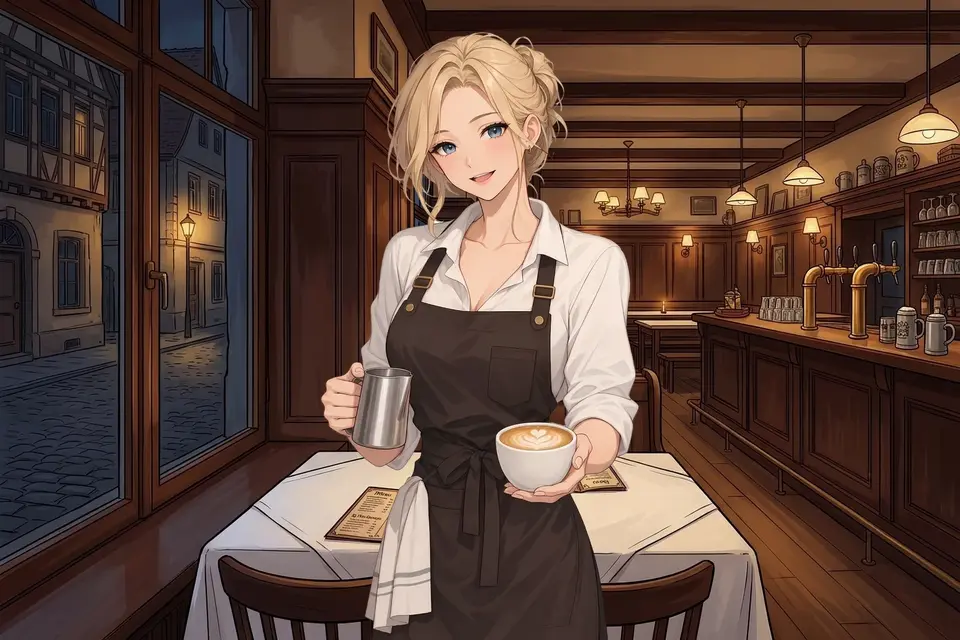
On Saturday evening you go to a restaurant with Marco. The waitress, Anna, finds you a table by the window. You order drinks and food, ask politely for a missing fork, and at the end ask for the bill. Then comes the classic German question: Zusammen oder getrennt? Do you pay for both of you, or does everyone pay their own part? And how much do you tip?

The story is written for A1 level learners and takes about 5 minutes. If you liked it, try An order at the café next.

Phrases you will learn

  • Haben Sie einen Tisch für zwei Personen? – Do you have a table for two?
  • Ich möchte ein Wasser, bitte. – I'd like a water, please.
  • Ich hätte gern eine Apfelschorle. – I'd like an apple spritzer.
  • Könnte ich bitte eine Gabel haben? – Could I have a fork, please?
  • Wir möchten bitte zahlen. / Die Rechnung, bitte. – We'd like to pay, please. / The bill, please.
  • Zusammen oder getrennt? – Together or separately?
  • Machen Sie 20 Euro. / Stimmt so. – Make it 20 euros. / Keep the change.

Grammar tip: möchte + infinitive

Ich möchte (I would like) is the polite way to order. When you add a second verb, it goes to the very end of the sentence:

  • Ich möchte ein Wasser. – I'd like a water.
  • Ich möchte ein Wasser trinken. – I'd like to drink a water (not Ich möchte trinken ein Wasser).
  • Wir möchten bitte zahlen. – We'd like to pay, please.

Ich will (I want) is correct German, but sounds rude when you order. Use Ich möchte, Ich hätte gern or Ich nehme.

Good to know: tipping in Germany

In restaurants people usually tip about 5–10 percent. You don't leave the tip on the table: you tell the waiter the total you want to pay (Machen Sie 20 Euro), or hand over the money and say Stimmt so.

How to play

Click the scene or press Space to read on. When it is your turn, choose an answer with the mouse or the number keys. Natural answers earn points; a wrong answer is never a dead end, Marco or the waiter shows you the right form and you go on.

Tap any word to see its translation and hear it pronounced. Save the new words to your personal learn list and practise them later with flashcards.

Read the dialogue

The whole story in German with English translation, every answer you can choose

Scene: Inside a German restaurant in the evening

Es ist Samstagabend. Du gehst mit Marco in ein Restaurant.

It's Saturday evening. You're going to a restaurant with Marco.

Anna: Guten Abend! Haben Sie reserviert?

Good evening! Do you have a reservation?

Your answer

  1. Good answer

    Nein. Haben Sie einen Tisch für zwei Personen?

    No. Do you have a table for two?

  2. Good answer

    Nein, aber wir sind zu zweit.

    No, but there are two of us.

Anna: Kein Problem. Der Tisch am Fenster ist frei.

No problem. The table by the window is free.

Anna: Was möchten Sie trinken?

What would you like to drink?

Your answer

  1. Good answer

    Ich möchte ein Wasser, bitte.

    I'd like a water, please.

  2. Good answer

    Ich hätte gern eine Apfelschorle.

    I'd like an apple spritzer.

  3. Mistake: word order: the infinitive goes to the end

    Ich möchte trinken ein Wasser.

    I would like to drink a water.

    Anna: Ein Wasser, gern. Man sagt: „Ich möchte ein Wasser trinken“, das Verb steht am Ende.

    A water, sure. You say "Ich möchte ein Wasser trinken": the verb goes at the end.

Marco: Und für mich ein Bier, bitte.

And a beer for me, please.

Anna: Und was möchten Sie essen?

And what would you like to eat?

Your answer

  1. Good answer

    Ich möchte das Schnitzel mit Pommes, bitte.

    I'd like the schnitzel with chips, please.

    Anna: Sehr gern.

    Certainly.

  2. Good answer

    Ich nehme die Gemüsesuppe, bitte.

    I'll have the vegetable soup, please.

    Anna: Sehr gern.

    Certainly.

  3. Correct German, not the best answer here: sounds rude: say "Ich möchte"

    Ich will das Schnitzel.

    I want the schnitzel.

    Anna: Okay ... ein Schnitzel.

    Okay ... one schnitzel.

    Marco: Sag lieber „Ich möchte“. „Ich will“ klingt hier unhöflich.

    Better say "Ich möchte". "Ich will" sounds rude here.

Marco: Für mich die Pizza Margherita.

The Pizza Margherita for me.

Zehn Minuten später kommt das Essen. Es riecht super!

Ten minutes later the food arrives. It smells great!

Aber du hast keine Gabel.

But you don't have a fork.

Your answer

  1. Good answer

    Entschuldigung! Könnte ich bitte eine Gabel haben?

    Excuse me! Could I have a fork, please?

    Anna: Oh, Entschuldigung! Natürlich. Hier, bitte.

    Oh, sorry! Of course. Here you are.

  2. Good answer

    Entschuldigung, ich brauche eine Gabel.

    Excuse me, I need a fork.

    Anna: Oh, Entschuldigung! Natürlich. Hier, bitte.

    Oh, sorry! Of course. Here you are.

  3. Mistake: too rude: ask with "Könnte ich …"

    Hallo! Gabel!

    Hello! Fork!

    Marco: Psst! Sag lieber: „Entschuldigung, könnte ich bitte eine Gabel haben?“

    Shh! Better say: "Excuse me, could I have a fork, please?"

    Anna: Eine Gabel? Natürlich, hier, bitte.

    A fork? Of course, here you are.

Anna: Guten Appetit!

Enjoy your meal!

Ihr esst und redet. Später ist der Teller leer.

You eat and talk. Later your plate is empty.

Anna: Hat es Ihnen geschmeckt?

Did you enjoy your meal?

Your answer

  1. Good answer

    Ja, sehr lecker! Wir möchten bitte zahlen.

    Yes, very tasty! We'd like to pay, please.

  2. Good answer

    Ja, danke! Die Rechnung, bitte.

    Yes, thanks! The bill, please.

  3. Mistake: English word: say "die Rechnung"

    Ja, lecker! Den Check, bitte.

    Yes, tasty! The check, please.

    Anna: Die Rechnung? Sehr gern.

    The bill? Certainly.

Anna: Zusammen oder getrennt?

Together or separately?

Your answer

  1. Good answer

    Zusammen, bitte. Ich lade dich ein, Marco!

    Together, please. It's on me, Marco!

    Marco: Oh, danke! Dann lade ich dich nächstes Mal ein.

    Oh, thanks! Then next time it's on me.

  2. Good answer

    Getrennt, bitte.

    Separately, please.

  3. Mistake: say "getrennt" for separate bills

    Allein, bitte.

    Alone, please.

    Anna: Ah, Sie meinen getrennt. Jeder zahlt allein. Gern!

    Ah, you mean separately. Everyone pays for themselves. Sure!

Anna: Das macht zusammen 36,80 Euro.

That's 36.80 euros altogether.

Your answer

  1. Good answer

    Machen Sie 40 Euro.

    Make it 40 euros.

  2. Good answer

    Hier sind 40 Euro. Stimmt so.

    Here's 40 euros. Keep the change.

  3. Correct German, not the best answer here: in Germany you usually tip about 10 percent

    Hier sind 36,80 Euro.

    Here's 36.80 euros.

    Marco: Im Restaurant gibt man meistens etwa zehn Prozent Trinkgeld.

    In restaurants people usually tip about ten percent.

Anna: Ihr Teil macht 18,40 Euro.

Your part comes to 18.40 euros.

Your answer

  1. Good answer

    Machen Sie 20 Euro.

    Make it 20 euros.

  2. Good answer

    Hier sind 20 Euro. Stimmt so.

    Here's 20 euros. Keep the change.

  3. Correct German, not the best answer here: in Germany you usually tip about 10 percent

    Hier sind 18,40 Euro.

    Here's 18.40 euros.

    Marco: Im Restaurant gibt man meistens etwa zehn Prozent Trinkgeld.

    In restaurants people usually tip about ten percent.

Marco: Ich zahle auch, mit Karte.

I'll pay too, by card.

Anna: Vielen Dank! Einen schönen Abend noch!

Thank you very much! Have a nice evening!

Du: Danke, Ihnen auch!

Thanks, you too!

Du gehst mit Marco nach Hause. Du kannst jetzt im Restaurant bestellen und bezahlen. Super gemacht!

You go home with Marco. Now you can order and pay in a restaurant. Well done!