Wie spät ist es? – Pläne für heute Abend · Telling time in German – making plans for tonight · A1

Click the scene or press Space to continue, use the number keys to choose an answer. Tap a word to see its translation. Want to read along? Read the whole dialogue in German with English translation below.

What happens in the story

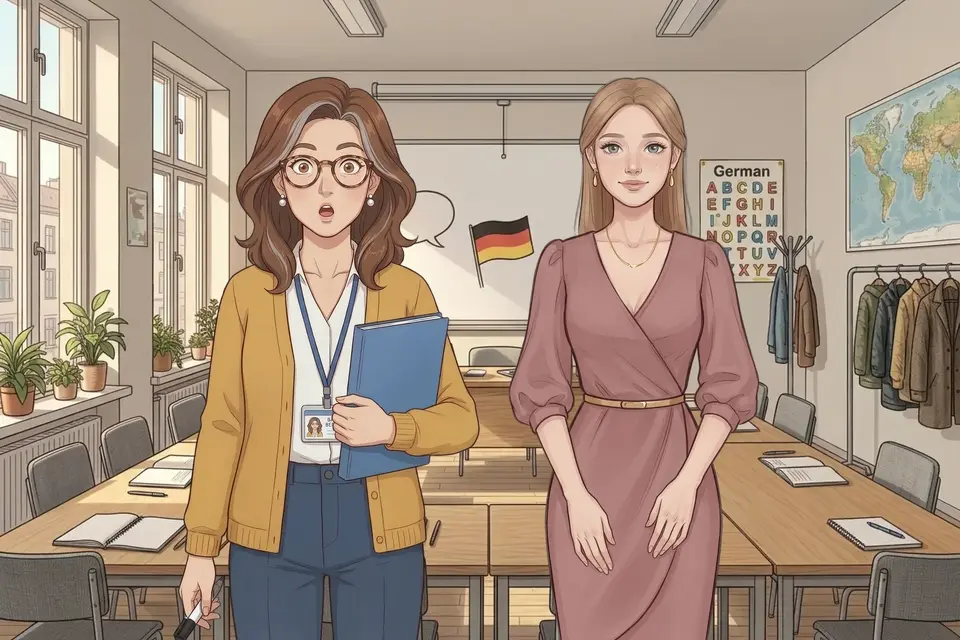
It is Friday, and your German class with Frau Berger is nearly over. Her last question: what time is it? After the lesson Marco, your classmate from Introduce yourself in German, asks you to the cinema. The film starts at halb acht, but what time is that exactly? You agree on a meeting time, wait outside the cinema, and when Marco finally arrives you tell him how late it is.

The story is written for A1 level learners and takes about 4 minutes. You need clock times again in A phone call in German, when you book a table.

Phrases you will learn

  • Wie spät ist es? – What time is it?
  • Es ist Viertel vor eins. – It's a quarter to one.
  • Kommst du heute Abend mit ins Kino? – Do you want to come to the cinema tonight?
  • Um wie viel Uhr? / Wann beginnt der Film? – What time? / When does the film start?
  • Der Film beginnt um halb acht. – The film starts at half past seven.
  • Treffen wir uns um Viertel nach sieben? – Shall we meet at a quarter past seven?
  • Es ist fünf vor halb acht. – It's twenty-five past seven.

Grammar tip: telling time in German

  • Viertel nach sieben = 7:15, Viertel vor acht = 7:45
  • halb acht = 7:30. Careful: German counts half an hour towards the next hour, so halb acht is not 8:30!
  • fünf vor halb acht = 7:25, fünf nach halb acht = 7:35
  • Timetables and official times use the 24-hour clock: 19:30 Uhr is neunzehn Uhr dreißig.

For a clock time use um: um sieben Uhr, um halb acht. For days use am: am Freitag um acht. Ask Wie spät ist es? for the time now, and Um wie viel Uhr …? or Wann …? for when something happens.

How to play

Click the scene or press Space to read on. When it is your turn, choose an answer with the mouse or the number keys. Natural answers earn points; a wrong answer is never a dead end, Frau Berger or Marco shows you the right form and you go on.

Tap any word to see its translation and hear it pronounced. Save the new words to your personal learn list and practise them later with flashcards.
Read the dialogue

The whole story in German with English translation, every answer you can choose

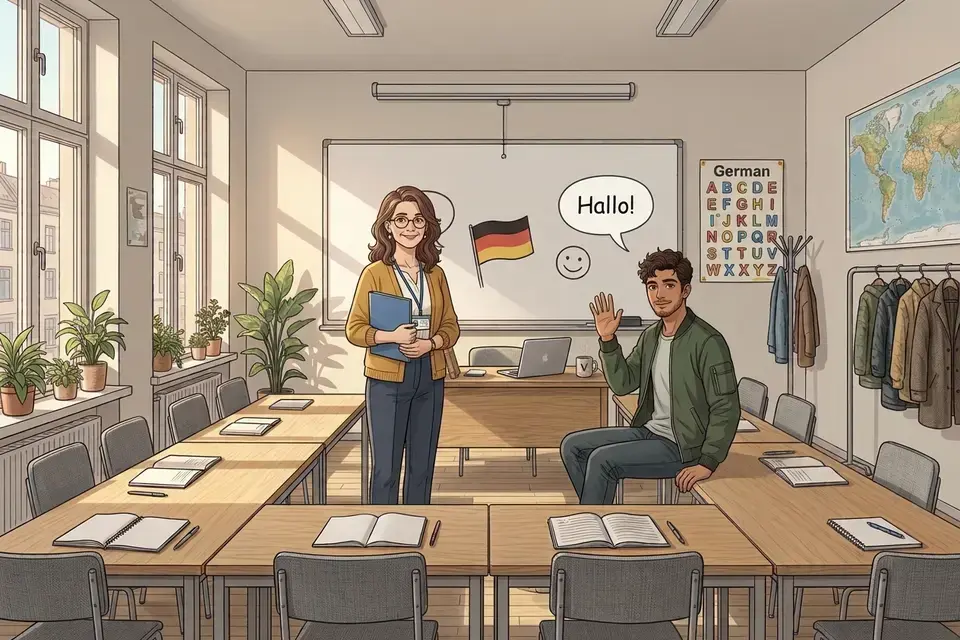
Scene: A classroom in a language school

Es ist Freitag. Der Deutschkurs ist fast zu Ende.

It's Friday. The German class is nearly over.

Die Uhr an der Wand zeigt 12:45 Uhr.

The clock on the wall says 12:45.

Berger: So, letzte Frage für heute. Wie spät ist es?

Right, last question for today. What time is it?

Your answer

  1. Good answer

    Es ist Viertel vor eins.

    It's a quarter to one.

    Berger: Sehr gut! Viertel vor eins.

    Very good! A quarter to one.

  2. Good answer

    Es ist zwölf Uhr fünfundvierzig.

    It's twelve forty-five.

    Berger: Richtig! Und im Alltag sagen wir oft: Viertel vor eins.

    Right! And in everyday speech we often say "Viertel vor eins".

  3. Mistake: nach = past: 12:45 is "Viertel vor eins"

    Es ist Viertel nach eins.

    It's a quarter past one.

    Berger: Fast! Viertel nach eins ist 13:15 Uhr. Schau noch mal.

    Almost! A quarter past one is 1:15. Have another look.

    Berger: Es ist 15 Minuten vor eins. Also?

    It's 15 minutes before one. So?

Your answer

  1. Good answer

    Es ist Viertel vor eins.

    It's a quarter to one.

    Berger: Genau!

    Exactly!

Berger: Das war es für heute. Schönes Wochenende!

That's it for today. Have a nice weekend!

Marco: Alex, kommst du heute Abend mit ins Kino?

Alex, do you want to come to the cinema with me tonight?

Your answer

  1. Good answer

    Ja, gern! Um wie viel Uhr?

    Yes, I'd love to! What time?

  2. Good answer

    Ja, gern! Wann beginnt der Film?

    Yes, I'd love to! When does the film start?

  3. Mistake: to ask "when": "Um wie viel Uhr …?" or "Wann …?"

    Ja, gern! Wie spät ist der Film?

    Yes, I'd love to! How late is the film?

    Marco: Ha, der Film ist nicht spät! Du meinst: „Um wie viel Uhr?“

    Ha, the film isn't late! You mean: "Um wie viel Uhr?" (at what time?)

    Marco: Mit „Wie spät ist es?“ fragst du: Wie viel Uhr ist es jetzt?

    "Wie spät ist es?" asks what time it is right now.

Marco: Der Film beginnt um halb acht.

The film starts at half past seven.

Your answer

  1. Good answer

    Um halb acht, also um 19:30 Uhr. Super!

    At half past seven, so at 7:30 pm. Great!

    Marco: Genau!

    Exactly!

  2. Mistake: halb acht is 7:30: half an hour before eight

    Um halb acht, also um 20:30 Uhr? Okay.

    At "halb acht", so at 8:30 pm? Okay.

    Marco: Nein, nein! Halb acht ist 19:30 Uhr.

    No, no! "Halb acht" is 7:30 pm.

    Marco: Auf Deutsch heißt das: eine halbe Stunde vor acht.

    In German it means half an hour before eight.

    Du: Ah, halb acht ist 19:30 Uhr. Gut zu wissen!

    Ah, "halb acht" is 7:30 pm. Good to know!

Marco: Treffen wir uns um Viertel nach sieben vor dem Kino?

Shall we meet in front of the cinema at a quarter past seven?

Your answer

  1. Good answer

    Ja, um Viertel nach sieben. Bis dann!

    Yes, at a quarter past seven. See you then!

  2. Good answer

    Okay, also um 19:15 Uhr. Bis später!

    Okay, so at 7:15 pm. See you later!

  3. Mistake: clock times take "um": um Viertel nach sieben

    Ja, am Viertel nach sieben.

    Yes, on a quarter past seven.

    Marco: Fast! „Am“ für den Tag, „um“ für die Uhrzeit.

    Almost! "Am" for the day, "um" for the time.

    Marco: Also: heute um Viertel nach sieben. Bis dann!

    So: today at a quarter past seven. See you then!

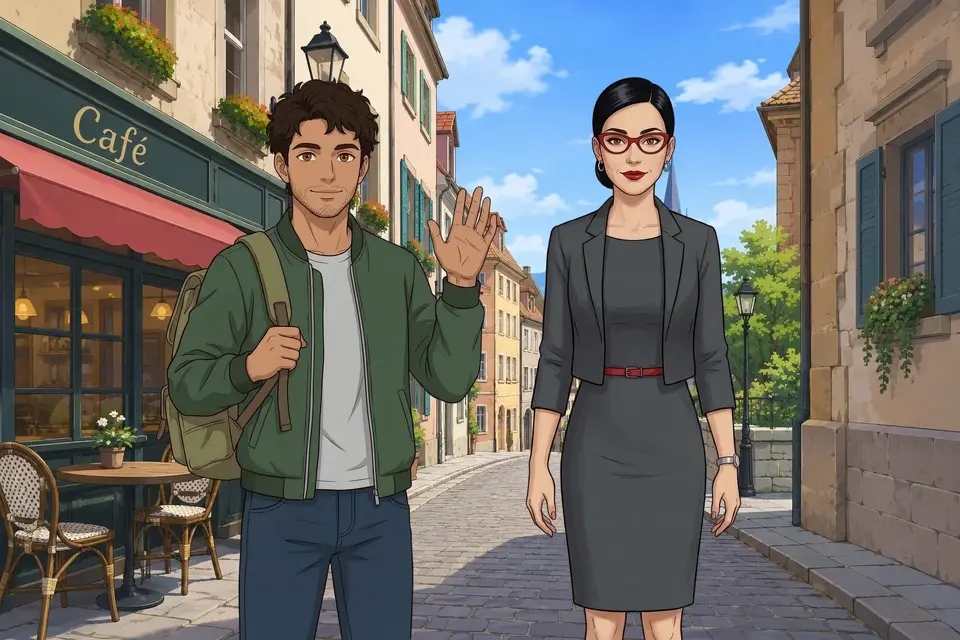
Scene: A street in Berlin

Du bist um 19:15 Uhr vor dem Kino. Aber Marco ist nicht da.

You're outside the cinema at 7:15 pm. But Marco isn't there.

Du wartest und wartest. Endlich kommt Marco. Er rennt!

You wait and wait. Finally Marco arrives. He's running!

Marco: Entschuldigung! Mein Bus war zu spät. Wie spät ist es?

Sorry! My bus was late. What time is it?

Dein Handy zeigt 19:25 Uhr.

Your phone says 7:25 pm.

Your answer

  1. Good answer

    Es ist fünf vor halb acht. Schnell!

    It's twenty-five past seven. Quick!

    Marco: Wow, fünf vor halb acht! Das klingt richtig deutsch.

    Wow, "fünf vor halb acht"! That sounds really German.

  2. Good answer

    Es ist 19:25 Uhr. Der Film beginnt gleich!

    It's 7:25 pm. The film starts soon!

    Marco: Oh nein, schnell!

    Oh no, quick!

  3. Mistake: that's 7:35: 7:25 is "fünf vor halb acht"

    Es ist fünf nach halb acht.

    It's twenty-five to eight.

    Marco: Was? Dann läuft der Film schon!

    What? Then the film is already on!

    Marco: Ach nein, schau: 19:25 Uhr. Das ist fünf vor halb acht.

    Oh no, look: 7:25 pm. That's "fünf vor halb acht".

Marco: Tut mir leid! Wartest du schon lange?

I'm sorry! Have you been waiting long?

Your answer

  1. Good answer

    Kein Problem! Komm, wir haben noch fünf Minuten.

    No problem! Come on, we still have five minutes.

  2. Good answer

    Schon okay. Aber nächstes Mal bist du pünktlich!

    It's okay. But next time you're on time!

    Marco: Versprochen!

    I promise!

Um halb acht sitzt ihr im Kino. Der Film beginnt.

At half past seven you're sitting in the cinema. The film starts.

Du kannst jetzt die Uhrzeit auf Deutsch sagen. Super gemacht!

Now you can tell the time in German. Well done!