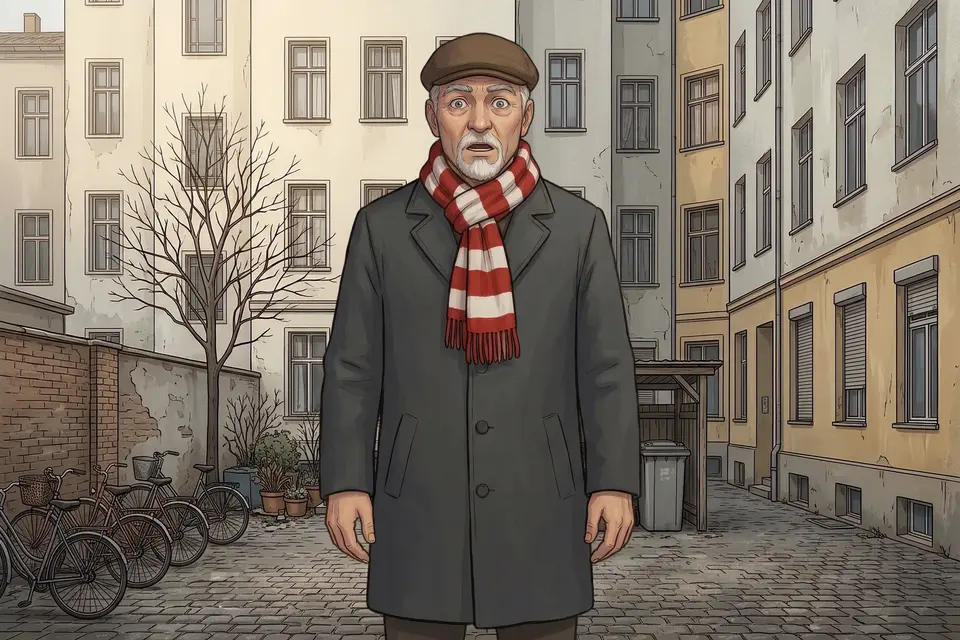
What happens in the story
Your new flat has no balcony, and Amira would like her daughter Lina to see how vegetables grow. So Herr Schmidt, your old neighbour from the house meeting, invites you both to his allotment club (Kleingartenverein), where he is the secretary. Between the hedges and the garden huts you learn how the waiting list works, what the garden rules say about vegetables, barbecues and quiet times, and what happens if you skip the community hours. Then you come up with a plan that works for two households.
The story is written for B2 level learners and takes about 5 minutes.
Phrases you will learn
- Wie kann man sich auf die Warteliste setzen lassen? – How can you get put on the waiting list?
- Ein Drittel der Fläche ist für Obst und Gemüse zu nutzen. – A third of the area is to be used for fruit and vegetables.
- Muss ein Drittel mit Gemüse bepflanzt werden? – Does a third have to be planted with vegetables?
- Darf hier eigentlich gegrillt werden? – Is barbecuing actually allowed here?
- Ist dann eine Gebühr zu zahlen? – Is there a fee to pay then?
- So ließe sich die Arbeit gut aufteilen. – That way the work could be split well.
- Ich lege ein gutes Wort für Sie ein. – I'll put in a good word for you.
Grammar tip: rules without a person
Rules and regulations often don't say who must do something. German has several ways to do that:
- Passiv with a modal verb: modal + participle + werden: Hier darf gegrillt werden. Don't mix it with man: Darf man gegrillt werden? means "may one be grilled?". Say Darf man grillen? or Darf gegrillt werden?
- sein + zu + infinitive = must / can be done: Eine Gebühr ist zu zahlen. (haben + zu is the same with a person: Jedes Mitglied hat zehn Stunden zu leisten.)
- sich lassen + infinitive = can be done: Die Arbeit lässt sich gut aufteilen. And sich … lassen = to have something done to you: sich auf die Liste setzen lassen (no zu after a modal verb).
Good to know: the Schrebergarten
Germany has around 900,000 allotment gardens, also called Schrebergärten. They are leased cheaply from a club and governed by the Federal Allotment Garden Act (Bundeskleingartengesetz): the hut (Laube) may be at most 24 m² and may not be lived in, and part of the plot, usually about a third, must be used for fruit and vegetables. Each club adds its own garden rules (Gartenordnung) on hedges, quiet times and community work. In big cities waiting lists are often several years long, so put your name down early.
How to play
Click the scene or press Space to read on. When it is your turn, choose an answer with the mouse or the number keys. Natural answers earn points; a wrong answer is never a dead end, Herr Schmidt and Amira repeat the right form and the tour goes on.
Tap any word to see its translation and hear it pronounced. Save new words to your personal learn list, and find more B2 vocabulary in the German B2 word list.