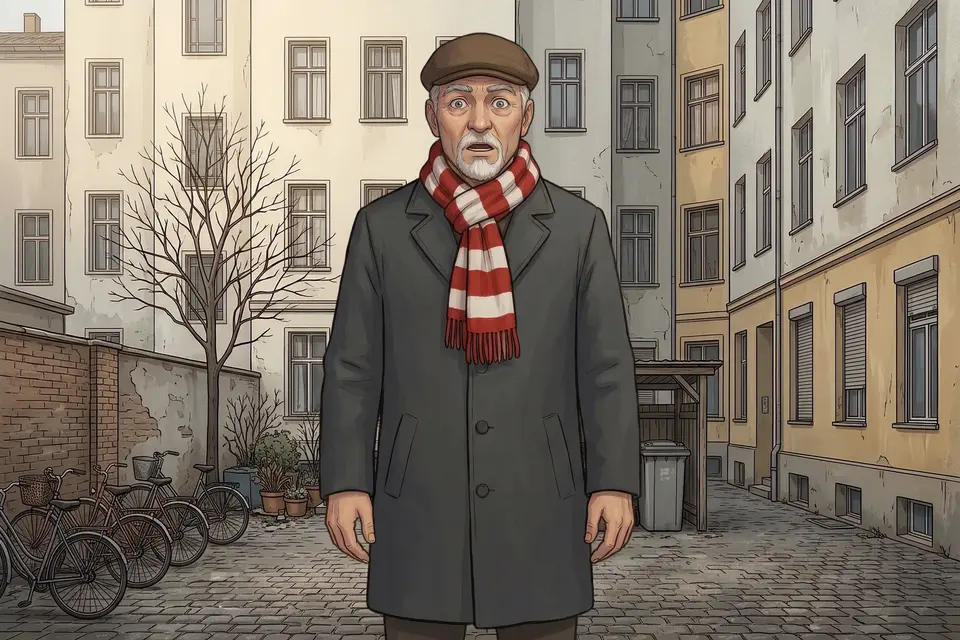
Die Hausversammlung· House meeting in Germany – neighbours decide on the courtyard · B2
Click the scene or press Space to continue, use the number keys to choose an answer. Tap a word to see its translation. Want to read along? Read the whole dialogue in German with English translation below.
What happens in the story
A notice in the stairwell announces a house meeting (Hausversammlung): your landlady, Frau Krause, wants to redesign the courtyard, either with covered bike racks or with a little garden with benches. Your neighbour Amira, who carries two bikes up and down the stairs every day, wants the racks; Herr Schmidt, the retired neighbour you know from Waste sorting in Germany, wants the garden. At the meeting you weigh up both sides, propose a compromise, deal with the question of who will water the plants, and write the minutes.
The story is written for B2 level learners and takes about 5 minutes.
Phrases you will learn
Worum geht es denn genau? – So what exactly is it about?
Ich verstehe beide Seiten. – I understand both sides.
Sowohl ein Garten als auch Fahrradständer hätten Vorteile. – Both a garden and bike racks would have advantages.
Weder im Keller noch im Treppenhaus ist Platz. – There's room neither in the cellar nor in the stairwell.
Wie wäre es, wenn wir den Hof teilen würden? – How about we split the courtyard?
Je mehr Leute mitmachen, desto weniger Arbeit hat jeder Einzelne. – The more people join in, the less work for each person.
Es wurde einstimmig beschlossen, dass … – It was unanimously decided that …
Grammar tip: sowohl … als auch, weder … noch, je … desto
sowohl … als auch (both … and) joins two subjects, so the verb is plural: Sowohl ein Garten als auch Fahrradständer hätten Vorteile.
weder … noch (neither … nor) is already negative, so there is no nicht or kein: Weder im Keller noch im Treppenhaus ist Platz.
je … desto (the … the): the je clause has its verb at the end; after desto + comparative the verb comes straight away: Je mehr Leute mitmachen, desto weniger Arbeit hat jeder.
And a small one: es geht um → the question word is worum, not worüber.
Good to know: house meetings
In a rented building, the landlord or the property management (Hausverwaltung) decides how shared spaces are used, but many ask the tenants first at a house meeting. In owner-occupied buildings, decisions are taken at the formal owners' meeting (Eigentümerversammlung) and recorded in minutes (Protokoll). Bikes in the stairwell are a classic source of conflict, because escape routes must stay free.
How to play
Click the scene or press Space to read on. When it is your turn, choose an answer with the mouse or the number keys. Natural answers earn points; a wrong answer is never a dead end, your neighbours repeat the right form and the meeting goes on.
The whole story in German with English translation, every answer you can choose
Scene: The stairwell of an old Berlin apartment building
Im Treppenhaus hängt ein neuer Zettel: „Hausversammlung am Samstag um 11 Uhr im Hof. Thema: Wie nutzen wir den Hof?“ Amira kommt mit Linas Laufrad unter dem Arm die Treppe herunter.
There's a new notice in the stairwell: "House meeting on Saturday at 11 in the courtyard. Topic: how do we use the courtyard?" Amira comes down the stairs with Lina's balance bike under her arm.
Amira: Hast du den Zettel gesehen? Gehst du am Samstag hin?
Have you seen the notice? Are you going on Saturday?
Your answer
Good answer
Klar, das lasse ich mir nicht entgehen. Worum geht es denn genau?
Sure, I wouldn't miss it. So what exactly is it about?
Good answer
Ja, ich komme.
Yes, I'm coming.
Mistake: the phrase is "es geht um", so the question word is "worum"
Klar. Worüber geht es denn genau?
Sure. So what exactly is it about?
Amira: Worum es geht? Um den Hof!
What it's about? The courtyard!
Amira: Frau Krause will den Hof neu gestalten. Entweder kommen überdachte Fahrradständer hin oder ein kleiner Garten mit Bänken. Für beides ist angeblich kein Platz.
Frau Krause wants to redesign the courtyard. Either covered bike racks go there or a little garden with benches. Supposedly there isn't room for both.
Amira: Ich bin für die Fahrradständer. Ich trage jeden Tag zwei Räder durchs Treppenhaus, und Herr Schmidt beschwert sich dann über die Kratzer an der Wand.
I'm for the bike racks. I carry two bikes through the stairwell every day, and then Herr Schmidt complains about the scratches on the wall.
Scene: A back courtyard with recycling bins in blue, yellow, brown and grey
Samstag, elf Uhr. Zwölf Nachbarn stehen zwischen den Mülltonnen. Frau Krause hat eine Mappe dabei, Herr Schmidt hat die Arme verschränkt.
Saturday, eleven o'clock. Twelve neighbours are standing between the bins. Frau Krause has a folder with her, Herr Schmidt has his arms crossed.
Krause: Schön, dass Sie alle da sind. Wir haben zwei Vorschläge für den Hof: Fahrradständer oder einen Garten mit Bänken. Wer möchte etwas dazu sagen?
Lovely that you're all here. We have two proposals for the courtyard: bike racks or a garden with benches. Who would like to say something about it?
Schmidt: Ich bin ganz klar für den Garten. Fahrräder gehören in den Keller, nicht in einen schönen Hof.
I'm clearly for the garden. Bikes belong in the cellar, not in a nice courtyard.
Your answer
Good answer
Ich verstehe beide Seiten. Sowohl ein Garten als auch Fahrradständer hätten Vorteile für das ganze Haus.
I understand both sides. Both a garden and bike racks would have advantages for the whole building.
Krause: Sehr diplomatisch.
Very diplomatic.
Good answer
Ich finde beide Ideen gut.
I like both ideas.
Krause: Sehr diplomatisch.
Very diplomatic.
Mistake: with "sowohl … als auch" there are two subjects, so the verb is plural: hätten
Ich verstehe beide Seiten. Sowohl ein Garten als auch Fahrradständer hätte Vorteile.
I understand both sides. Both a garden and bike racks would have advantages.
Krause: Beide hätten Vorteile, da haben Sie recht. Sehr diplomatisch.
Both would have advantages, you're right. Very diplomatic.
Amira: Aber wohin dann mit den Fahrrädern? Weder im Keller noch im Treppenhaus ist Platz. Und mit einem Kind die Räder jeden Tag in den Keller tragen?
But where should the bikes go then? There's room neither in the cellar nor in the stairwell. And carry the bikes down to the cellar every day with a child?
Krause: Hm. Alex, Sie wohnen im zweiten Stock und fahren auch Rad. Haben Sie eine Idee?
Hm. Alex, you live on the second floor and you cycle too. Do you have an idea?
Your answer
Good answer
Wie wäre es, wenn wir den Hof teilen würden? Die Fahrradständer könnten an der Wand neben den Mülltonnen aufgestellt werden, und in der Mitte wäre Platz für Bänke und Hochbeete.
How about we split the courtyard? The bike racks could be put up against the wall next to the bins, and in the middle there would be room for benches and raised beds.
Schmidt: Hochbeete … Hm. Das klingt gar nicht so schlecht.
Raised beds … Hm. That doesn't sound bad at all.
Good answer
Können wir nicht beides machen? Die Fahrräder an die Wand, die Bänke in die Mitte.
Can't we do both? The bikes against the wall, the benches in the middle.
Schmidt: Hm. Und vielleicht ein paar Hochbeete dazu. Das klingt gar nicht so schlecht.
Hm. And maybe a few raised beds as well. That doesn't sound bad at all.
Mistake: in the Passiv you need the participle: könnten aufgestellt werden
Wie wäre es, wenn wir den Hof teilen würden? Die Fahrradständer könnten an der Wand aufstellen werden.
How about we split the courtyard? The bike racks could be put up against the wall.
Krause: Sie könnten dort aufgestellt werden, ja. Und in der Mitte wäre noch Platz für Bänke und vielleicht Hochbeete.
They could be put up there, yes. And in the middle there would still be room for benches and maybe raised beds.
Schmidt: Hochbeete … Hm. Das klingt gar nicht so schlecht.
Raised beds … Hm. That doesn't sound bad at all.
Schmidt: Aber wer pflegt die Beete? Ich bin fast achtzig, ich kann nicht jeden Abend zwanzig Gießkannen schleppen.
But who looks after the beds? I'm almost eighty, I can't lug twenty watering cans every evening.
Your answer
Good answer
Je mehr Leute mitmachen, desto weniger Arbeit hat jeder Einzelne. Ich würde mich zum Beispiel gern ums Gießen kümmern.
The more people join in, the less work there is for each person. I, for example, would be happy to take care of the watering.
Amira: Ich mache auch mit! Lina gießt bestimmt gern.
I'll join in too! Lina will love watering.
Good answer
Wir können einen Gießplan machen. Ich helfe gern.
We can make a watering rota. I'm happy to help.
Amira: Ich mache auch mit! Lina gießt bestimmt gern.
I'll join in too! Lina will love watering.
Mistake: after "desto" + comparative the verb comes next: desto weniger Arbeit hat jeder Einzelne
Je mehr Leute mitmachen, desto weniger Arbeit jeder Einzelne hat.
The more people join in, the less work there is for each person.
Amira: Genau, desto weniger Arbeit hat jeder! Ich mache auch mit, und Lina gießt bestimmt gern.
Exactly, the less work there is for everyone! I'll join in too, and Lina will love watering.
Krause: Dann stimmen wir ab. Wer ist dafür, den Hof zu teilen: Fahrradständer an der Wand, Bänke und Hochbeete in der Mitte?
Then let's vote. Who is in favour of splitting the courtyard: bike racks against the wall, benches and raised beds in the middle?
Zwölf Hände gehen hoch. Zuletzt auch die von Herrn Schmidt.
Twelve hands go up. Last of all, Herr Schmidt's too.
Krause: Einstimmig! Jetzt brauche ich nur noch jemanden, der das Protokoll schreibt.
Unanimous! Now I just need someone to write the minutes.
Your answer
Good answer
Das mache ich gern. „Es wurde einstimmig beschlossen, dass sowohl Fahrradständer als auch Hochbeete gebaut werden.“
I'll gladly do that. "It was unanimously decided that both bike racks and raised beds will be built."
Krause: Perfekt formuliert. Sie sollten Hausverwalter werden!
Perfectly worded. You should become a property manager!
Good answer
Ich schreibe das Protokoll, wenn Sie wollen.
I'll write the minutes if you like.
Krause: Sehr gern, danke!
Yes please, thank you!
Mistake: after "dass" the whole verb goes to the end: dass … gebaut werden
Das mache ich gern. „Es wurde beschlossen, dass sowohl Fahrradständer als auch Hochbeete werden gebaut.“
I'll gladly do that. "It was decided that both bike racks and raised beds will be built."
Krause: „… dass sowohl Fahrradständer als auch Hochbeete gebaut werden.“ Wunderbar, danke!
"… that both bike racks and raised beds will be built." Wonderful, thank you!
Schmidt: Und die erste Tomate bekommen Sie, Alex. Das haben Sie sich verdient.
And you get the first tomato, Alex. You've earned it.
Aus einem Streit zwischen Radfahrern und Gärtnern ist ein Kompromiss geworden, und du hast ihn vorgeschlagen. Gut verhandelt!
An argument between cyclists and gardeners has turned into a compromise, and you proposed it. Well negotiated!