Sankt Martin – der Laternenumzug· St. Martin's Day in Germany – the lantern parade · A1
Click the scene or press Space to continue, use the number keys to choose an answer. Tap a word to see its translation. Want to read along? Read the whole dialogue in German with English translation below.
What happens in the story
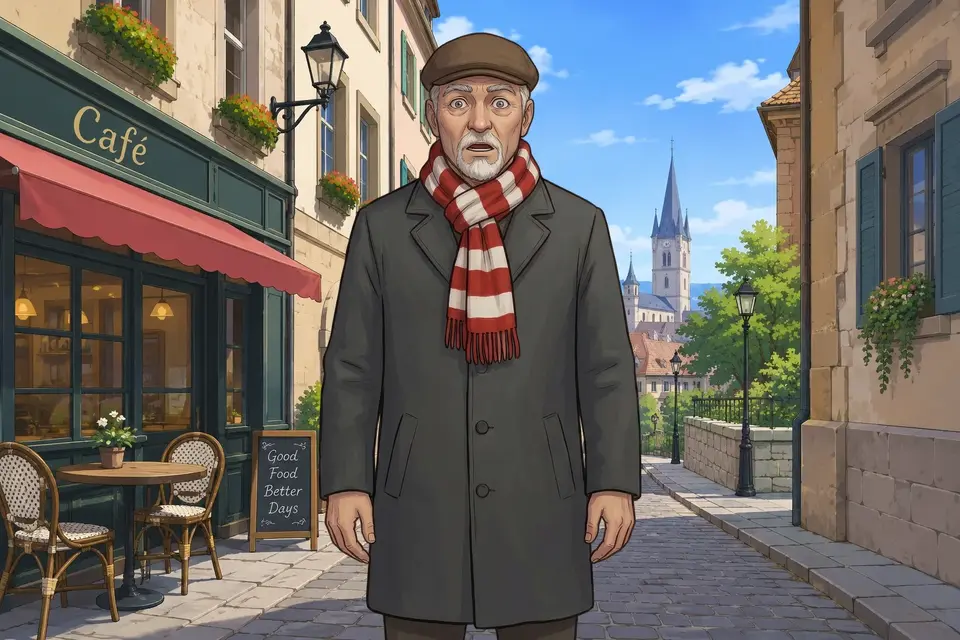
It is 11 November, St. Martin's Day, and already dark at five o'clock. Your classmate Amira from Family members in German takes you to the lantern parade (Laternenumzug) of her daughter Lina's nursery. There you meet your neighbour Herr Schmidt from Talking about the weather, who explains the story of St. Martin. The children sing Ich geh mit meiner Laterne, but then Lina's lantern goes dark. Can you help? At the bonfire Herr Schmidt, who is from Cologne, shares his Weckmänner.
The story is written for A1 level learners and takes about 5 minutes. It is a seasonal story for early November, like At the Christmas market for December.
Phrases you will learn
Heute ist Sankt Martin. – Today is St. Martin's Day.
Gibt es hier einen Umzug? – Ja, es gibt einen Umzug. – Is there a parade here? – Yes, there's a parade.
Sankt Martin reitet auf einem Pferd. – St. Martin rides on a horse.
Er teilt seinen Mantel mit einem armen Mann. – He shares his cloak with a poor man.
Wie geht das Lied? – How does the song go?
Gibt es hier einen Kiosk? – Is there a kiosk around here?
Am Ende gibt es ein Martinsfeuer. – At the end there's a St. Martin's bonfire.
Grammar tip: es gibt + accusative
Es gibt means "there is" or "there are", and the thing after it is in the accusative. Only masculine nouns change:
der Umzug → Es gibt einen Umzug.
der Kiosk → Gibt es hier einen Kiosk?
das Feuer → Es gibt ein Feuer.
die Laterne → Es gibt eine Laterne.
The form is always es gibt, also for plurals: Es gibt Weckmänner.
Good to know: St. Martin's Day in Germany
St. Martin's Day (Martinstag) is on 11 November. In the days around it, nurseries and primary schools hold lantern parades: the children make paper lanterns and walk through the streets in the dark, often behind a rider dressed as St. Martin, the Roman soldier who cut his cloak in half for a freezing beggar. They sing songs like Ich geh mit meiner Laterne and Laterne, Laterne, Sonne, Mond und Sterne, and the parade often ends at a bonfire (Martinsfeuer).
In the Rhineland, children get a Weckmann, a man made of sweet yeast bread with a clay pipe (called Stutenkerl in Westphalia). Many families eat roast goose (Martinsgans) around St. Martin's Day.
How to play
Click the scene or press Space to read on. When it is your turn, choose an answer with the mouse or the number keys. Natural answers earn points; a wrong answer is never a dead end, Herr Schmidt shows you the right form and you go on.
Tap any word to see its translation and hear it pronounced. Save the new words to your personal learn list and practise them later with flashcards.
Read the dialogue
The whole story in German with English translation, every answer you can choose
Scene: A Berlin street on an autumn evening with street lamps
Es ist der 11. November. Es ist fünf Uhr und schon dunkel.
It's the 11th of November. It's five o'clock and already dark.
Heute ist Sankt Martin. Amira und ihre Tochter Lina holen dich ab.
Today is St. Martin's Day. Amira and her daughter Lina come to pick you up.
Lina hat eine rote Laterne mit einem Mond. Sie hat sie in der Kita gebastelt.
Lina has a red lantern with a moon on it. She made it at nursery.
Amira: Hallo! Die Kita macht heute einen Laternenumzug.
Hi! The nursery is having a lantern parade today.
Amira: Ich kenne das auch noch nicht so gut.
I don't really know it well yet either.
Vor der Kita warten viele Familien. Da ist auch dein Nachbar Herr Schmidt mit seinem Enkel.
Lots of families are waiting outside the nursery. Your neighbour Herr Schmidt is there too, with his grandson.
Schmidt: Guten Abend! Na, gehen Sie auch mit?
Good evening! So, are you coming along too?
Your answer
Good answer
Guten Abend! Ja, das ist mein erster Umzug.
Good evening! Yes, it's my first parade.
Schmidt: Wie schön! Das wird Ihnen gefallen.
How lovely! You'll like it.
Good answer
Guten Abend! Gibt es hier einen Umzug?
Good evening! Is there a parade here?
Schmidt: Ja, es gibt einen Umzug, durch das ganze Viertel.
Yes, there's a parade, right through the neighbourhood.
Mistake: der Umzug: es gibt einen Umzug
Guten Abend! Gibt es hier ein Umzug?
Good evening! Is there a parade here?
Schmidt: Ja, es gibt einen Umzug! Der Umzug, also: einen Umzug.
Yes, there's a parade! "Der Umzug", so: "einen Umzug".
Schmidt: Nach „es gibt“ kommt der Akkusativ.
After "es gibt" comes the accusative.
Schmidt: Vorne reitet Sankt Martin auf einem Pferd.
St. Martin rides at the front on a horse.
Schmidt: Er teilt seinen Mantel mit einem armen Mann. Das ist die Geschichte.
He shares his cloak with a poor man. That's the story.
Amira: Und dann singen alle, oder?
And then everyone sings, right?
Schmidt: Genau. Kennen Sie „Ich geh mit meiner Laterne“?
Exactly. Do you know "Ich geh mit meiner Laterne"?
Your answer
Good answer
Nein. Wie geht das Lied?
No. How does the song go?
Schmidt: Ganz einfach. Hören Sie gut zu!
It's very easy. Listen carefully!
Good answer
Nein, aber ich kenne „Laterne, Laterne, Sonne, Mond und Sterne“!
No, but I know "Lantern, lantern, sun, moon and stars"!
Schmidt: Oh, Sie kennen ja schon ein Laternenlied!
Oh, you already know a lantern song!
Der Umzug beginnt. Die Kinder singen leise, dann laut:
The parade starts. The children sing softly, then loudly:
„Ich geh mit meiner Laterne und meine Laterne mit mir.“
"I walk with my lantern, and my lantern walks with me."
„Dort oben leuchten die Sterne, hier unten leuchten wir.“
"Up there the stars are shining, down here we're shining."
Plötzlich ist Linas Laterne dunkel. Die Batterie ist leer!
Suddenly Lina's lantern goes dark. The battery is flat!
Lina ist traurig. Amira schaut dich an.
Lina is sad. Amira looks at you.
Your answer
Good answer
Gibt es hier einen Kiosk? Ich hole schnell Batterien.
Is there a kiosk around here? I'll quickly get some batteries.
Schmidt: Ja, an der Ecke gibt es einen Kiosk. Gleich da vorne!
Yes, there's a kiosk on the corner. Just up ahead!
Du kaufst schnell zwei Batterien. Linas Laterne leuchtet wieder!
You quickly buy two batteries. Lina's lantern is shining again!
Mistake: der Kiosk: es gibt einen Kiosk
Gibt es hier ein Kiosk? Ich hole Batterien.
Is there a kiosk here? I'll get batteries.
Schmidt: Ja, es gibt einen Kiosk, an der Ecke. Der Kiosk, also einen Kiosk!
Yes, there's a kiosk, on the corner. "Der Kiosk", so "einen Kiosk"!
Du kaufst schnell zwei Batterien. Linas Laterne leuchtet wieder!
You quickly buy two batteries. Lina's lantern is shining again!
Good answer
Lina, hier, nimm meine Taschenlampe!
Lina, here, take my torch!
Amira: Gute Idee! Wir stecken sie in die Laterne.
Good idea! Let's put it inside the lantern.
Linas Laterne leuchtet wieder. Jetzt ist sie sogar besonders hell!
Lina's lantern is shining again. Now it's even extra bright!
Amira: Danke! Lina strahlt wieder.
Thank you! Lina's beaming again.
Am Ende gibt es ein großes Martinsfeuer auf dem Platz.
At the end there's a big St. Martin's bonfire on the square.
Schmidt: Und jetzt gibt es Weckmänner! Ich habe welche dabei.
And now it's time for Weckmänner! I've brought some.
Schmidt: Ich komme aus Köln. Da gibt es an Sankt Martin immer einen Weckmann.
I'm from Cologne. There you always get a Weckmann on St. Martin's Day.
Amira: Was ist ein Weckmann?
What's a Weckmann?
Schmidt: Ein Mann aus süßem Brot, mit einer Pfeife. Hier, bitte!
A man made of sweet bread, with a pipe. Here you go!
Your answer
Good answer
Danke schön! Gibt es auch einen Weckmann für Lina?
Thank you! Is there a Weckmann for Lina too?
Schmidt: Natürlich! Für Lina gibt es sogar einen großen.
Of course! For Lina there's even a big one.
Good answer
Mmh, lecker! Danke schön, Herr Schmidt.
Mmm, delicious! Thank you, Herr Schmidt.
Schmidt: Gern! Und Lina bekommt auch einen.
You're welcome! And Lina gets one too.
Ihr steht am Feuer und esst. Die Kinder singen noch ein Lied.
You all stand by the fire and eat. The children sing one more song.
Schmidt: So, ich gehe jetzt nach Hause. Mir ist kalt!
Right, I'm going home now. I'm cold!
Your answer
Good answer
Danke für den Weckmann! Schönen Abend noch!
Thanks for the Weckmann! Have a nice evening!
Good answer
Gute Nacht, Herr Schmidt! Bis morgen an der Bushaltestelle!
Good night, Herr Schmidt! See you tomorrow at the bus stop!
Schmidt: Bis bald! Tschüss, Lina!
See you soon! Bye, Lina!
Du gehst mit Amira und Lina nach Hause. Du kennst jetzt Sankt Martin und sein Lied. Super gemacht!
You walk home with Amira and Lina. Now you know St. Martin's Day and its song. Well done!