Wohnungsbesichtigung · Apartment viewing in German – questions to ask · A2

Click the scene or press Space to continue, use the number keys to choose an answer. Tap a word to see its translation. Want to read along? Read the whole dialogue in German with English translation below.

What happens in the story

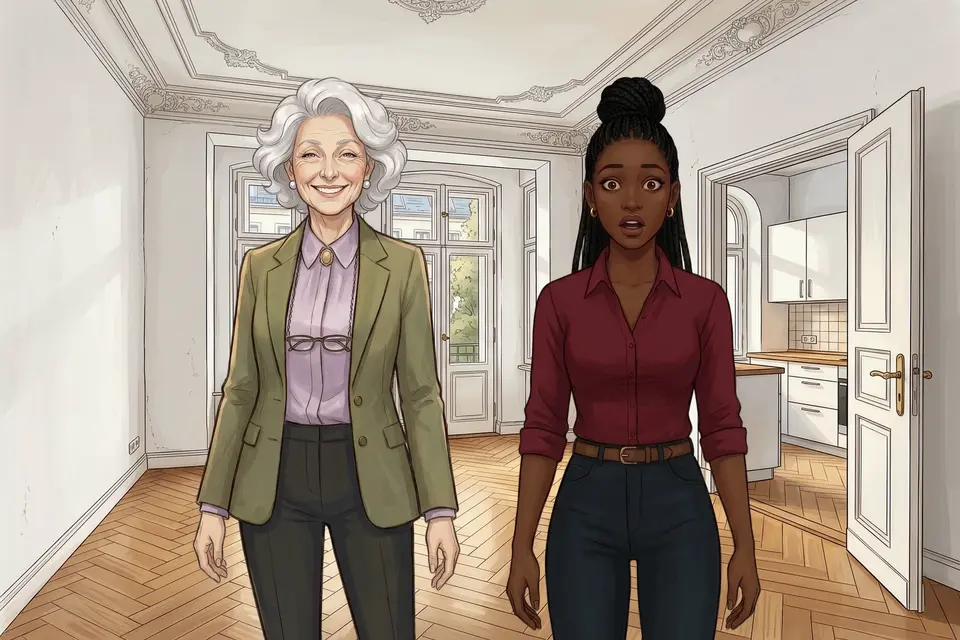
After weeks of searching you have a flat viewing (Wohnungsbesichtigung) in Berlin. The landlady, Frau Krause, shows you two rooms, a kitchen and a bathroom. You ask if you may look around, how much the rent is without and with bills, and whether you can pay the deposit in instalments. She asks about pets and your job, and tells you which documents she needs. Do you take the flat?

The story is written for A2 level learners and takes about 6 minutes.

Phrases you will learn

  • Ich komme zur Wohnungsbesichtigung. – I'm here for the flat viewing.
  • Darf ich mich kurz umsehen? – May I have a quick look around?
  • Wie hoch ist die Kaltmiete? – How much is the rent without bills?
  • Wie hoch sind die Nebenkosten? – How much are the extra costs?
  • Kann ich die Kaution in Raten zahlen? – Can I pay the deposit in instalments?
  • Darf man hier Katzen haben? – Are cats allowed here?
  • Kann ich Ihnen die Unterlagen per E-Mail schicken? – Can I send you the documents by email?

Grammar tip: questions with modal verbs

In a yes/no question the modal verb (darf, kann, muss) comes first, and the second verb goes to the end:

  • Darf ich die Küche sehen? (not Ich darf die Küche sehen?)
  • Muss ich die Kaution sofort bezahlen? (not Muss ich bezahlen die Kaution sofort?)
  • Kann man hier Fahrräder abstellen?

Good to know: rent words

Kaltmiete is the rent for the flat alone. Nebenkosten are the extra costs (heating, water, rubbish). Together they make the Warmmiete. The Kaution (deposit) can be up to three months' basic rent, and by law you may pay it in three monthly instalments.

How to play

Click the scene or press Space to read on. When it is your turn, choose an answer with the mouse or the number keys. Natural answers earn points; a wrong answer is never a dead end, Frau Krause shows you the right form and you go on.

Tap any word to see its translation and hear it pronounced. Save the new words to your personal learn list and practise them later with flashcards.

Read the dialogue

The whole story in German with English translation, every answer you can choose

Scene: A street in Berlin

Du suchst seit Wochen eine Wohnung in Berlin. Heute um fünf hast du eine Besichtigung.

You've been looking for a flat in Berlin for weeks. Today at five you have a viewing.

Du klingelst bei Krause.

You ring the bell at the Krause flat.

Krause: Ja, bitte?

Yes, hello?

Your answer

  1. Good answer

    Guten Tag, ich komme zur Wohnungsbesichtigung.

    Hello, I'm here for the flat viewing.

  2. Good answer

    Guten Tag, ich möchte die Wohnung ansehen.

    Hello, I'd like to see the flat.

  3. Mistake: word order: the infinitive goes to the end

    Guten Tag, ich möchte ansehen die Wohnung.

    Hello, I'd like to see the flat.

    Krause: Sie möchten die Wohnung ansehen? Gern!

    You'd like to see the flat? Sure!

Krause: Kommen Sie hoch, dritter Stock.

Come up, third floor.

Scene: An empty flat with wooden floors

Krause: So, das ist die Wohnung. Zwei Zimmer, Küche, Bad, 55 Quadratmeter.

So, this is the flat. Two rooms, kitchen, bathroom, 55 square metres.

Your answer

  1. Good answer

    Schön! Darf ich mich kurz umsehen?

    Nice! May I have a quick look around?

  2. Good answer

    Schön! Kann ich die Küche sehen?

    Nice! Can I see the kitchen?

  3. Mistake: in a question the modal verb comes first

    Schön! Ich darf die Küche sehen?

    Nice! I may see the kitchen?

    Krause: Sie meinen: „Darf ich die Küche sehen?“ Bei Fragen steht das Verb vorne.

    You mean: "May I see the kitchen?" In questions the verb goes first.

Your answer

  1. Good answer

    Darf ich die Küche sehen?

    May I see the kitchen?

Krause: Natürlich. Die Küche ist neu, mit Herd und Kühlschrank.

Of course. The kitchen is new, with a cooker and a fridge.

Krause: Haben Sie Fragen?

Do you have any questions?

Your answer

  1. Good answer

    Wie hoch ist die Kaltmiete?

    How much is the rent without bills?

  2. Good answer

    Wie hoch sind die Nebenkosten?

    How much are the extra costs?

  3. Good answer

    Was kostet die Wohnung warm?

    How much is the flat with bills?

Krause: Die Kaltmiete ist 750 Euro. Dazu kommen 200 Euro Nebenkosten.

The basic rent is 750 euros. Plus 200 euros of extra costs.

Krause: Warm sind es also 950 Euro im Monat.

So with bills it's 950 euros a month.

Krause: Und die Kaution ist drei Kaltmieten, also 2250 Euro.

And the deposit is three months' basic rent, so 2,250 euros.

Your answer

  1. Good answer

    Kann ich die Kaution in Raten zahlen?

    Can I pay the deposit in instalments?

  2. Good answer

    Muss ich die Kaution sofort bezahlen?

    Do I have to pay the deposit straight away?

  3. Mistake: word order: the infinitive goes to the end

    Muss ich bezahlen die Kaution sofort?

    Do I have to pay the deposit straight away?

    Krause: Sie meinen: „Muss ich die Kaution sofort bezahlen?“ Das Verb kommt ans Ende.

    You mean: "Do I have to pay the deposit straight away?" The verb goes to the end.

Krause: Nein, Sie dürfen die Kaution in drei Raten zahlen. So ist das Gesetz.

No, you're allowed to pay the deposit in three instalments. That's the law.

Krause: Jetzt habe ich eine Frage. Haben Sie Haustiere?

Now I have a question. Do you have any pets?

Your answer

  1. Good answer

    Ja, eine Katze. Darf man hier Katzen haben?

    Yes, a cat. Are cats allowed here?

    Krause: Eine Katze ist kein Problem. Hunde sind schwieriger.

    A cat is no problem. Dogs are harder.

  2. Good answer

    Nein, ich habe keine Haustiere.

    No, I don't have any pets.

    Krause: Gut.

    Good.

Krause: Und was machen Sie beruflich?

And what do you do for a living?

Your answer

  1. Good answer

    Ich arbeite bei einer Bank.

    I work at a bank.

  2. Good answer

    Ich arbeite in einem Krankenhaus.

    I work in a hospital.

  3. Mistake: in + dative: in einer Bank

    Ich arbeite in eine Bank.

    I work in a bank.

    Krause: Ah, in einer Bank. Sehr schön.

    Ah, in a bank. Very nice.

Krause: Es gibt leider viele Interessenten. Ich brauche Ihre Unterlagen bis Freitag.

Unfortunately there are a lot of people interested. I need your documents by Friday.

Krause: Also die Schufa-Auskunft und drei Gehaltsnachweise.

That is, the credit report and three payslips.

Your answer

  1. Good answer

    Ich möchte die Wohnung gern nehmen. Kann ich Ihnen die Unterlagen per E-Mail schicken?

    I'd really like to take the flat. Can I send you the documents by email?

    Krause: Ja, gern. Sie waren sehr freundlich. Ich melde mich!

    Yes, of course. You were very nice. I'll be in touch!

  2. Good answer

    Vielen Dank. Ich muss noch ein bisschen nachdenken.

    Thank you very much. I need to think about it a bit.

    Krause: Natürlich. Aber warten Sie nicht zu lange!

    Of course. But don't wait too long!

Du gehst die Treppe hinunter. Du kannst jetzt bei einer Besichtigung die richtigen Fragen stellen. Super gemacht!

You go down the stairs. Now you can ask the right questions at a viewing. Well done!