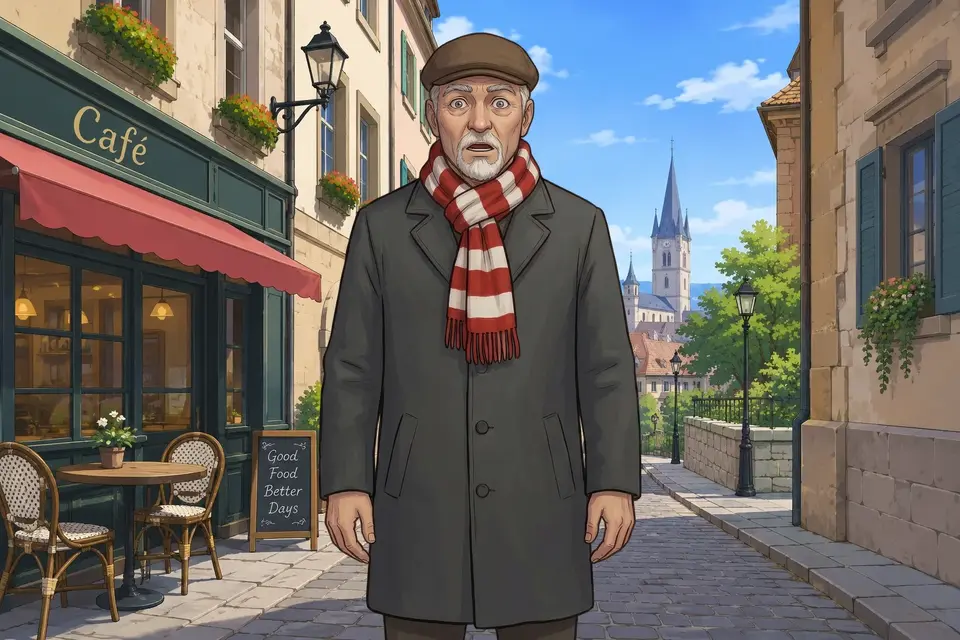
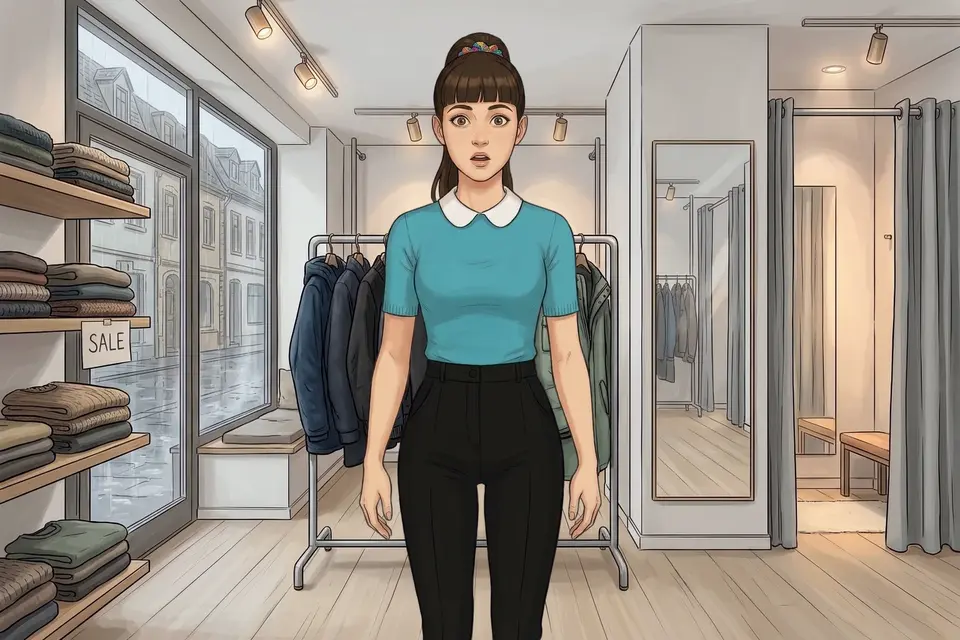
What happens in the story
You bring six empty bottles to the supermarket to get your deposit (Pfand) back, but the machine doesn't work. Jonas, who works there, helps you and gives you a deposit receipt. Then you shop from your list: you ask where the eggs are, buy apples and milk, and at the checkout hand in your receipt, say if you need a bag and pay by card or in cash.
The story is written for A1 level learners and takes about 5 minutes.
Phrases you will learn
- Der Automat geht nicht. / Der Automat ist kaputt. – The machine isn't working. / The machine is broken.
- Ich habe sechs Flaschen. – I have six bottles.
- Wo finde ich die Eier? – Where can I find the eggs?
- Ich nehme zwei Kilo Äpfel. – I'll take two kilos of apples.
- eine Packung Eier, ein Liter Milch – a box of eggs, a litre of milk
- Brauchen Sie eine Tüte? – Do you need a bag?
- Zahlen Sie bar oder mit Karte? – Are you paying cash or by card?
Grammar tip: plurals
German has several plural endings, so learn each noun with its plural:
- die Flasche → die Flaschen (-n)
- das Ei → die Eier (-er; das Eis is ice cream!)
- der Apfel → die Äpfel (umlaut)
- die Tüte → die Tüten (-n)
After a number or a quantity the noun is plural: sechs Flaschen, ein Kilo Äpfel. The quantity word itself often stays singular: zwei Kilo, drei Liter.
Good to know: Pfand
Most plastic bottles and cans in Germany have a deposit of 25 cents, glass bottles often 8 or 15 cents. You put them into the machine at the supermarket entrance, get a receipt (Pfandbon) and hand it in at the checkout.
How to play
Click the scene or press Space to read on. When it is your turn, choose an answer with the mouse or the number keys. Natural answers earn points; a wrong answer is never a dead end, Jonas shows you the right form and you go on.
Tap any word to see its translation and hear it pronounced. Save the new words to your personal learn list and practise them later with flashcards.