Small Talk über das Wetter · Talking about the weather in German – small talk · A1

Click the scene or press Space to continue, use the number keys to choose an answer. Tap a word to see its translation. Want to read along? Read the whole dialogue in German with English translation below.

What happens in the story

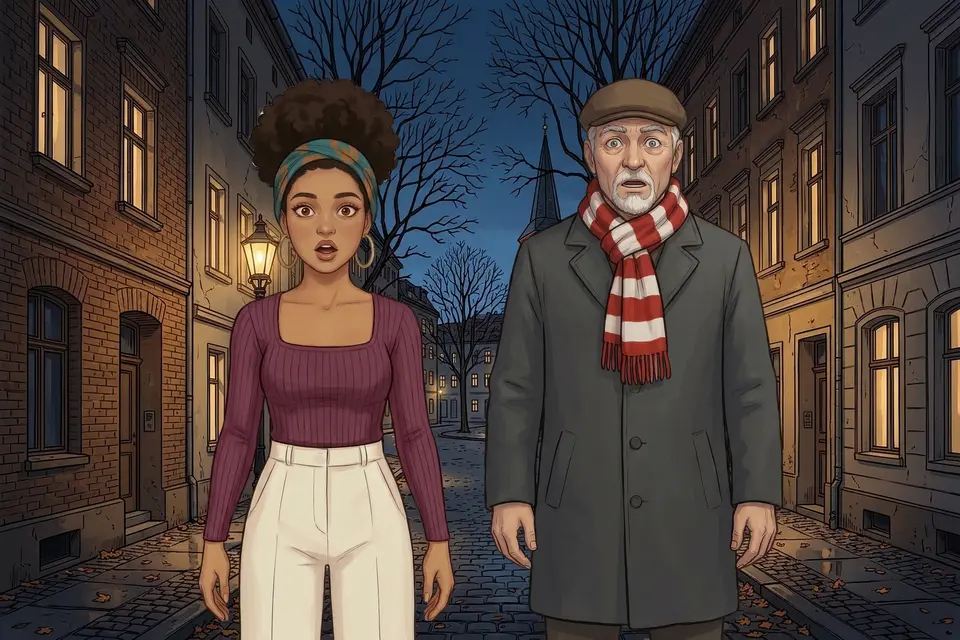
On a cold Monday morning you wait at the bus stop with your neighbour, Herr Schmidt. He starts the most German small talk of all: the weather. You talk about the cold and the wind, the weather in your home country, and then it suddenly starts to rain and he has no umbrella. Snow is forecast for tomorrow: do you love it or hate it?

The story is written for A1 level learners and takes about 4 minutes.

Phrases you will learn

  • Heute ist es aber kalt, oder? – It's really cold today, isn't it?
  • Es ist windig / sonnig / warm. – It's windy / sunny / warm.
  • Mir ist kalt. – I feel cold.
  • Bei uns ist es oft warm und sonnig. – Where I'm from it's often warm and sunny.
  • Es regnet! / Morgen soll es schneien. – It's raining! / It's supposed to snow tomorrow.
  • Wir teilen meinen Schirm. – Let's share my umbrella.
  • Schönen Tag noch! – Have a nice day!

Grammar tip: es ist kalt, but mir ist kalt

For the weather, German uses es: es ist kalt, es regnet (it's raining), es schneit (it's snowing). Weather verbs have their own form, so say es regnet, not es ist Regen.

For how you feel, use mir ist …: Mir ist kalt (I feel cold), Mir ist warm. Ich bin kalt means you are a cold, unfriendly person!

And the verb always comes second: Bei uns ist es oft warm, Heute regnet es.

How to play

Click the scene or press Space to read on. When it is your turn, choose an answer with the mouse or the number keys. Natural answers earn points; a wrong answer is never a dead end, Herr Schmidt shows you the right form and you go on.

Tap any word to see its translation and hear it pronounced. Save the new words to your personal learn list and practise them later with flashcards.
Read the dialogue

The whole story in German with English translation, every answer you can choose

Scene: A street in Berlin

Es ist Montagmorgen. Du wartest an der Bushaltestelle.

It's Monday morning. You're waiting at the bus stop.

Dein Nachbar Herr Schmidt wartet auch.

Your neighbour Herr Schmidt is waiting too.

Schmidt: Guten Morgen! Na, heute ist es aber kalt, oder?

Good morning! Well, it's really cold today, isn't it?

Your answer

  1. Good answer

    Ja, es ist sehr kalt!

    Yes, it's very cold!

  2. Good answer

    Ja, wirklich! Und es ist so windig.

    Yes, really! And it's so windy.

  3. Mistake: say "Mir ist kalt": "ich bin kalt" means you're a cold person

    Ja, ich bin so kalt!

    Yes, I'm so cold!

    Schmidt: Ha! Sie meinen „Mir ist kalt“. „Ich bin kalt“ heißt, Sie sind ein kalter Mensch!

    Ha! You mean "Mir ist kalt" (I feel cold). "Ich bin kalt" means you're a cold person!

Your answer

  1. Good answer

    Ach so! Mir ist kalt.

    I see! I feel cold.

    Schmidt: Mir auch!

    Me too!

Schmidt: Und wie ist das Wetter in Ihrer Heimat?

And what's the weather like where you're from?

Your answer

  1. Good answer

    Bei uns ist es oft warm und sonnig.

    Where I'm from it's often warm and sunny.

    Schmidt: Ach, wie schön! Dann ist Berlin sicher hart für Sie.

    Oh, how lovely! Then Berlin must be hard for you.

  2. Good answer

    Bei uns regnet es viel, wie hier.

    Where I'm from it rains a lot, like here.

    Schmidt: Dann fühlen Sie sich hier ja wie zu Hause!

    Then you must feel right at home here!

  3. Mistake: word order: the verb comes second: Bei uns ist es …

    Bei uns es ist oft warm.

    Where I'm from it is often warm.

    Schmidt: Ah, bei Ihnen ist es oft warm. Wie schön!

    Ah, it's often warm where you're from. How lovely!

    Schmidt: Kleiner Tipp: Das Verb steht an Position zwei. „Bei uns ist es oft warm.“

    A little tip: the verb goes in second place. "Bei uns ist es oft warm."

Plötzlich wird der Himmel dunkel. Dann fallen die ersten Tropfen.

Suddenly the sky turns dark. Then the first drops fall.

Your answer

  1. Good answer

    Oh nein, es regnet!

    Oh no, it's raining!

  2. Mistake: say "es regnet"

    Oh nein, es ist Regen!

    Oh no, it is rain!

    Schmidt: Ja, es regnet! Regen ist das Nomen, regnen ist das Verb.

    Yes, it's raining! "Regen" is the noun, "regnen" is the verb.

Schmidt: Und ich habe keinen Regenschirm!

And I don't have an umbrella!

Your answer

  1. Good answer

    Kommen Sie, wir teilen meinen Schirm!

    Come on, let's share my umbrella!

    Schmidt: Wie nett von Ihnen! Danke schön.

    How kind of you! Thank you.

  2. Good answer

    Ich habe leider auch keinen.

    Unfortunately I don't have one either.

    Schmidt: Dann stellen wir uns unter das Dach.

    Then let's stand under the shelter.

Schmidt: Im Radio haben sie gesagt, morgen soll es sogar schneien.

On the radio they said it's even supposed to snow tomorrow.

Your answer

  1. Good answer

    Wirklich? Super, ich liebe Schnee!

    Really? Great, I love snow!

    Schmidt: Sie sind jung. Ich mag den Schnee nicht mehr so.

    You're young. I don't like snow so much any more.

  2. Good answer

    Oh nein! Ich mag keinen Schnee.

    Oh no! I don't like snow.

    Schmidt: Ich auch nicht. Ich bleibe dann zu Hause!

    Me neither. I'll stay at home then!

Schmidt: Ah, da kommt mein Bus.

Ah, here comes my bus.

Your answer

  1. Good answer

    Schönen Tag noch, Herr Schmidt!

    Have a nice day, Herr Schmidt!

  2. Good answer

    Tschüss, bis morgen! Vielleicht im Schnee!

    Bye, see you tomorrow! Maybe in the snow!

Schmidt: Danke, bis morgen!

Thanks, see you tomorrow!

Herr Schmidt steigt in den Bus. Du hast heute einen echten Small Talk auf Deutsch gemacht. Super gemacht!

Herr Schmidt gets on the bus. Today you had real small talk in German. Well done!