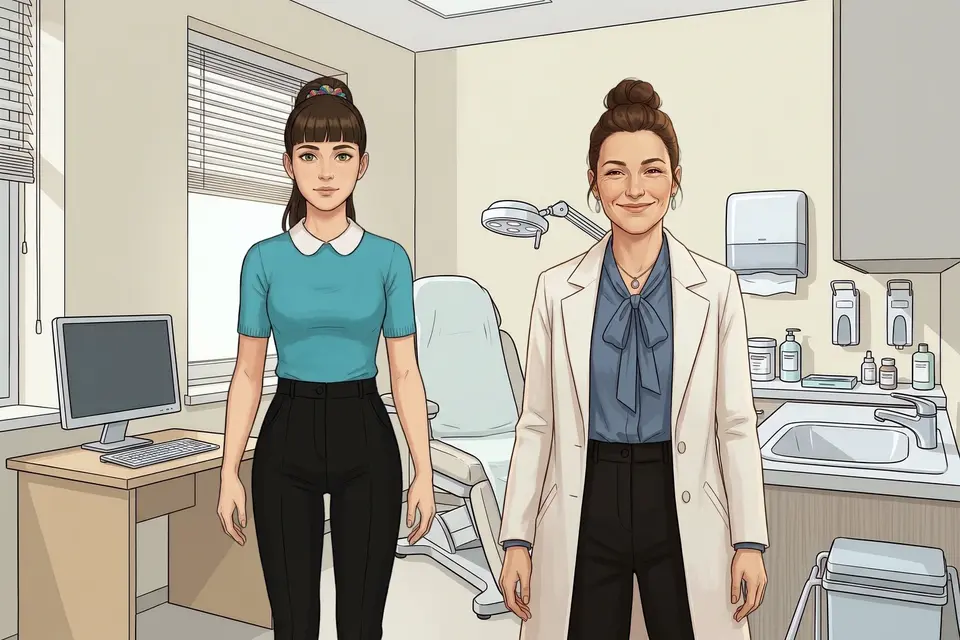
Beim Facharzt · Describing symptoms in German – at the specialist · B2

Click the scene or press Space to continue, use the number keys to choose an answer. Tap a word to see its translation. Want to read along? Read the whole dialogue in German with English translation below.

What happens in the story

Three weeks after your bike accident, your right knee still hurts, and your GP has referred you to an orthopaedic specialist. You check in with Frau Schulz at reception, then tell Dr Yılmaz what happened, when it hurts and what kind of pain it is. She examines the knee, suspects an irritated ligament and orders an MRI, and you find out whether you can keep jogging until then.

The story is written for B2 level learners and takes about 5 minutes. For a first visit to the GP at A2 level, play At the doctor in German.

Phrases you will learn

  • Hier sind meine Versichertenkarte und die Überweisung von meiner Hausärztin. – Here are my health insurance card and the referral from my GP.
  • Nachdem ich mit dem Fahrrad gestürzt war, hat mein Knie angefangen wehzutun. – After I fell off my bike, my knee started to hurt.
  • Seitdem ich wieder jogge, ist es abends manchmal geschwollen. – Since I started jogging again, it's sometimes swollen in the evening.
  • Vor allem beim Treppensteigen. – Mainly when climbing stairs.
  • Es ist ein stechender Schmerz, kein dumpfer. – It's a stabbing pain, not a dull one.
  • Sollte ich lieber pausieren, bis das MRT gemacht worden ist? – Should I rather take a break until the MRI has been done?

Grammar tip: nachdem, seitdem, bevor

  • nachdem (after) takes a tense one step further back than the main clause: Nachdem ich gestürzt war, hat mein Knie angefangen wehzutun (Plusquamperfekt + Perfekt), Nachdem ich gegessen habe, gehe ich (Perfekt + present).
  • seitdem / seit (since) is for something that started in the past and is still going on, usually with the present: Seitdem ich wieder jogge, ist es geschwollen.
  • bevor (before) and bis (until) also send the verb to the end.

When one of these clauses comes first, the main clause starts with its verb: Seitdem ich jogge, ist es geschwollen, not … es ist geschwollen.

Good to know: specialists in Germany

With public health insurance you usually see your GP (Hausarzt / Hausärztin) first, who gives you a referral (Überweisung) to a specialist (Facharzt) such as an orthopaedist. Bring your insurance card (Versichertenkarte) to every appointment. Doctors will ask exactly when, where and how it hurts: stechend (stabbing), dumpf (dull), ziehend (pulling), brennend (burning).

How to play

Click the scene or press Space to read on. When it is your turn, choose an answer with the mouse or the number keys. Natural answers earn points; a wrong answer is never a dead end, the doctor repeats the right form and the appointment goes on.

Tap any word to see its translation and hear it pronounced. Save new words to your personal learn list, and find more B2 vocabulary in the German B2 word list.
Read the dialogue

The whole story in German with English translation, every answer you can choose

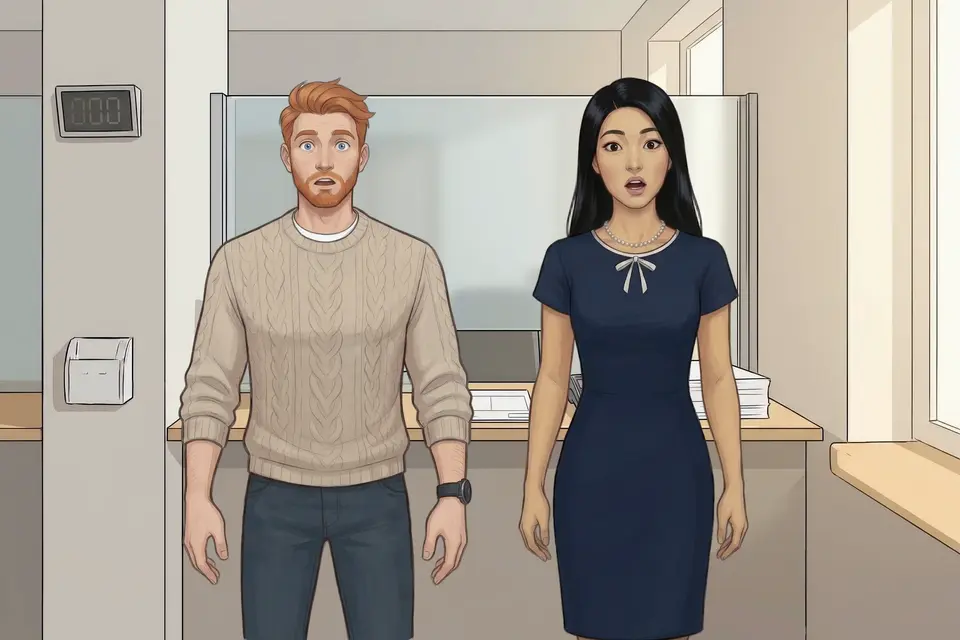
Scene: A plain service counter with a desk, a screen and a waiting number display

Eine orthopädische Praxis in Berlin-Mitte. Drei Wochen nach deinem Fahrradunfall tut dein rechtes Knie immer noch weh, und deine Hausärztin hat dich hierher überwiesen.

An orthopaedic practice in central Berlin. Three weeks after your bike accident your right knee still hurts, and your GP has referred you here.

Schulz: Guten Morgen! Was kann ich für Sie tun?

Good morning! What can I do for you?

Your answer

  1. Good answer

    Guten Morgen, ich habe um zehn Uhr einen Termin. Hier sind meine Versichertenkarte und die Überweisung von meiner Hausärztin.

    Good morning, I have an appointment at ten. Here are my health insurance card and the referral from my GP.

    Schulz: Danke, perfekt.

    Thanks, perfect.

  2. Good answer

    Hallo, ich habe einen Termin. Hier ist meine Karte.

    Hello, I have an appointment. Here's my card.

    Schulz: Danke. Haben Sie auch eine Überweisung?

    Thank you. Do you have a referral too?

    Du: Ja, von meiner Hausärztin. Hier.

    Yes, from my GP. Here.

  3. Mistake: "Hausärztin" is feminine: von meiner Hausärztin

    Ich habe um zehn Uhr einen Termin. Hier ist die Überweisung von meinem Hausärztin.

    I have an appointment at ten. Here's the referral from my GP.

    Schulz: Von Ihrer Hausärztin, danke. Und Ihre Versichertenkarte, bitte?

    From your GP, thank you. And your health insurance card, please?

Schulz: Frau Doktor Yılmaz ruft Sie gleich auf.

Dr Yılmaz will call you in shortly.

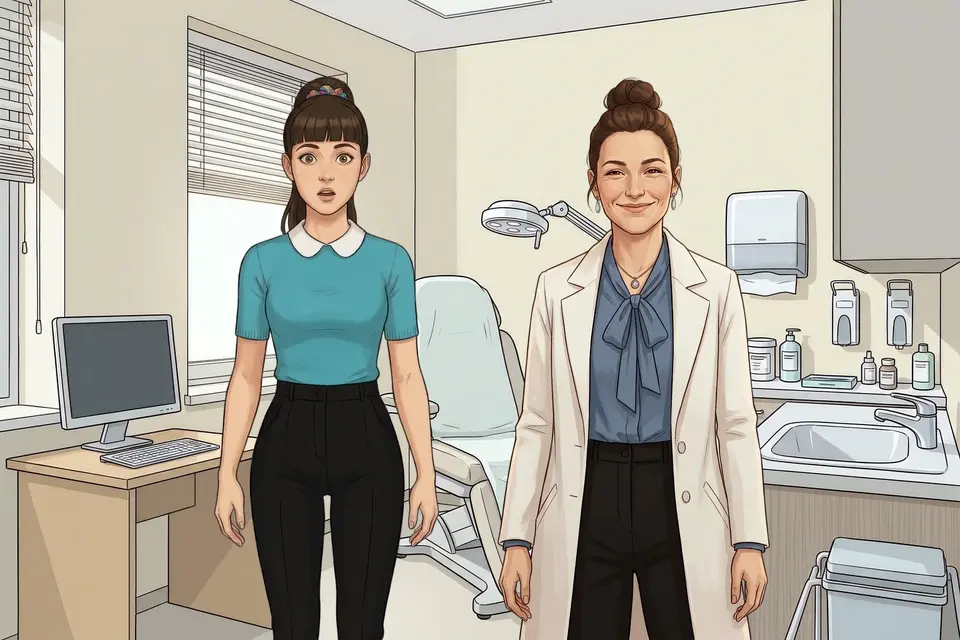
Scene: A bright medical treatment room with a treatment chair and a lamp

Nach zehn Minuten sitzt du im Behandlungszimmer. Die Ärztin liest die Überweisung und schaut dich dann an.

After ten minutes you're sitting in the treatment room. The doctor reads the referral and then looks at you.

Yilmaz: Guten Morgen. Ihre Hausärztin schreibt etwas von einem Knie. Erzählen Sie mal, was ist passiert?

Good morning. Your GP writes something about a knee. Tell me, what happened?

Your answer

  1. Good answer

    Nachdem ich vor drei Wochen mit dem Fahrrad gestürzt war, hat mein rechtes Knie angefangen wehzutun. Erst dachte ich, es sei nur eine Prellung.

    After I fell off my bike three weeks ago, my right knee started to hurt. At first I thought it was just a bruise.

    Yilmaz: Ein Sturz also. Gut, dass Sie es so genau beschreiben.

    A fall, then. Good that you describe it so precisely.

  2. Good answer

    Ich bin vor drei Wochen mit dem Fahrrad gestürzt, und seitdem tut mein Knie weh.

    I fell off my bike three weeks ago, and my knee has hurt ever since.

    Yilmaz: Ein Sturz also.

    A fall, then.

  3. Mistake: after "nachdem", use the tense one step further back than the main clause: nachdem ich gestürzt war, …

    Nachdem ich vor drei Wochen mit dem Fahrrad gestürzt bin, hat mein Knie angefangen wehzutun.

    After I fell off my bike three weeks ago, my knee started to hurt.

    Yilmaz: Nachdem Sie gestürzt waren, verstehe. Ein Sturz also.

    After you had fallen, I see. A fall, then.

Yilmaz: Wann genau tut es weh? Beim Gehen, beim Sport, in Ruhe?

When exactly does it hurt? When walking, during sport, at rest?

Your answer

  1. Good answer

    Vor allem beim Treppensteigen. Und seitdem ich wieder jogge, ist es abends manchmal geschwollen.

    Mainly when climbing stairs. And since I started jogging again, it's sometimes swollen in the evening.

    Yilmaz: Sie joggen schon wieder? Das erklärt einiges.

    You're already jogging again? That explains a lot.

  2. Good answer

    Wenn ich Treppen steige, und manchmal nachts.

    When I climb stairs, and sometimes at night.

    Yilmaz: Nachts auch? Machen Sie im Moment Sport?

    At night too? Are you doing any sport at the moment?

    Du: Ja, seitdem es mir etwas besser geht, jogge ich wieder.

    Yes, since I've been feeling a bit better, I've been jogging again.

    Yilmaz: Das erklärt einiges.

    That explains a lot.

  3. Mistake: after the "seitdem" clause, the main clause starts with its verb: seitdem ich wieder jogge, ist es …

    Vor allem beim Treppensteigen. Und seitdem ich wieder jogge, es ist abends geschwollen.

    Mainly when climbing stairs. And since I started jogging again, it's swollen in the evening.

    Yilmaz: Seitdem Sie wieder joggen, ist es geschwollen? Das erklärt einiges.

    Since you started jogging again, it's been swollen? That explains a lot.

Die Ärztin bittet dich auf die Liege und tastet dein Knie ab. Dann drückt sie an der Innenseite.

The doctor asks you to get onto the couch and feels your knee. Then she presses on the inside.

Yilmaz: Tut das weh, wenn ich hier drücke?

Does that hurt when I press here?

Your answer

  1. Good answer

    Ja, genau da. Es ist ein stechender Schmerz, kein dumpfer.

    Yes, right there. It's a stabbing pain, not a dull one.

    Yilmaz: Stechend, an der Innenseite. Das passt zusammen.

    Stabbing, on the inside. That fits.

  2. Good answer

    Ja, ein bisschen.

    Yes, a bit.

    Yilmaz: Eher stechend oder dumpf?

    More stabbing or dull?

    Du: Stechend.

    Stabbing.

    Yilmaz: An der Innenseite, stechend. Das passt zusammen.

    On the inside, stabbing. That fits.

  3. Mistake: after "ein" a masculine noun in the nominative takes -er: ein stechender Schmerz

    Ja, genau da. Es ist ein stechende Schmerz.

    Yes, right there. It's a stabbing pain.

    Yilmaz: Ein stechender Schmerz, an der Innenseite. Das passt zusammen.

    A stabbing pain, on the inside. That fits.

Yilmaz: Wahrscheinlich ist das Innenband gereizt. Bevor wir über irgendetwas Größeres nachdenken, machen wir ein MRT. Bis dahin bekommen Sie Physiotherapie.

The inner ligament is probably irritated. Before we think about anything bigger, we'll do an MRI. Until then you'll get physiotherapy.

Your answer

  1. Good answer

    Darf ich bis dahin weiter joggen, oder sollte ich lieber pausieren, bis das MRT gemacht worden ist?

    Can I keep jogging until then, or should I rather take a break until the MRI has been done?

    Yilmaz: Gute Frage. Bitte pausieren. Radfahren ist in Ordnung, Joggen nicht.

    Good question. Please take a break. Cycling is fine, jogging isn't.

  2. Good answer

    Darf ich weiter Sport machen?

    Can I keep doing sport?

    Yilmaz: Radfahren ist in Ordnung, Joggen bitte nicht.

    Cycling is fine, but please don't jog.

  3. Mistake: in the Perfekt of the Passiv, "worden" comes before "ist": bis das MRT gemacht worden ist

    Sollte ich lieber pausieren, bis das MRT gemacht ist worden?

    Should I rather take a break until the MRI has been done?

    Yilmaz: Bis es gemacht worden ist, ja. Bitte pausieren. Radfahren ist in Ordnung, Joggen nicht.

    Until it's been done, yes. Please take a break. Cycling is fine, jogging isn't.

Yilmaz: Kühlen Sie das Knie abends zehn Minuten, und den Termin fürs MRT macht Frau Schulz vorne mit Ihnen. Gute Besserung!

Cool the knee for ten minutes in the evenings, and Frau Schulz at the front will make the MRI appointment with you. Get well soon!

Mit einem MRT-Termin, einem Rezept für Physiotherapie und einer klaren Diagnose gehst du nach Hause. Du hast deine Beschwerden genau beschrieben. Sehr gut!

You go home with an MRI appointment, a prescription for physiotherapy and a clear diagnosis. You described your symptoms precisely. Very good!