Fahrradunfall · Reporting an accident in German – a bike accident and the insurance · B2

Click the scene or press Space to continue, use the number keys to choose an answer. Tap a word to see its translation. Want to read along? Read the whole dialogue in German with English translation below.

What happens in the story

On your way to work, the driver of a parked car opens his door right in front of you, and you crash. Your colleague Felix was cycling behind you and saw everything. You tell him what happened and ask him to be your witness. Three days later you report the claim at the customer centre of the driver's car insurer: Frau Nguyen asks you to describe the accident, whether the police came and what was damaged.

The story is written for B2 level learners and takes about 5 minutes. Three weeks later your knee still hurts: Describing symptoms in German.

Phrases you will learn

  • Die Autotür wurde plötzlich aufgerissen, und ich konnte nicht mehr bremsen. – The car door was suddenly flung open and I couldn't brake in time.
  • Falls die Versicherung einen Zeugen braucht … – In case the insurance needs a witness …
  • Ich fuhr auf dem Radweg, als plötzlich die Fahrertür geöffnet wurde. – I was riding in the cycle lane when suddenly the driver's door was opened.
  • Die Polizei wurde sofort gerufen und hat den Unfall aufgenommen. – The police were called straight away and recorded the accident.
  • Die Reparatur des Fahrrads kostet laut Kostenvoranschlag 340 Euro. – According to the quote, the repair of the bike costs 340 euros.

Grammar tip: the Passiv in the past, and als vs. wenn

To report what happened without saying who did it, use the Passiv in the past: Die Tür wurde geöffnet, Die Polizei wurde gerufen (or in the Perfekt: ist gerufen worden). Die Polizei ist gerufen without worden describes a state, not what happened.

For a single event in the past, "when" is als: Ich fuhr auf dem Radweg, als die Tür geöffnet wurde. wenn is for things that happen repeatedly (immer wenn) or in the present and future. Written reports like a claim form use the Präteritum: ich fuhr, ich prallte dagegen, ich stürzte.

Good to know: after an accident in Germany

If someone else caused the accident, their liability insurance (Haftpflichtversicherung; for a car, the Kfz-Haftpflicht) pays for your damage. Write down the other person's details and insurance, call the police if anyone is hurt or the facts are disputed, keep the police reference number (Aktenzeichen), and ask witnesses for their contact details. "Dooring" accidents with opened car doors are a common cause of cycling accidents in cities.

How to play

Click the scene or press Space to read on. When it is your turn, choose an answer with the mouse or the number keys. Natural answers earn points; a wrong answer is never a dead end, the other person repeats the right form and the story goes on.

Tap any word to see its translation and hear it pronounced. Save new words to your personal learn list, and find more B2 vocabulary in the German B2 word list.
Read the dialogue

The whole story in German with English translation, every answer you can choose

Scene: A street in Berlin

Montagmorgen, auf dem Weg zur Arbeit. Du fährst auf dem Radweg, Felix ein Stück hinter dir. Plötzlich geht neben dir eine Autotür auf. Ein Knall, dann liegst du auf dem Asphalt.

Monday morning, on the way to work. You're riding in the cycle lane, Felix a little behind you. Suddenly a car door opens next to you. A bang, then you're lying on the tarmac.

Felix: Alex! Alles okay? Was ist passiert?

Alex! Are you okay? What happened?

Your answer

  1. Good answer

    Ich glaube, es geht. Die Autotür wurde plötzlich aufgerissen, und ich konnte nicht mehr bremsen. Mein Knie tut weh.

    I think I'm okay. The car door was suddenly flung open and I couldn't brake in time. My knee hurts.

    Felix: Ich hab's gesehen. Der Fahrer hat nicht in den Spiegel geschaut. Bleib erst mal sitzen.

    I saw it. The driver didn't look in the mirror. Stay sitting for a moment.

  2. Good answer

    Eine Autotür ist plötzlich aufgegangen. Mein Knie tut weh.

    A car door suddenly opened. My knee hurts.

    Felix: Ich hab's gesehen. Der Fahrer hat nicht in den Spiegel geschaut. Bleib erst mal sitzen.

    I saw it. The driver didn't look in the mirror. Stay sitting for a moment.

  3. Mistake: reißen is irregular: aufgerissen

    Die Autotür wurde plötzlich aufgereißt, und ich konnte nicht mehr bremsen.

    The car door was suddenly flung open and I couldn't brake in time.

    Felix: Ja, aufgerissen, ohne in den Spiegel zu schauen. Ich hab's gesehen. Bleib erst mal sitzen.

    Yes, flung open without looking in the mirror. I saw it. Stay sitting for a moment.

Der Autofahrer entschuldigt sich immer wieder, ruft die Polizei und gibt dir seine Versicherungsdaten. Felix hilft dir, das verbogene Fahrrad an den Rand zu schieben.

The driver keeps apologising, calls the police and gives you his insurance details. Felix helps you push the bent bike to the side.

Felix: Wenn du mich brauchst: Ich hab alles gesehen.

If you need me: I saw everything.

Your answer

  1. Good answer

    Danke! Könntest du mir deine Kontaktdaten schicken? Falls die Versicherung einen Zeugen braucht.

    Thanks! Could you send me your contact details? In case the insurance needs a witness.

    Felix: Klar, ich schreib dir gleich. Ich bin dein Zeuge.

    Sure, I'll message you right away. I'm your witness.

  2. Good answer

    Kannst du der Versicherung später sagen, was du gesehen hast?

    Can you tell the insurance later what you saw?

    Felix: Klar, ich schick dir meine Nummer. Ich bin dein Zeuge.

    Sure, I'll send you my number. I'm your witness.

  3. Mistake: "Zeuge" adds -n outside the nominative: einen Zeugen

    Danke! Falls die Versicherung einen Zeuge braucht, kann ich dich anrufen?

    Thanks! If the insurance needs a witness, can I call you?

    Felix: Klar, wenn sie einen Zeugen braucht, ruf mich an. Ich bin dein Zeuge.

    Sure, if they need a witness, call me. I'm your witness.

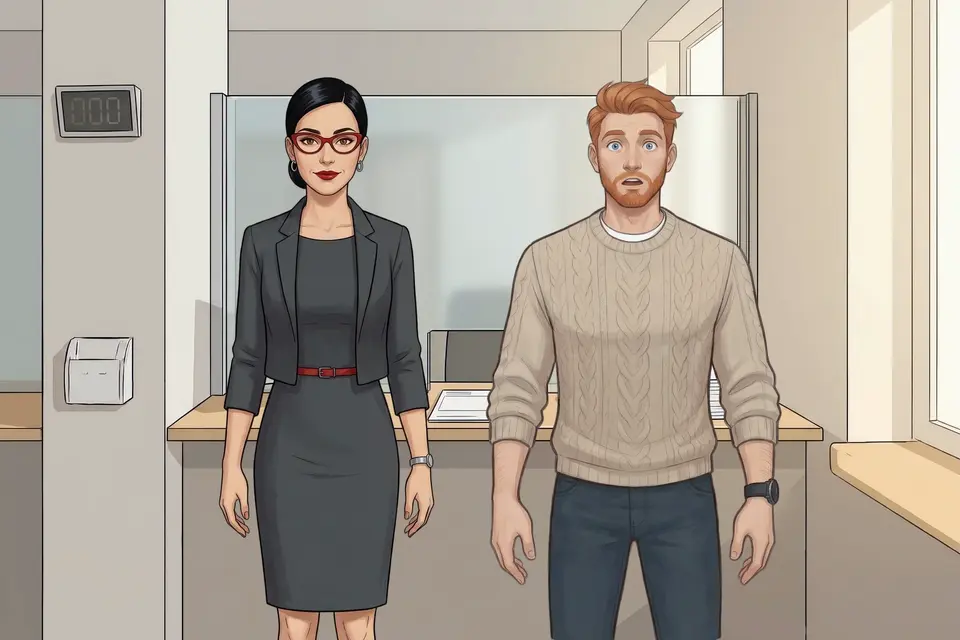
Scene: A plain service counter with a desk, a screen and a waiting number display

Drei Tage später, im Kundencenter der Autoversicherung des Fahrers. Du hast einen Kostenvoranschlag vom Fahrradladen und das Aktenzeichen der Polizei dabei.

Three days later, at the customer centre of the driver's car insurer. You have a quote from the bike shop and the police reference number with you.

Nguyen: Guten Tag. Sie möchten einen Schaden melden? Dann schildern Sie mir bitte, wie der Unfall passiert ist.

Good afternoon. You'd like to report a claim? Then please describe to me how the accident happened.

Your answer

  1. Good answer

    Ich fuhr am Montag auf dem Radweg, als plötzlich die Fahrertür eines parkenden Autos geöffnet wurde. Ich prallte dagegen und stürzte.

    On Monday I was riding in the cycle lane when suddenly the driver's door of a parked car was opened. I crashed into it and fell.

    Nguyen: Danke, das ist sehr präzise. So kann ich es direkt in die Schadensmeldung übernehmen.

    Thank you, that's very precise. I can put it straight into the claim report like that.

  2. Good answer

    Ich bin auf dem Radweg gefahren, und dann hat der Fahrer seine Tür aufgemacht. Ich bin hingefallen.

    I was riding in the cycle lane, and then the driver opened his door. I fell over.

    Nguyen: Verstehe. Ich schreibe: Die Fahrertür wurde geöffnet, als Sie vorbeifuhren.

    I see. I'll write: the driver's door was opened as you were riding past.

  3. Mistake: for a single event in the past use "als"; "wenn" is for repeated events or the present and future

    Ich fuhr auf dem Radweg, wenn plötzlich die Fahrertür eines Autos geöffnet wurde.

    I was riding in the cycle lane when suddenly the driver's door of a car was opened.

    Nguyen: Als die Tür geöffnet wurde, verstehe. Ich schreibe das so in die Schadensmeldung.

    When the door was opened, I see. I'll put it like that in the claim report.

Nguyen: Wurde die Polizei gerufen?

Were the police called?

Your answer

  1. Good answer

    Ja, die Polizei wurde sofort gerufen und hat den Unfall aufgenommen. Hier ist das Aktenzeichen. Außerdem gibt es einen Zeugen.

    Yes, the police were called straight away and recorded the accident. Here's the reference number. There's also a witness.

    Nguyen: Sehr gut, mit Zeugen und Polizeibericht ist der Fall eindeutig.

    Very good, with a witness and a police report the case is clear.

  2. Good answer

    Ja, ein Polizist ist gekommen. Hier ist die Nummer.

    Yes, a police officer came. Here's the number.

    Nguyen: Das Aktenzeichen, danke. Gab es auch Zeugen?

    The reference number, thank you. Were there any witnesses too?

    Du: Ja, mein Kollege Felix hat alles gesehen.

    Yes, my colleague Felix saw everything.

    Nguyen: Sehr gut, dann ist der Fall eindeutig.

    Very good, then the case is clear.

  3. Mistake: for an action in the past use "wurde gerufen" or "ist gerufen worden"; "ist gerufen" describes a state

    Ja, die Polizei ist sofort gerufen und hat den Unfall aufgenommen.

    Yes, the police were called straight away and recorded the accident.

    Nguyen: Die Polizei wurde gerufen, gut. Haben Sie das Aktenzeichen? Und gab es Zeugen?

    The police were called, good. Do you have the reference number? And were there any witnesses?

    Du: Ja, hier ist das Aktenzeichen, und mein Kollege Felix hat alles gesehen.

    Yes, here's the reference number, and my colleague Felix saw everything.

    Nguyen: Sehr gut, dann ist der Fall eindeutig.

    Very good, then the case is clear.

Nguyen: Welche Schäden sind denn entstanden?

So what damage was caused?

Your answer

  1. Good answer

    Das Vorderrad wurde komplett verbogen, und mein Knie wird gerade noch untersucht. Die Reparatur des Fahrrads kostet laut Kostenvoranschlag dreihundertvierzig Euro.

    The front wheel was completely bent, and my knee is still being examined. According to the quote, the repair of the bike costs three hundred and forty euros.

    Nguyen: Danke. Die Kosten für die Reparatur übernehmen wir, und die Arztrechnungen reichen Sie einfach nach.

    Thank you. We'll cover the cost of the repair, and you can simply send in the medical bills later.

  2. Good answer

    Mein Fahrrad ist kaputt, die Reparatur kostet dreihundertvierzig Euro. Und mein Knie tut noch weh.

    My bike is broken, the repair costs three hundred and forty euros. And my knee still hurts.

    Nguyen: Die Kosten für die Reparatur übernehmen wir, und die Arztrechnungen reichen Sie einfach nach.

    We'll cover the cost of the repair, and you can simply send in the medical bills later.

  3. Mistake: "von" takes the dative: von dem Fahrrad; in formal German better the genitive: die Reparatur des Fahrrads

    Das Vorderrad wurde verbogen. Die Reparatur von das Fahrrad kostet dreihundertvierzig Euro.

    The front wheel was bent. The repair of the bike costs three hundred and forty euros.

    Nguyen: Die Reparatur des Fahrrads, gut. Die Kosten übernehmen wir, und Arztrechnungen reichen Sie einfach nach.

    The repair of the bike, good. We'll cover the costs, and you can simply send in medical bills later.

Nguyen: Und ich wünsche Ihnen gute Besserung. Lassen Sie das Knie unbedingt von einem Facharzt anschauen.

And I hope you get well soon. Make sure you have the knee looked at by a specialist.

Schadensmeldung abgegeben, Zeuge und Polizeibericht vorhanden, die Reparatur wird bezahlt. Du hast den Unfall klar und sachlich geschildert. Gut gemacht!

Claim submitted, witness and police report in place, the repair will be paid for. You described the accident clearly and factually. Well done!