Beim Arzt · At the doctor in German – A2 dialogue · A2

Click the scene or press Space to continue, use the number keys to choose an answer. Tap a word to see its translation. Want to read along? Read the whole dialogue in German with English translation below.

What happens in the story

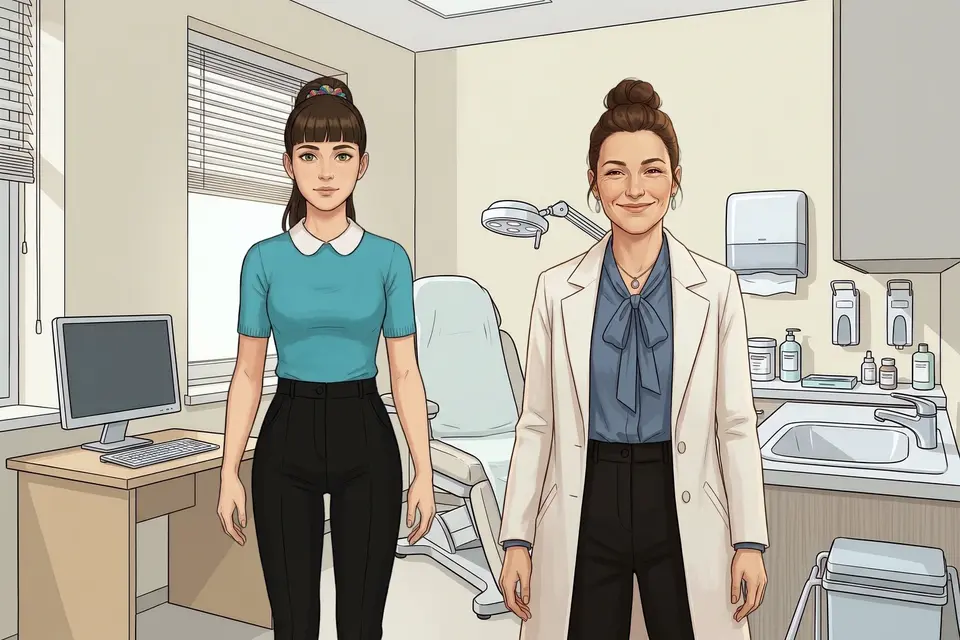
You haven't felt well for a few days, so you go to the doctor. At the reception Frau Schulz asks for your health insurance card and whether you've been there before. Then Dr. Yılmaz asks what is wrong, how long you've had the symptoms, whether you have a temperature and which medication you take. You get a sick note and tips for getting better, and learn what to buy at the pharmacy, as in At the pharmacy.

The story is written for A2 level learners and takes about 6 minutes.

Phrases you will learn

  • Ich habe um neun Uhr einen Termin. – I have an appointment at nine.
  • Was fehlt Ihnen? – What's the matter?
  • Ich habe Halsschmerzen und Husten. – I have a sore throat and a cough.
  • Mein Hals tut weh. – My throat hurts.
  • Seit wann haben Sie die Beschwerden? – Seit drei Tagen. – How long have you had the symptoms? – For three days.
  • Ich habe kein Fieber. – I don't have a temperature.
  • Ich schreibe Sie bis Freitag krank. – I'll sign you off sick until Friday.
  • Gute Besserung! – Get well soon!

Grammar tip: seit + dative

To say how long something has been going on, German uses the present tense with seit, and seit is always followed by the dative:

  • seit drei Tagen (plural: add -n) – for three days
  • seit einer Woche (die Woche → einer) – for a week
  • seit einem Monat (der Monat → einem) – for a month

English says "I have had a cough for three days", German simply says Ich habe seit drei Tagen Husten. For pain, use Ich habe …schmerzen (Kopfschmerzen, Bauchschmerzen, Rückenschmerzen) or … tut weh.

How to play

Click the scene or press Space to read on. When it is your turn, choose an answer with the mouse or the number keys. Natural answers earn points; a wrong answer is never a dead end, the doctor or the receptionist shows you the right form and you go on.

Tap any word to see its translation and hear it pronounced. Save the new words to your personal learn list and practise them later with flashcards.

Read the dialogue

The whole story in German with English translation, every answer you can choose

Scene: A plain service counter with a desk, a screen and a waiting number display

Du fühlst dich seit ein paar Tagen nicht gut.

You haven't felt well for a few days.

Heute hast du um neun Uhr einen Termin beim Arzt.

Today you have an appointment at the doctor's at nine o'clock.

Schulz: Guten Morgen! Was kann ich für Sie tun?

Good morning! What can I do for you?

Your answer

  1. Good answer

    Guten Morgen. Ich habe um neun Uhr einen Termin.

    Good morning. I have an appointment at nine.

    Schulz: Ah ja, ich sehe Sie hier im Kalender.

    Ah yes, I can see you here in the calendar.

  2. Mistake: wrong preposition: um neun Uhr

    Guten Morgen. Ich habe einen Termin an neun Uhr.

    Good morning. I have an appointment at nine.

    Schulz: Um neun Uhr, ja. Bei der Uhrzeit sagen wir „um“.

    At nine, yes. With clock times we say "um".

    Schulz: Ah ja, ich sehe Sie hier im Kalender.

    Ah yes, I can see you here in the calendar.

Schulz: Ihre Versichertenkarte, bitte. Waren Sie schon einmal bei uns?

Your health insurance card, please. Have you been here before?

Your answer

  1. Good answer

    Nein, ich bin zum ersten Mal hier.

    No, this is my first time here.

  2. Good answer

    Nein, ich war noch nie hier.

    No, I've never been here.

Schulz: Kein Problem. Füllen Sie bitte diesen Fragebogen aus.

No problem. Please fill in this questionnaire.

Schulz: Nehmen Sie dann bitte im Wartezimmer Platz.

Then please take a seat in the waiting room.

Scene: A bright medical treatment room with a treatment chair and a lamp

Nach zwanzig Minuten bist du dran.

After twenty minutes it's your turn.

Yilmaz: Guten Tag, ich bin Dr. Yılmaz. Was fehlt Ihnen denn?

Hello, I'm Dr. Yılmaz. So what's the matter?

Your answer

  1. Good answer

    Ich habe Halsschmerzen und Husten.

    I have a sore throat and a cough.

  2. Good answer

    Ich habe Kopfschmerzen und mein Hals tut weh.

    I have a headache and my throat hurts.

  3. Mistake: say "Ich habe Halsschmerzen"

    Mein Hals ist Schmerzen.

    My throat is pain.

    Yilmaz: Ah, Sie haben Halsschmerzen. Man sagt „Ich habe Halsschmerzen“ oder „Mein Hals tut weh“.

    Ah, you have a sore throat. You say "Ich habe Halsschmerzen" or "Mein Hals tut weh".

Your answer

  1. Good answer

    Ich habe Halsschmerzen.

    I have a sore throat.

Yilmaz: Seit wann haben Sie die Beschwerden?

How long have you had the symptoms?

Your answer

  1. Good answer

    Seit drei Tagen.

    For three days.

  2. Good answer

    Seit einer Woche.

    For a week.

  3. Mistake: seit + dative: Tagen

    Seit drei Tage.

    For three days.

    Yilmaz: Sie meinen „seit drei Tagen“. Nach „seit“ kommt der Dativ, also mit -n.

    You mean "seit drei Tagen". "Seit" takes the dative, so with -n.

Your answer

  1. Good answer

    Seit drei Tagen.

    For three days.

Yilmaz: Haben Sie auch Fieber?

Do you have a temperature too?

Your answer

  1. Good answer

    Ja, gestern hatte ich 38 Grad.

    Yes, yesterday I had a temperature of 38.

  2. Good answer

    Nein, ich habe kein Fieber.

    No, I don't have a temperature.

  3. Mistake: use "kein" with nouns

    Nein, ich habe nicht Fieber.

    No, I don't have a temperature.

    Yilmaz: Also kein Fieber. Gut! Mit Nomen sagen wir „kein“.

    So no temperature. Good! With nouns we say "kein".

Yilmaz: Ich höre Sie kurz ab. Atmen Sie bitte tief ein.

I'll just listen to your chest. Please breathe in deeply.

Die Ärztin hört deine Lunge ab und sieht in deinen Hals.

The doctor listens to your lungs and looks into your throat.

Yilmaz: Das ist eine Erkältung. Nichts Schlimmes.

It's a cold. Nothing serious.

Yilmaz: Nehmen Sie im Moment Medikamente?

Are you taking any medication at the moment?

Your answer

  1. Good answer

    Ja, ich habe gestern eine Tablette gegen Kopfschmerzen genommen.

    Yes, yesterday I took a tablet for my headache.

    Yilmaz: Das ist in Ordnung.

    That's fine.

  2. Good answer

    Nein, ich nehme keine Medikamente.

    No, I'm not taking any medication.

    Yilmaz: Gut.

    Good.

Yilmaz: Sie brauchen jetzt viel Ruhe und Tee. Ich schreibe Sie bis Freitag krank.

Now you need lots of rest and tea. I'll sign you off sick until Friday.

Yilmaz: Ihr Arbeitgeber bekommt die Krankmeldung automatisch.

Your employer gets the sick note automatically.

Your answer

  1. Good answer

    Danke. Brauche ich ein Rezept?

    Thank you. Do I need a prescription?

    Yilmaz: Nein. Für den Hals bekommen Sie Lutschtabletten in der Apotheke, ohne Rezept.

    No. For your throat you can get lozenges at the pharmacy, without a prescription.

  2. Good answer

    Danke. Muss ich noch einmal kommen?

    Thank you. Do I need to come back?

    Yilmaz: Nur wenn es nach einer Woche nicht besser ist.

    Only if it isn't better after a week.

  3. Correct German, not the best answer here: a question starts with the verb: Brauche ich …?

    Danke. Ich brauche ein Rezept?

    Thank you. I need a prescription?

    Yilmaz: Brauchen Sie ein Rezept? Nein, für den Hals bekommen Sie Lutschtabletten in der Apotheke, ohne Rezept.

    Do you need a prescription? No, for your throat you can get lozenges at the pharmacy, without a prescription.

Yilmaz: Gute Besserung!

Get well soon!

Your answer

  1. Good answer

    Vielen Dank, Frau Doktor. Auf Wiedersehen!

    Thank you very much, doctor. Goodbye!

  2. Mistake: she isn't ill: say "Vielen Dank, auf Wiedersehen"

    Danke, Ihnen auch gute Besserung!

    Thanks, get well soon to you too!

    Yilmaz: Danke, aber ich bin nicht krank! Auf Wiedersehen.

    Thanks, but I'm not ill! Goodbye.

Du gehst nach Hause und kochst einen Tee.

You go home and make a cup of tea.

Jetzt kannst du beim Arzt sagen, was dir fehlt und seit wann. Super gemacht!

Now you can tell a doctor what's wrong and for how long. Well done!