Beim Bäcker – Brötchen am Sonntag · At the bakery in German – Sunday bread rolls · A1

Click the scene or press Space to continue, use the number keys to choose an answer. Tap a word to see its translation. Want to read along? Read the whole dialogue in German with English translation below.

What happens in the story

It is Sunday morning in Berlin. All the shops are closed, but the bakery on the corner is open until eleven, and your friends are coming for breakfast. At the counter Frau Schulz asks what you would like: you order six bread rolls (Brötchen), choose plain or seeded ones, and ask for pretzels. The pretzels are sold out, so you pick something else. Then you pay, either with the exact money or by card, but card payment only starts at ten euros.

The story is written for A1 level learners and takes about 4 minutes. For more shopping, try At the supermarket; for "halb neun" and other times, see Telling time in German.

Phrases you will learn

  • Was darf es sein? – What can I get you?
  • Ich hätte gern sechs Brötchen. – I'd like six bread rolls, please.
  • Vier normale und zwei Körnerbrötchen, bitte. – Four plain and two seeded rolls, please.
  • Darf es noch etwas sein? – Anything else?
  • Die Brezeln sind leider alle. – The pretzels are sold out, I'm afraid.
  • Das macht fünf Euro zehn. – That comes to five euros ten.
  • Ich habe es passend. – I have the exact money.
  • Schönen Sonntag noch! – Danke, Ihnen auch! – Have a nice Sunday! – Thanks, you too!

Grammar tip: ich hätte gern and plurals

Ich hätte gern … is the polite way to order: Ich hätte gern zwei Brezeln. Don't say Ich habe gern …: that means "I like having …".

Plurals at the bakery:

  • das Brötchen → die Brötchen (no ending: nouns in -chen never change)
  • die Brezel → die Brezeln (-n)
  • das Croissant → die Croissants (-s, as in many words from other languages)

Prices are said with Euro in the middle: 5,10 € is fünf Euro zehn, not fünfzehn (15).

Good to know: Sunday bread rolls

Shops in Germany are closed on Sundays, but many bakeries may open for a few hours in the morning. Fresh rolls for Sunday breakfast are a small tradition. Many small bakeries prefer cash or take cards only above a minimum amount.

How to play

Click the scene or press Space to read on. When it is your turn, choose an answer with the mouse or the number keys. Natural answers earn points; a wrong answer is never a dead end, Frau Schulz shows you the right form and you go on.

Tap any word to see its translation and hear it pronounced. Save the new words to your personal learn list and practise them later with flashcards.

Read the dialogue

The whole story in German with English translation, every answer you can choose

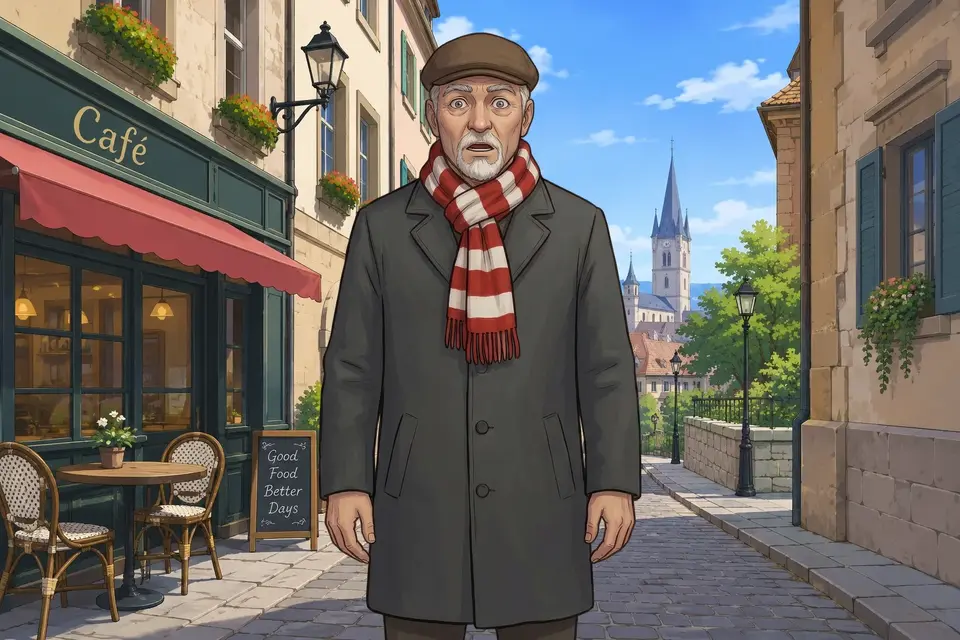
Scene: A street in Berlin

Es ist Sonntagmorgen, halb neun. Die Straße ist ganz ruhig.

It's Sunday morning, half past eight. The street is very quiet.

Am Sonntag sind die Geschäfte in Deutschland zu.

On Sundays the shops in Germany are closed.

Aber die Bäckerei an der Ecke hat bis elf Uhr auf.

But the bakery on the corner is open until eleven.

Deine Freunde kommen um zehn zum Frühstück. Du brauchst Brötchen!

Your friends are coming for breakfast at ten. You need bread rolls!

Scene: Inside the café

In der Bäckerei riecht es nach frischem Brot. Endlich bist du dran.

The bakery smells of fresh bread. Finally it's your turn.

Schulz: Guten Morgen! Was darf es sein?

Good morning! What can I get you?

Your answer

  1. Good answer

    Guten Morgen! Ich hätte gern sechs Brötchen.

    Good morning! I'd like six bread rolls, please.

  2. Mistake: say "ich hätte gern"

    Guten Morgen! Ich habe gern sechs Brötchen.

    Good morning! I like having six bread rolls.

    Schulz: Sie haben gern Brötchen? Ich auch!

    You like having bread rolls? So do I!

    Schulz: Sie meinen sicher: „Ich hätte gern sechs Brötchen.“

    I'm sure you mean: "I'd like six bread rolls."

  3. Correct German, not the best answer here: correct, but short: add "Ich hätte gern …" or "bitte"

    Sechs Brötchen.

    Six bread rolls.

    Schulz: Sechs Brötchen, gern.

    Six bread rolls, sure.

Your answer

  1. Good answer

    Ach so! Ich hätte gern sechs Brötchen.

    I see! I'd like six bread rolls, please.

Schulz: Gern. Normale Brötchen oder Körnerbrötchen?

Sure. Plain rolls or seeded rolls?

Your answer

  1. Good answer

    Vier normale und zwei Körnerbrötchen, bitte.

    Four plain and two seeded rolls, please.

    Schulz: Vier normale, zwei Körner. Sehr gern.

    Four plain, two seeded. With pleasure.

  2. Good answer

    Alle normal, bitte.

    All plain, please.

    Schulz: Sechs normale. Sehr gern.

    Six plain ones. With pleasure.

  3. Mistake: no -s: the plural of Brötchen is Brötchen

    Vier normale und zwei Körnerbrötchens, bitte.

    Four plain and two seeded rolls, please.

    Schulz: Zwei Körnerbrötchen, gern. Ohne -s: ein Brötchen, zwei Brötchen.

    Two seeded rolls, sure. Without an -s: one roll, two rolls.

Schulz: Darf es noch etwas sein?

Anything else?

Dein Freund Tom isst am liebsten Brezeln.

Your friend Tom likes pretzels best.

Your answer

  1. Good answer

    Ja, ich hätte gern noch zwei Brezeln.

    Yes, I'd also like two pretzels.

  2. Mistake: plural: Brezeln

    Ja, noch zwei Brezel, bitte.

    Yes, two more pretzel, please.

    Schulz: Zwei Brezeln, ja. Eine Brezel, zwei Brezeln.

    Two pretzels, yes. One pretzel, two pretzels.

  3. Good answer

    Haben Sie auch Brezeln?

    Do you have pretzels too?

Schulz: Oh, tut mir leid. Die Brezeln sind leider alle.

Oh, I'm sorry. The pretzels are all gone, I'm afraid.

Schulz: Aber wir haben noch Laugenbrötchen und Croissants.

But we still have pretzel rolls and croissants.

Your answer

  1. Good answer

    Super, dann nehme ich zwei Laugenbrötchen.

    Great, then I'll take two pretzel rolls.

    Schulz: Gute Idee! Das ist fast wie eine Brezel.

    Good idea! That's almost like a pretzel.

  2. Good answer

    Gut, dann nehme ich zwei Croissants.

    OK, then I'll take two croissants.

    Schulz: Gern. Die sind ganz frisch.

    Sure. They're really fresh.

  3. Mistake: plural: Croissants

    Gut, dann nehme ich zwei Croissant.

    OK, then I'll take two croissant.

    Schulz: Zwei Croissants, gern. Hier hört man das -s.

    Two croissants, sure. Here you can hear the -s.

Schulz: So, das macht zusammen fünf Euro zehn.

Right, that comes to five euros ten altogether.

Your answer

  1. Good answer

    Moment, ich habe es passend. Bitte schön.

    Just a moment, I have the exact money. Here you go.

    Schulz: Oh, wunderbar! Danke schön.

    Oh, wonderful! Thank you.

  2. Good answer

    Kann ich mit Karte zahlen?

    Can I pay by card?

    Schulz: Mit Karte leider erst ab zehn Euro.

    By card only from ten euros, I'm afraid.

    Du: Kein Problem. Hier sind zehn Euro in bar.

    No problem. Here's ten euros in cash.

    Schulz: Danke. Und vier Euro neunzig zurück.

    Thanks. And four euros ninety change.

  3. Mistake: "fünf Euro zehn" is 5.10, not 15

    Hier sind fünfzehn Euro.

    Here's fifteen euros.

    Schulz: Fünfzehn? Nein, nein: fünf Euro zehn. Also 5,10 Euro.

    Fifteen? No, no: five euros ten. So 5.10 euros.

    Schulz: Dann bekommen Sie neun Euro neunzig zurück.

    Then you get nine euros ninety back.

Schulz: Schönen Sonntag noch und guten Appetit!

Have a nice Sunday, and enjoy your breakfast!

Your answer

  1. Good answer

    Danke, Ihnen auch!

    Thanks, you too!

  2. Mistake: to the shop assistant, say "Ihnen": formal

    Danke, dir auch!

    Thanks, you too!

    Schulz: Danke! Im Geschäft sagt man meistens „Ihnen auch“.

    Thanks! In a shop people usually say "Ihnen auch".

Du gehst mit einer warmen Tüte nach Hause. Die Brötchen riechen so gut!

You walk home with a warm paper bag. The rolls smell so good!

Du kannst jetzt beim Bäcker bestellen. Super gemacht!

Now you can order at the bakery. Well done!