telc B1: Kontaktaufnahme· telc B1 speaking part 1 example – getting to know each other (Kontaktaufnahme) · B1
Click the scene or press Space to continue, use the number keys to choose an answer. Tap a word to see its translation. Want to read along? Read the whole dialogue in German with English translation below.
What happens in the story
One week before the telc exam, Frau Berger runs the whole speaking exam once from the beginning. Part 1, Kontaktaufnahme, is a conversation in which you and your partner get to know each other. You and Lena already know each other from the course, so Frau Berger asks you to act as if you were meeting for the first time. Lena offers du, and you talk about where you come from, why you came to Berlin, your jobs, your languages and your weekends. Don't just answer: ask Lena questions too. At the end Frau Berger, as the examiner, asks one extra question and gives you her feedback.
Wollen wir uns duzen? – Ja, gern! – Shall we use "du"? – Yes, sure!
Ich wohne seit acht Monaten in Berlin. – I've been living in Berlin for eight months.
Warum bist du nach Berlin gekommen? – Why did you come to Berlin?
Als ich nach Berlin kam, konnte ich fast kein Deutsch. – When I came to Berlin, I could hardly speak any German.
Darf ich fragen, was du beruflich machst? – May I ask what you do for a living?
Vorher hatte ich einen Job in einem Hotel. – Before that I had a job in a hotel.
Deutsch finde ich am schwierigsten, weil die Grammatik so kompliziert ist. – I find German the hardest, because the grammar is so complicated.
Wenn das Wetter schön ist, fahre ich mit dem Fahrrad an den Wannsee. – When the weather's nice, I cycle out to the Wannsee lake.
Grammar tip: seit, als and the verb at the end
Seit takes the dative and the present tense: Ich wohne seit acht Monaten hier (not seit acht Monate, not ich habe … gewohnt).
For one event in the past, "when" is als, usually with the Präteritum: Als ich nach Berlin kam …. Wenn is for the present, the future and things that happened again and again.
After Darf ich fragen, … or Kannst du mir sagen, …, the question becomes a subordinate clause and the verb goes to the end: …, was du beruflich machst. The same goes for weil, and after a wenn clause the main clause starts with the verb: Wenn das Wetter schön ist, fahre ich …
Exam tip: telc B1 Sprechen Teil 1
The telc B1 speaking exam takes about 15 minutes, is usually taken in pairs and has three parts: Kontaktaufnahme (getting to know each other), Über ein Thema sprechen (talking about a topic) and Gemeinsam etwas planen (planning something together). Before the exam you get preparation time for parts 2 and 3. Part 1 takes about three minutes and is a free conversation: talk about yourself and ask your partner about name, origin, home, family, job, languages and hobbies; the examiners may ask an extra question. Answer in full sentences and ask questions back: one-word answers like Drei. are correct German, but they don't show what you can do. You can choose du or Sie with your partner; just stick to it.
How to play
Click the scene or press Space to read on. When it is your turn, choose an answer with the mouse or the number keys. Natural answers earn points; a wrong answer is never a dead end, Frau Berger gives you a tip and you go on.
The whole story in German with English translation, every answer you can choose
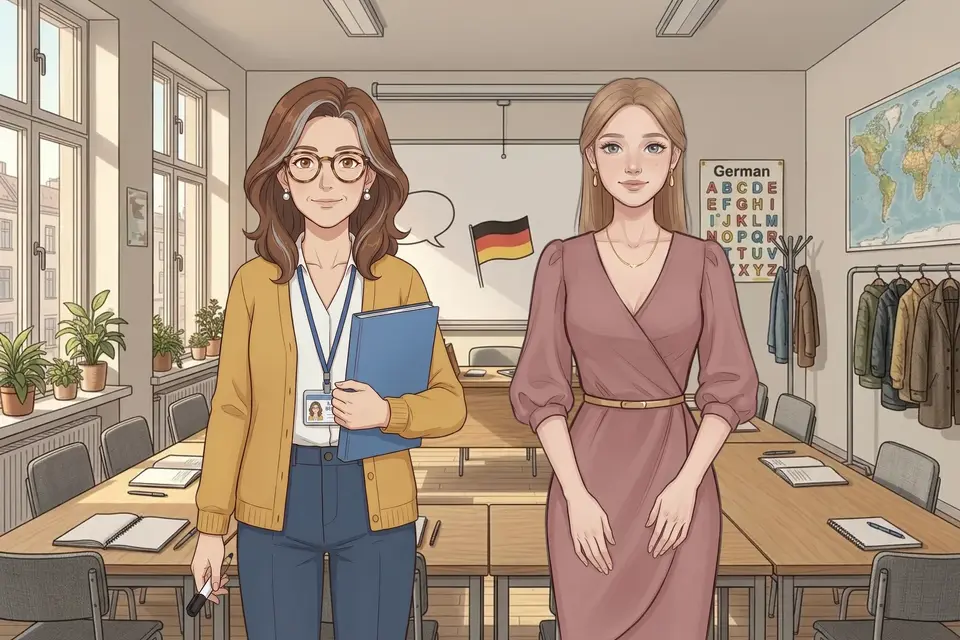
Scene: A classroom in a language school
Noch eine Woche bis zur telc-Prüfung. Heute spielt Frau Berger die ganze mündliche Prüfung einmal von Anfang an durch.
One more week until the telc exam. Today Frau Berger runs through the whole speaking exam once, from the beginning.
Berger: Die mündliche Prüfung dauert ungefähr fünfzehn Minuten und hat drei Teile. Sie sind immer zu zweit.
The speaking exam takes about fifteen minutes and has three parts. You always take it in pairs.
Berger: Teil eins heißt „Kontaktaufnahme“. Sie lernen Ihre Partnerin kennen: Name, Herkunft, Wohnort, Familie, Beruf, Sprachen, Freizeit.
Part one is called "Kontaktaufnahme", making contact. You get to know your partner: name, where you're from, where you live, family, job, languages, free time.
Berger: Alex und Lena, Sie kennen sich natürlich schon. Tun Sie bitte so, als ob Sie sich heute zum ersten Mal sehen.
Alex and Lena, you already know each other, of course. Please act as if you're meeting for the first time today.
Berger: Und denken Sie daran: Nicht nur antworten, sondern auch fragen! Bitte, Lena, fangen Sie an.
And remember: don't just answer, ask questions too! Lena, please start.
Lena: Hallo! Ich bin Lena. Wollen wir uns duzen?
Hi! I'm Lena. Shall we use "du"?
Your answer
Good answer
Ja, gern! Ich heiße Alex Kowalczyk, aber sag einfach Alex.
Yes, sure! My name's Alex Kowalczyk, but just call me Alex.
Lena: Kowalczyk? Wie schreibt man das?
Kowalczyk? How do you spell that?
Du: K, O, W, A, L, C, Z, Y, K. Das fragen mich viele.
K, O, W, A, L, C, Z, Y, K. Lots of people ask me that.
Good answer
Ja, gern. Ich bin Alex. Freut mich!
Yes, sure. I'm Alex. Nice to meet you!
Correct German, not the best answer here: correct German, but she has just offered du: say "Ja, gern" and use du
Sehr erfreut. Wie ist Ihr Nachname, bitte?
Pleased to meet you. What's your surname, please?
Lena: Äh … du kannst ruhig du sagen!
Er … you can just say "du"!
Du: Oh, natürlich. Ich bin Alex.
Oh, of course. I'm Alex.
Lena: Woher kommst du denn, Alex? Und wohnst du schon lange in Berlin?
So where are you from, Alex? And have you been living in Berlin for long?
Your answer
Good answer
Ich komme aus Polen, aus Krakau, und wohne seit acht Monaten in Berlin.
I'm from Poland, from Kraków, and I've been living in Berlin for eight months.
Good answer
Ich komme aus Kanada, aus Toronto, und wohne seit acht Monaten in Berlin.
I'm from Canada, from Toronto, and I've been living in Berlin for eight months.
Good answer
Ich komme aus Spanien, aus Valencia, und wohne seit acht Monaten in Berlin.
I'm from Spain, from Valencia, and I've been living in Berlin for eight months.
Mistake: seit takes the dative: seit acht Monaten
Ich komme aus Kanada und wohne seit acht Monate in Berlin.
I'm from Canada and I've been living in Berlin for eight months.
Lena: Seit acht Monaten erst? Dein Deutsch ist schon richtig gut!
Only eight months? Your German is really good already!
Berger: Kleiner Tipp, Alex: Nach „seit“ kommt der Dativ, im Plural mit -n: seit acht Monaten, seit zwei Jahren.
A little tip, Alex: "seit" takes the dative, and in the plural it adds -n: seit acht Monaten, seit zwei Jahren.
Lena: Und warum bist du nach Berlin gekommen?
And why did you come to Berlin?
Your answer
Good answer
Ich wollte schon lange in Deutschland leben. Als ich nach Berlin kam, konnte ich fast kein Deutsch, deshalb habe ich sofort einen Kurs angefangen.
I'd wanted to live in Germany for a long time. When I came to Berlin I could hardly speak any German, so I started a course straight away.
Lena: Das kenne ich! Bei mir war es genauso.
I know that feeling! It was exactly the same for me.
Good answer
Ich finde Berlin spannend, und hier gibt es viele Jobs. Deshalb bin ich hergezogen.
I find Berlin exciting, and there are lots of jobs here. That's why I moved here.
Lena: Das stimmt, Berlin ist nie langweilig.
That's true, Berlin is never boring.
Mistake: for one event in the past, use "als": Als ich nach Berlin kam, …
Ich wollte in Deutschland leben. Wenn ich nach Berlin gekommen bin, konnte ich fast kein Deutsch.
I wanted to live in Germany. When I came to Berlin I could hardly speak any German.
Lena: Als du nach Berlin kamst, konntest du kaum Deutsch? Das kenne ich!
When you came to Berlin you could hardly speak German? I know that feeling!
Berger: Gut verstanden, Lena. Alex: Für ein einmaliges Ereignis in der Vergangenheit sagen wir „als“, nicht „wenn“. „Als ich nach Berlin kam …“
Well understood, Lena. Alex: for a one-off event in the past we say "als", not "wenn". "Als ich nach Berlin kam …"
Lena: Ich komme aus der Ukraine, aus Charkiw. Ich bin vor zwei Jahren mit meiner Mutter nach Deutschland gekommen.
I'm from Ukraine, from Kharkiv. I came to Germany with my mother two years ago.
Lena macht eine Pause und sieht dich an. Jetzt bist du dran: Stell ihr eine Frage.
Lena pauses and looks at you. Now it's your turn: ask her a question.
Your answer
Good answer
Darf ich fragen, was du beruflich machst?
May I ask what you do for a living?
Good answer
Was machst du beruflich?
What do you do for a living?
Mistake: in an indirect question the verb goes to the end: was du beruflich machst
Darf ich fragen, was machst du beruflich?
May I ask what you do for a living?
Lena: Was ich beruflich mache? Gern!
What I do for a living? Sure!
Berger: Gut gefragt, Alex, nur die Wortstellung: „Darf ich fragen, was du beruflich machst?“ Nach „Darf ich fragen“ steht das Verb am Ende.
Good question, Alex, just the word order: "Darf ich fragen, was du beruflich machst?" After "Darf ich fragen" the verb goes at the end.
Lena: In der Ukraine war ich Englischlehrerin. Hier arbeite ich zurzeit an der Rezeption in einem Hotel, aber ich möchte wieder unterrichten.
In Ukraine I was an English teacher. Here I'm working on the reception of a hotel at the moment, but I'd like to teach again.
Lena: Dafür brauche ich aber zuerst das B1-Zertifikat. Und du? Was machst du?
But for that I need the B1 certificate first. And you? What do you do?
Your answer
Good answer
Seit ein paar Wochen arbeite ich im Kundenservice einer Firma. Vorher hatte ich einen Job in einem Hotel, genau wie du jetzt.
For a few weeks I've been working in customer service at a company. Before that I had a job in a hotel, just like you now.
Lena: Wirklich? Dann weißt du ja, wie anstrengend die Wochenenden im Hotel sind!
Really? Then you know how tiring weekends in a hotel are!
Good answer
Ich arbeite im Kundenservice. Die Arbeit gefällt mir, weil ich viel mit Menschen spreche.
I work in customer service. I like the job because I talk to lots of people.
Lena: Das passt zu dir. Du redest ja auch gern!
That suits you. You like talking, after all!
Mistake: after "vorher" at the start, the verb comes next: Vorher hatte ich …
Ich arbeite im Kundenservice. Vorher ich hatte einen Job in einem Hotel.
I work in customer service. Before that I had a job in a hotel.
Lena: Vorher hattest du einen Job in einem Hotel? Wie ich jetzt!
Before that you had a job in a hotel? Like me now!
Berger: Achtung: Das Verb steht an Position zwei. „Vorher hatte ich …“, nicht „Vorher ich hatte …“.
Careful: the verb goes in position two. "Vorher hatte ich …", not "Vorher ich hatte …".
Lena: Welche Sprachen sprichst du eigentlich?
Which languages do you actually speak?
Your answer
Good answer
Meine Muttersprache natürlich, außerdem Englisch und jetzt Deutsch. Deutsch finde ich am schwierigsten, weil die Grammatik so kompliziert ist.
My native language, of course, and also English and now German. I find German the hardest, because the grammar is so complicated.
Lena: Oh ja, die Artikel! Der, die, das …
Oh yes, the articles! Der, die, das …
Correct German, not the best answer here: too short: in part 1, give a full answer with details
Drei.
Three.
Lena: Drei? Und welche?
Three? Which ones?
Du: Meine Muttersprache, Englisch und Deutsch.
My native language, English and German.
Berger: Kleiner Tipp: Eine Antwort mit einem Wort ist zu wenig. Erzählen Sie ruhig mehr, das zeigt, was Sie können.
A little tip: a one-word answer isn't enough. Feel free to say more, it shows what you can do.
Mistake: after "weil" the verb goes to the end: weil ich es erst seit acht Monaten lerne
Deutsch spreche ich noch nicht so gut, weil ich lerne es erst seit acht Monaten.
I don't speak German that well yet, because I've only been learning it for eight months.
Lena: Weil du es erst seit acht Monaten lernst? Dafür sprichst du aber super!
Because you've only been learning it for eight months? Considering that, you speak brilliantly!
Berger: Nach „weil“ steht das Verb am Ende: „…, weil ich es erst seit acht Monaten lerne.“
After "weil" the verb goes at the end: "…, weil ich es erst seit acht Monaten lerne."
Berger: Danke. Ich habe noch eine Frage an Sie beide: Was machen Sie gern am Wochenende?
Thank you. I have one more question for both of you: what do you like doing at the weekend?
Berger: Alex, bitte.
Alex, please.
Your answer
Good answer
Wenn das Wetter schön ist, fahre ich mit dem Fahrrad an den Wannsee. Und wenn es regnet, gehe ich ins Kino.
When the weather's nice, I cycle out to the Wannsee lake. And when it rains, I go to the cinema.
Berger: Schön, und gleich zwei Bedingungen. Sehr gut.
Nice, and two conditions at once. Very good.
Good answer
Ich treffe mich gern mit Freunden, zum Beispiel im Café oder auf dem Flohmarkt.
I like meeting friends, for example at a café or at the flea market.
Berger: Danke.
Thank you.
Mistake: after a "wenn" clause, the main clause starts with the verb: …, fahre ich …
Wenn das Wetter schön ist, ich fahre mit dem Fahrrad an den Wannsee.
When the weather's nice, I cycle out to the Wannsee lake.
Berger: Ah, wenn das Wetter schön ist, fahren Sie an den Wannsee. Schön! Nach dem Wenn-Satz kommt sofort das Verb: „…, fahre ich …“.
Ah, when the weather's nice, you go out to the Wannsee. Lovely! After the "wenn" clause the verb comes straight away: "…, fahre ich …".
Lena: Ich gehe am Wochenende oft schwimmen. Vielleicht kommst du mal mit?
I often go swimming at the weekend. Maybe you'd like to come along some time?
Berger: Danke, die Zeit ist um. Das war Teil eins.
Thank you, time's up. That was part one.
Berger: Sie haben Fragen gestellt, auf die Antworten reagiert und ganze Sätze gesagt. Genau das wollen die Prüfer hören.
You asked questions, reacted to the answers and spoke in full sentences. That's exactly what the examiners want to hear.
Berger: Noch ein Tipp: Ob Sie du oder Sie sagen, entscheiden Sie selbst. Wichtig ist nur, dass Sie dabei bleiben.
One more tip: whether you say "du" or "Sie" is up to you. The only important thing is that you stick to it.
Berger: Nach einer kurzen Pause machen wir mit Teil zwei weiter.
After a short break we'll carry on with part two.
Lena hebt die Hand zum High Five. Teil eins hast du geschafft, ganz ohne Notizen. Super gemacht!
Lena holds up her hand for a high five. You've done part one, without any notes at all. Well done!