In the City: Bank and Post Office in German

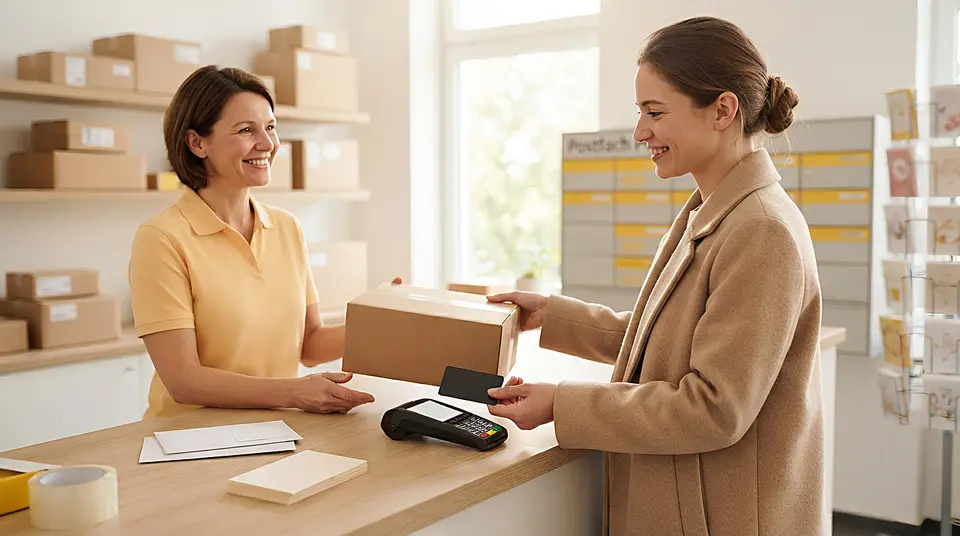
Sooner or later, everyone who lives in or visits a German-speaking country has to go to die Post (the post office) or die Bank (the bank). You want to send a postcard home, pick up a parcel that arrived while you were at work, open a bank account for your salary or simply get some cash from an ATM. These are short, everyday situations – and they are exactly the kind of situations you meet in the A1 exam.
In this guide you’ll learn the most important words for the bank and the post office, always with the article and the plural. You’ll see the sentence patterns you need again and again (Ich möchte …, Wo kann ich …?, Können Sie …?), read short dialogues, practice signs, opening hours and forms, and test yourself with exercises. The answers are hidden until you open them, so you can really check what you know.
All example sentences are at A1 level. If you are still working on the basics of everyday conversations, you may also like our guides to going shopping in German and how to ask for directions in a city.
Bank and post office: the most important words at a glance
Before we go into detail, here is a short list of the words you will use most often. Learn every noun together with its article – der, die or das – and its plural. This is the only reliable way to remember the gender.
Article | Noun | Plural | English |
|---|---|---|---|
die | Post | – | the post office, the mail |
die | Bank | die Banken | the bank |
der | Brief | die Briefe | the letter |
das | Paket | die Pakete | the parcel, the package |
die | Briefmarke | die Briefmarken | the stamp |
das | Konto | die Konten | the account |
das | Geld | – | the money |
der | Geldautomat | die Geldautomaten | the ATM, the cash machine |
die | Karte | die Karten | the card |
der | Schalter | die Schalter | the counter |
das | Formular | die Formulare | the form |
der | Ausweis | die Ausweise | the ID card |
Notice that die Post can mean two things: the post office as a place (Ich gehe zur Post. – I’m going to the post office.) and the mail you get (Ist Post für mich da? – Is there any mail for me?). The context always makes it clear.
At the post office: die Post
The national postal company in Germany is Deutsche Post. Letters are sent by Deutsche Post, and parcels mostly by its parcel brand DHL – both belong to the same group. Other parcel companies also deliver in Germany, but the words you learn here work for all of them.
Many people today don’t go to a big post office building. Very often the post office counter is inside a supermarket, a kiosk or a stationery shop. This is called a Partnerfiliale or simply Postfiliale. You buy stamps, send parcels and pick up packages there, just like in a classic post office.
Words for letters and parcels
Article | Noun | Plural | English |
|---|---|---|---|
der | Brief | die Briefe | the letter |
die | Postkarte | die Postkarten | the postcard |
der | Briefumschlag | die Briefumschläge | the envelope |
die | Briefmarke | die Briefmarken | the stamp |
das | Paket | die Pakete | the parcel |
das | Päckchen | die Päckchen | the small parcel |
das | Einschreiben | die Einschreiben | the registered letter |
der | Briefkasten | die Briefkästen | the mailbox |
die | Adresse | die Adressen | the address |
der | Absender | die Absender | the sender |
der | Empfänger | die Empfänger | the recipient |
die | Postleitzahl | die Postleitzahlen | the postal code, ZIP code |
der | Postbote | die Postboten | the mail carrier (male) |
die | Postbotin | die Postbotinnen | the mail carrier (female) |
die | Filiale | die Filialen | the branch |
die | Packstation | die Packstationen | the parcel locker |
A few small notes about these words:
Das Päckchen is the small form of das Paket. All nouns that end in -chen are neuter and have the same form in the plural: das Päckchen – die Päckchen.
Der Briefkasten is used for the yellow public mailbox on the street and for your own mailbox at home. The plural has an umlaut: die Briefkästen.
Das Einschreiben comes from the verb einschreiben. Verbs used as nouns are always neuter: das Einschreiben, das Essen, das Leben.
Die Postleitzahl is often shortened to PLZ. In Germany it always has five digits, for example 10115 Berlin.
Verbs at the post office
Verb | er / sie / es | Example |
|---|---|---|
schicken | schickt | Ich schicke einen Brief nach Spanien. |
senden | sendet | Sie sendet ein Paket an ihre Mutter. |
kaufen | kauft | Ich kaufe zehn Briefmarken. |
bekommen | bekommt | Er bekommt heute ein Paket. |
abholen | holt … ab | Ich hole das Paket morgen ab. |
einwerfen | wirft … ein | Er wirft den Brief in den Briefkasten ein. |
ausfüllen | füllt … aus | Bitte füllen Sie das Formular aus. |
unterschreiben | unterschreibt | Bitte unterschreiben Sie hier. |
wiegen | wiegt | Das Paket wiegt zwei Kilo. |
kosten | kostet | Was kostet das? |
The verbs with a pink prefix are separable verbs: in a normal sentence the prefix goes to the end. Ich hole das Paket ab. Er wirft den Brief ein. We’ll look at this pattern again in the grammar section below. Unterschreiben looks similar, but it is not separable: Ich unterschreibe hier.
Useful phrases at the post office counter
And here are typical sentences you will hear from the person at the counter:
Dialogue: sending a parcel
Read the dialogue first with the translation, then cover the English and read it again in German.
Notice the useful little words in this dialogue: Gern (sure, with pleasure), noch (still, also), ungefähr (about) and natürlich (of course). They make your German sound friendly and natural.
How to write an address in German
In Germany the address on a letter or parcel follows a fixed order. The house number comes after the street name, and the postal code comes before the city:
If you send something from abroad, add the country in the last line: DEUTSCHLAND. Write the sender’s address (der Absender) on the back of the envelope or in the top left corner, and the recipient’s address (der Empfänger) on the front. On a form you often see the abbreviation Str. for Straße and Nr. for Nummer.
Not at home? Benachrichtigung, Filiale and Packstation
What happens when the mail carrier brings a parcel and you are not at home? Usually the carrier leaves a notification card in your mailbox – die Benachrichtigung or die Benachrichtigungskarte. On the card you can read where your parcel is now. Often the parcel is with a neighbor (beim Nachbarn), in a post office branch (in der Filiale) or in a Packstation.
A Packstation is a big yellow machine with many small lockers. You can pick up your parcels there at any time, also at night and on Sundays. To use it, you register with DHL and open the locker with a code in the Post & DHL app. You can also send parcels from a Packstation.
If you pick up a parcel in a branch, bring the notification card and your ID or passport. Don’t wait too long: the parcel stays there only for a limited time (normally about one week). Then it goes back to the sender.
At the bank: die Bank
In Germany you will see many different banks: big private banks, Sparkassen (savings banks, usually one in every town), Volksbanken and many online banks without branches. For daily life you normally need one thing: ein Girokonto – a current account (checking account). Your salary goes into this account, and you pay your rent, your phone and your insurance from it.
Words for the bank
Article | Noun | Plural | English |
|---|---|---|---|
die | Bank | die Banken | the bank |
die | Sparkasse | die Sparkassen | the savings bank |
das | Konto | die Konten | the account |
das | Girokonto | die Girokonten | the current account |
das | Geld | – | the money |
das | Bargeld | – | cash |
der | Geldautomat | die Geldautomaten | the ATM |
die | Bankkarte | die Bankkarten | the bank card |
die | Kreditkarte | die Kreditkarten | the credit card |
die | Geheimzahl | die Geheimzahlen | the PIN |
die | Überweisung | die Überweisungen | the bank transfer |
der | Kontoauszug | die Kontoauszüge | the bank statement |
die | Gebühr | die Gebühren | the fee |
der | Geldschein | die Geldscheine | the bank note |
die | Münze | die Münzen | the coin |
der | Termin | die Termine | the appointment |
der | Kunde | die Kunden | the customer (male) |
die | Kundin | die Kundinnen | the customer (female) |
die | Unterschrift | die Unterschriften | the signature |
A few notes:
Das Konto has the plural die Konten. You will sometimes also hear die Kontos, but die Konten is the standard form.
Der Geldautomat and der Kunde add -n or -en not only in the plural but also in other cases: Ich suche einen Geldautomaten. Die Bank hat viele Kunden. You don’t need the full rule at A1 – just learn the phrase einen Geldautomaten.
All nouns ending in -ung are feminine: die Überweisung, die Benachrichtigung, die Öffnung, die Rechnung.
Der Euro and der Cent stay the same after numbers: zehn Euro, fünfzig Cent – never ❌ zehn Euros.
Girokonto, Girocard and IBAN – what is what?
Three words confuse many newcomers in Germany, so here is a short explanation:
Das Girokonto is your normal bank account for everyday money. Some banks charge a monthly fee for it (die Kontoführungsgebühr), others don’t.
Die Girocard is the typical German bank card that you get with your Girokonto. Many people still call it by its old name, die EC-Karte. You pay with it in shops and get cash from ATMs. Today many banks also give you a debit card from Visa or Mastercard instead of, or together with, the Girocard.
Die IBAN is the international number of your account. A German IBAN starts with DE and has 22 characters. You need it for every transfer, and your employer and landlord will ask you for it. People usually say it in groups of four: DE89 3704 0044 …
Verbs at the bank
Verb | er / sie / es | Example |
|---|---|---|
ein Konto eröffnen | eröffnet | Ich möchte ein Konto eröffnen. |
Geld abheben | hebt … ab | Er hebt 100 Euro ab. |
Geld einzahlen | zahlt … ein | Sie zahlt Geld auf ihr Konto ein. |
überweisen | überweist | Ich überweise die Miete. |
bezahlen | bezahlt | Kann ich mit Karte bezahlen? |
wechseln | wechselt | Können Sie mir 50 Euro wechseln? |
sparen | spart | Wir sparen für den Urlaub. |
unterschreiben | unterschreibt | Bitte unterschreiben Sie den Vertrag. |
eingeben | gibt … ein | Geben Sie Ihre Geheimzahl ein. |
Again the pink prefixes are separable: Ich hebe Geld ab. Sie zahlt Geld ein. Überweisen is not separable: Ich überweise das Geld. And eingeben is separable with a vowel change: Sie gibt die Geheimzahl ein.
Useful phrases at the bank
Dialogue: opening a bank account
The fee in this dialogue is only an example – every bank has its own prices.
At the ATM: am Geldautomaten
The screen of a German ATM shows short instructions. Most machines also have an English menu, but in the exam and in many small towns German is useful:
Grammar patterns you need at the bank and the post office
You don’t need much grammar to manage these situations. Five patterns cover almost everything.
Pattern 1: Ich möchte + infinitive
Möchten is the most polite and most useful verb for services. The second verb goes to the end of the sentence in the infinitive:
Person | möchten | … | End |
|---|---|---|---|
ich | möchte | einen Brief | schicken. |
du | möchtest | Geld | abheben? |
er / sie | möchte | ein Konto | eröffnen. |
wir | möchten | das Paket | abholen. |
Sie | möchten | Briefmarken | kaufen? |
You can also use möchte with a noun only: Ich möchte zehn Briefmarken, bitte. If you want to learn more verbs like this, read our guide to German modal verbs.
Pattern 2: separable verbs
Many important verbs here have a separable prefix: abholen, abheben, einzahlen, einwerfen, ausfüllen, eingeben. In a normal sentence the verb is in position 2 and the prefix goes to the end:
With möchten, können or müssen, the verb stays together at the end: Ich möchte das Paket abholen. Kann ich hier Geld abheben? More examples are in our guide to separable and inseparable verbs.
Pattern 3: the accusative after brauchen, haben, kaufen, schicken
The thing you want, buy or send is the direct object, so it is in the accusative. At A1 only the masculine article changes:
Gender | Nominative | Accusative | Example |
|---|---|---|---|
masculine | der / ein Brief | den / einen Brief | Ich schicke einen Brief. |
feminine | die / eine Briefmarke | die / eine Briefmarke | Ich brauche eine Briefmarke. |
neuter | das / ein Paket | das / ein Paket | Ich schicke ein Paket. |
plural | die Briefe | die Briefe | Ich kaufe Briefmarken. |
So remember: Ich brauche einen Termin. Ich suche einen Geldautomaten. Haben Sie einen Briefumschlag?
Pattern 4: zur Post, zur Bank – where you go and where you are
To say where you are going, use zu + dative. Zu der becomes zur, zu dem becomes zum:
Question | Answer | English |
|---|---|---|
Wohin gehst du? | Ich gehe zur Post. | I’m going to the post office. |
Wohin gehst du? | Ich gehe zur Bank. | I’m going to the bank. |
Wohin gehst du? | Ich gehe zum Geldautomaten. | I’m going to the ATM. |
Wo bist du? | Ich bin auf der Post. | I’m at the post office. |
Wo bist du? | Ich bin bei der Bank. | I’m at the bank. |
Wo ist das Paket? | Es ist in der Filiale. | It is in the branch. |
In everyday German people say auf der Post or bei der Post and auf der Bank, bei der Bank or in der Bank – all are correct. For the destination, zur Post and zur Bank are the safest choice. The dative after zu, bei and in is explained in our guide to the German dative case.
To say where something is sent, use nach for countries and cities without an article and an for a person: Ich schicke das Paket nach Spanien. Ich schicke den Brief an meine Oma.
Pattern 5: polite questions with Können Sie …? and Wo kann ich …?
Pattern | Example | English |
|---|---|---|
Können Sie …? | Können Sie mir helfen? | Can you help me? |
Können Sie …? | Können Sie das bitte wiederholen? | Can you repeat that, please? |
Wo kann ich …? | Wo kann ich Briefmarken kaufen? | Where can I buy stamps? |
Kann ich …? | Kann ich mit Karte bezahlen? | Can I pay by card? |
Gibt es hier …? | Gibt es hier einen Briefkasten? | Is there a mailbox here? |
Add bitte and Entschuldigung and you are always polite: Entschuldigung, wo ist hier ein Geldautomat?
Prices and numbers: Was kostet das?
At the post office and at the bank you hear a lot of numbers – prices, weights, amounts and opening hours. Prices are written with a comma in German and read like this:
Written | Spoken | English |
|---|---|---|
0,95 € | fünfundneunzig Cent | 95 cents |
2,50 € | zwei Euro fünfzig | 2 euros 50 |
10,00 € | zehn Euro | 10 euros |
120 € | hundertzwanzig Euro | 120 euros |
3 kg | drei Kilo | 3 kilos |
These prices are examples to practice the numbers, not real postage prices – prices for letters and parcels change from time to time, so always check them at the counter or on the Deutsche Post website. If you still have problems with big numbers, read our beginner’s guide to German numbers.
Signs and opening hours: reading practice for the exam
In the reading part of the A1 exam (Lesen) you read short texts such as notes, ads, signs and notices. Bank and post office signs are a perfect topic for this. Here are typical signs you can see in a German city:
Sign | Meaning |
|---|---|
Geöffnet | Open |
Geschlossen | Closed |
Heute geschlossen | Closed today |
Eingang / Ausgang | Entrance / Exit |
Bitte hier warten | Please wait here |
Bitte Abstand halten | Please keep your distance |
Außer Betrieb | Out of order |
SB-Bereich 24 Stunden geöffnet | Self-service area open 24 hours |
Leerung: Mo–Fr 17:00 Uhr, Sa 12:00 Uhr | Collection times on a mailbox |
Pakete bitte am Schalter 2 | Parcels at counter 2, please |
Wegen Umbau geschlossen | Closed for renovation |
SB means Selbstbedienung (self-service). In the SB-Bereich of a bank you find ATMs and machines for bank statements, often open day and night, even when the bank itself is closed. The Leerung on a mailbox tells you when the mail is collected. If you post a letter after the last collection, it leaves the next working day.
Opening hours: Öffnungszeiten
Opening hours are written in a short form. Learn to read the days and times quickly. The following opening hours are an example for practice:
Day | Postfiliale am Markt | Sparkasse Hauptstraße |
|---|---|---|
Montag | 9:00–18:00 Uhr | 9:00–16:00 Uhr |
Dienstag | 9:00–18:00 Uhr | 9:00–18:00 Uhr |
Mittwoch | 9:00–18:00 Uhr | 9:00–13:00 Uhr |
Donnerstag | 9:00–18:00 Uhr | 9:00–18:00 Uhr |
Freitag | 9:00–18:00 Uhr | 9:00–14:00 Uhr |
Samstag | 9:00–13:00 Uhr | geschlossen |
Sonntag | geschlossen | geschlossen |
Useful sentences: Die Post ist von neun bis achtzehn Uhr geöffnet. Am Samstag ist die Sparkasse geschlossen. Am Mittwoch hat die Bank nur bis 13 Uhr auf. If you need help with times and days, see our guides to telling the time in German and the days of the week.
Forms: Formulare in the writing exam
In the writing part of most A1 exams, you fill in a form with information about a person and write a short message of about 30 words. Forms are also a big part of real life at the bank and the post office – for an account, a parcel or a change of address. These are the words you see on most forms:
Form field | English | Example |
|---|---|---|
Name / Nachname / Familienname | last name | Novak |
Vorname | first name | Petra |
Geburtsdatum | date of birth | 14.05.1995 |
Geburtsort | place of birth | Prag |
Staatsangehörigkeit | nationality | tschechisch |
Straße, Hausnummer | street, house number | Bahnhofstraße 8 |
PLZ, Wohnort | postal code, place of residence | 50667 Köln |
Telefonnummer | phone number | 0221 123456 |
petra.novak@… | ||
Familienstand | marital status | ledig / verheiratet |
Beruf | job | Krankenschwester |
Datum, Unterschrift | date, signature | 03.11.2026, Petra Novak |
Exercise 3: fill in the form
Read the text. Then fill in the five missing pieces of information in the bank form.
Field | Answer |
|---|---|
Name, Vorname | Bauer, Lukas |
Geburtsdatum | (1) … |
Staatsangehörigkeit | (2) … |
Straße, Hausnummer | Gartenstraße 21 |
PLZ, Wohnort | (3) … |
Beruf | (4) … |
Familienstand | (5) … |
Short messages in the writing exam
In the second writing task you get a situation and three points. You write about 30 words and answer all three points. Bank and post office topics fit here very well. Here is an example task and a model answer.
Task: You are at work, but a parcel for you is at the post office. Write to your neighbor Mia. Ask her to pick up the parcel. Say where the card is. Say when you come home.
The model text has about 45 words. It answers all three points, starts with Liebe Mia, (small letter after the comma: ich habe …) and ends with a greeting. To learn more about personal messages, read our article on informal letters in German.
Speaking practice: questions and requests
In the speaking part of the A1 exam you work in a small group. After you introduce yourself, you ask and answer questions about a topic with word cards (for example Thema: Post with the word Briefmarke). In the last part you make requests and react to them with picture cards (for example a picture of a stamp or an ATM). Here is how this can sound.
Questions with word cards
Requests with picture cards
Common mistakes
Mistake | Correct | Why |
|---|---|---|
❌ Ich gehe zu Post. | ✅ Ich gehe zur Post. | zu + der = zur; you need the article. |
❌ Ich brauche ein Termin. | ✅ Ich brauche einen Termin. | der Termin → accusative einen. |
❌ Ich abhole das Paket. | ✅ Ich hole das Paket ab. | abholen is separable. |
❌ Ich möchte ein Konto zu eröffnen. | ✅ Ich möchte ein Konto eröffnen. | No zu after möchten. |
❌ Das kostet zehn Euros. | ✅ Das kostet zehn Euro. | Euro doesn’t change after numbers. |
❌ Es gibt viele Bänke in der Stadt. | ✅ Es gibt viele Banken in der Stadt. | Bänke are benches. |
❌ 12 Lindenstraße | ✅ Lindenstraße 12 | House number after the street. |
❌ Ich schicke den Brief zu Italien. | ✅ Ich schicke den Brief nach Italien. | nach for countries without an article. |
More exercises with answers
Exercise 8: reading – an email from the bank
Read the email and answer the questions.
Useful tips for learning and real life
Learn words in pairs and groups. Learn der Brief with die Briefmarke and der Briefkasten, das Konto with das Girokonto and der Kontoauszug. Compound nouns always take the gender of the last word: die Briefmarke (because die Marke), der Briefkasten (because der Kasten).
Prepare your sentence before you go. Think of one sentence with Ich möchte … before you go to the counter. That gives you a good start, and the rest of the conversation is often very predictable.
Carry your ID. At the post office (for picking up parcels) and at the bank you often need den Ausweis or den Reisepass.
Say your IBAN in groups of four. Practice reading your own IBAN in German numbers – it’s great practice for numbers and very useful when you speak to your employer or a landlord.
Look at real signs. Next time you walk past a bank or a post office, read the opening hours and signs on the door. Translate them in your head – this is exactly the reading task in the exam.
Don’t be afraid to ask. Können Sie das bitte wiederholen? and Langsam, bitte are perfectly normal sentences. People at the counter hear them every day.
Use the app for practice. The Post & DHL app and most banking apps can be switched to German. Reading the menu in German is a small, daily language lesson.
The bank and the post office are small, predictable situations – and that makes them perfect for beginners. If you know about twenty nouns with their articles, five patterns and a few polite phrases, you can manage almost every visit. Go through the dialogues again, read them out loud, and try the exercises once more in a few days. Viel Erfolg – good luck!
Sophia is a certified German language expert (Goethe & telc) with over eight years of experience helping learners master German. She specializes in creating high-quality digital learning materials and writing informative articles, while teaching German and preparing students for exams – bringing practical, real-world language skills to every lesson.