Silvester in Berlin – Guten Rutsch!· New Year's Eve in Germany – Silvester in Berlin · A2
Click the scene or press Space to continue, use the number keys to choose an answer. Tap a word to see its translation. Want to read along? Read the whole dialogue in German with English translation below.
What happens in the story
It's the 31st of December, and your neighbour Amira from Neighbours in Germany has invited you for raclette. Herr Schmidt from downstairs, from Waste sorting in Germany, is there too, watching „Dinner for One“ as he does every year. You talk about the big party at the Brandenburg Gate, pour wax into cold water to see what the new year will bring, and share your resolutions. At midnight you go out onto the balcony with a glass of sparkling wine while fireworks go off all over Berlin. What do you wish everyone, before and after midnight?
The story is written for A2 level learners and takes about 6 minutes. It is a seasonal story for late December, like At the Christmas market for Advent; the next celebration is Karneval in Cologne in February.
Phrases you will learn
Guten Rutsch! – Happy New Year! (before midnight: "have a good slide into the new year")
Frohes neues Jahr! Prost Neujahr! – Happy New Year! Cheers to the New Year! (after midnight)
Ich werde hier mit euch feiern. – I'm going to celebrate here with you.
Die Form zeigt, was im neuen Jahr passieren wird. – The shape shows what will happen in the new year.
Das ist ein Schiff. Ich werde viel reisen! – It's a ship. I'm going to travel a lot!
Hast du gute Vorsätze? – Ich werde mehr Sport machen. – Do you have any resolutions? – I'm going to do more sport.
Auf ein gesundes neues Jahr! – To a healthy new year!
Grammar tip: the future with werden
To talk about plans and predictions you can use werden + infinitive. Werden is the conjugated verb in second position, and the infinitive goes to the very end:
ich werde, du wirst, er/sie wird, wir werden, ihr werdet, sie/Sie werden
Ich werde viel reisen (not Ich werde reisen viel or ich werde … reise).
Du wirst im neuen Jahr erfolgreich sein. Morgen werde ich lange schlafen.
For plans that are already fixed, Germans often just use the present tense with a time word: Morgen schlafe ich lange.
Good to know: Silvester in Germany
New Year's Eve is called Silvester. Many people celebrate at home with friends, often with raclette or fondue, and watch the short English sketch „Dinner for One“, which has been shown on German TV on New Year's Eve for decades. Lead pouring (Bleigießen), reading the future from shapes of melted metal, has been banned since 2018 because of the lead, so people pour wax instead (Wachsgießen). At midnight everyone toasts with Sekt and goes outside for the fireworks; private fireworks are only sold in the last days of December. In Berlin there is a big open-air party at the Brandenburg Gate. Say Guten Rutsch! before midnight and Frohes neues Jahr! after it, and in the first days of January too.
How to play
Click the scene or press Space to read on. When it is your turn, choose an answer with the mouse or the number keys. Natural answers earn points; a wrong answer is never a dead end, Amira or Herr Schmidt shows you the right form and you go on.
Tap any word to see its translation and hear it pronounced. Save the new words to your personal learn list and practise them later with flashcards.
Read the dialogue
The whole story in German with English translation, every answer you can choose
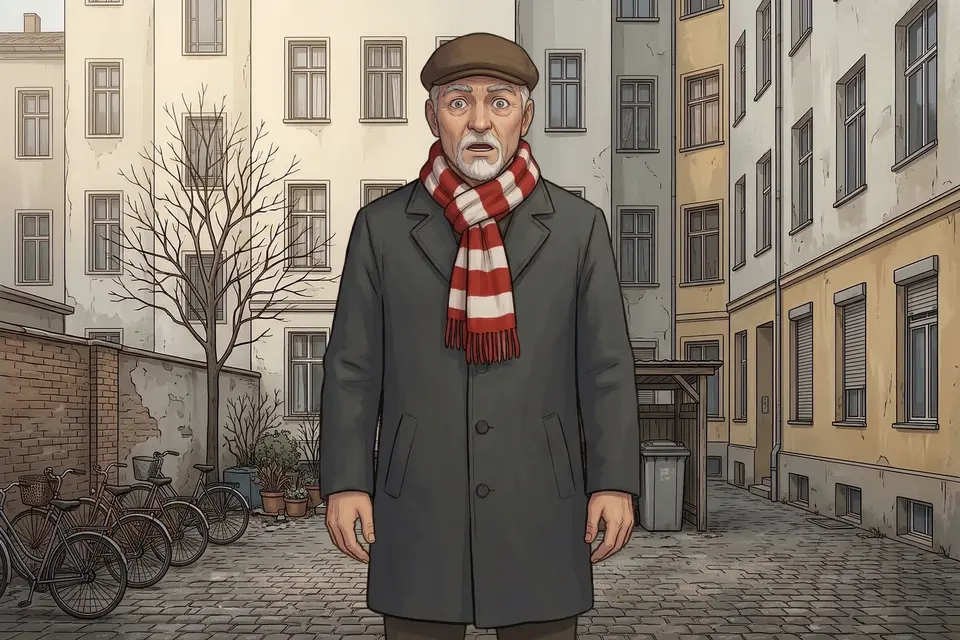
Scene: The stairwell of an old Berlin apartment building
Es ist der 31. Dezember, Silvester. Es ist acht Uhr abends.
It's the 31st of December, New Year's Eve. It's eight o'clock in the evening.
Deine Nachbarin Amira hat dich zum Raclette eingeladen. Du hast eine Flasche Sekt dabei.
Your neighbour Amira has invited you over for raclette. You've brought a bottle of sparkling wine.
Draußen knallt es schon. Irgendwo zündet jemand Böller.
Outside there are already bangs. Somewhere someone is setting off firecrackers.
Amira öffnet die Tür.
Amira opens the door.
Amira: Hallo Alex! Schön, dass du da bist! Komm rein!
Hi Alex! Great that you're here! Come in!
Your answer
Good answer
Hallo Amira! Guten Rutsch schon mal!
Hi Amira! Happy New Year in advance!
Amira: Danke, dir auch einen guten Rutsch!
Thanks, a happy New Year to you too!
Good answer
Hallo Amira! Danke für die Einladung. Hier, eine Flasche Sekt für Mitternacht!
Hi Amira! Thanks for the invitation. Here, a bottle of sparkling wine for midnight!
Amira: Oh, super, danke! Die machen wir um zwölf auf.
Oh, great, thanks! We'll open it at twelve.
Mistake: der Rutsch is masculine: Guten Rutsch!
Hallo Amira! Gute Rutsch!
Hi Amira! Happy New Year!
Amira: Danke, dir auch einen guten Rutsch! Es heißt „der Rutsch“, also: „Guten Rutsch!“
Thanks, a happy New Year to you too! It's "der Rutsch", so: "Guten Rutsch!"
Correct German, not the best answer here: correct, but it's only 8 pm: before midnight you say "Guten Rutsch!"
Hallo Amira! Frohes neues Jahr!
Hi Amira! Happy New Year!
Amira: Ha, noch nicht! Vor Mitternacht sagt man „Guten Rutsch!“. Und danach „Frohes neues Jahr!“.
Ha, not yet! Before midnight you say "Guten Rutsch!". And after it "Frohes neues Jahr!".
Amira: Lina schläft schon. Und Herr Schmidt von unten ist auch da.
Lina's already asleep. And Herr Schmidt from downstairs is here too.
Scene: A cosy living room with a dining table and a TV
Auf dem Tisch steht ein Raclette-Grill. Im Fernsehen läuft „Dinner for One“.
There's a raclette grill on the table. "Dinner for One" is on TV.
Schmidt: Guten Abend! Den Sketch sehe ich jedes Jahr an Silvester.
Good evening! I watch this sketch every year on New Year's Eve.
Schmidt: Er ist auf Englisch, aber in Deutschland kennt ihn jeder.
It's in English, but everyone in Germany knows it.
Schmidt: Gehen Sie um Mitternacht zum Brandenburger Tor? Da gibt es eine große Party.
Are you going to the Brandenburg Gate at midnight? There's a big party there.
Your answer
Good answer
Nein, ich werde hier mit euch feiern. Das ist viel gemütlicher.
No, I'm going to celebrate here with you. It's much cosier.
Schmidt: Wunderbar! Ich bin zu alt für so viele Menschen.
Wonderful! I'm too old for so many people.
Good answer
Nein, da ist es mir zu voll. Ich bleibe lieber hier.
No, it's too crowded for me there. I'd rather stay here.
Schmidt: Da haben Sie recht. Ich bin zu alt für so viele Menschen.
You're right there. I'm too old for so many people.
Mistake: after "werden" the verb is an infinitive at the end: ich werde hier mit euch feiern
Nein, ich werde hier mit euch feiert.
No, I'm going to celebrate here with you.
Schmidt: Sie werden hier mit uns feiern? Wunderbar!
You're going to celebrate here with us? Wonderful!
Schmidt: Nach „werden“ kommt das zweite Verb im Infinitiv ans Ende: Sie werden feiern.
After "werden" the second verb goes to the end in the infinitive: Sie werden feiern.
Amira: So, jeder macht sein eigenes Pfännchen. Nimm Käse, Kartoffeln, Pilze, was du magst!
Right, everyone makes their own little pan. Take cheese, potatoes, mushrooms, whatever you like!
Ihr esst und redet fast zwei Stunden lang. Es ist elf Uhr.
You eat and chat for almost two hours. It's eleven o'clock.
Amira: Jetzt machen wir Wachsgießen! Bleigießen ist ja seit 2018 verboten.
Now let's do wax pouring! Lead pouring has been banned since 2018, after all.
Amira: Du machst das Wachs auf dem Löffel heiß und gießt es ins kalte Wasser.
You heat the wax on the spoon and pour it into cold water.
Amira: Die Form zeigt, was im neuen Jahr passieren wird.
The shape shows what will happen in the new year.
Das Wachs zischt im Wasser. Heraus kommt eine komische Form, lang und mit einer Spitze.
The wax hisses in the water. Out comes a funny shape, long and with a point.
Amira: Na, was ist das?
So, what's that?
Your answer
Good answer
Ich glaube, das ist ein Schiff. Ich werde viel reisen!
I think it's a ship. I'm going to travel a lot!
Schmidt: Ein Schiff, ja! Sie werden die Welt sehen!
A ship, yes! You're going to see the world!
Good answer
Das ist bestimmt eine Rakete. Ich werde Karriere machen!
That's definitely a rocket. I'm going to have a great career!
Amira: Eine Rakete! Dann wirst du im neuen Jahr richtig erfolgreich sein!
A rocket! Then you're going to be really successful in the new year!
Mistake: with werden the infinitive goes to the very end: Ich werde viel reisen
Ich glaube, das ist ein Schiff. Ich werde reisen viel!
I think it's a ship. I'm going to travel a lot!
Amira: Du wirst viel reisen, wie schön! Das Verb „reisen“ kommt ganz ans Ende.
You're going to travel a lot, how lovely! The verb "reisen" goes right at the end.
Herr Schmidt gießt sein Wachs. Heraus kommt eine kleine, runde Kugel.
Herr Schmidt pours his wax. Out comes a small, round ball.
Schmidt: Eine Kugel! Das heißt: Das Glück kommt ins Rollen.
A ball! That means: luck is going to start rolling in.
Amira: Und, Alex, hast du gute Vorsätze für das neue Jahr?
So, Alex, do you have any New Year's resolutions?
Your answer
Good answer
Ja, ich werde jeden Tag zehn Minuten Deutsch lernen.
Yes, I'm going to study German for ten minutes every day.
Amira: Super! Dann wirst du nächstes Silvester schon perfekt Deutsch sprechen!
Great! Then by next New Year's Eve you'll be speaking perfect German!
Good answer
Ich werde mehr Sport machen. Und du?
I'm going to do more sport. What about you?
Amira: Ich werde mehr schlafen. Aber mit Lina wird das schwer!
I'm going to sleep more. But with Lina that'll be hard!
Schmidt: Ich mache keine Vorsätze mehr. Ich bin siebzig!
I don't make resolutions any more. I'm seventy!
Kurz vor Mitternacht geht ihr auf den Balkon. Amira öffnet deinen Sekt.
Just before midnight you all go out onto the balcony. Amira opens your sparkling wine.
Alle zählen laut: „Zehn, neun, acht … drei, zwei, eins!“