Der erste Arbeitstag· First day at work in German – du or Sie? · B1
Click the scene or press Space to continue, use the number keys to choose an answer. Tap a word to see its translation. Want to read along? Read the whole dialogue in German with English translation below.
What happens in the story
You got the job in Job interview in German, and today is your first Monday in customer service. Frau Neumann from HR gives you your access card and laptop and asks about your journey. Then your team leader, Frau Petersen, welcomes you: do you call her Karin or Frau Petersen? Your colleague Felix, who will train you (einarbeiten), offers du straight away. At lunch you tell Felix about your first morning, he explains who gets du and who gets Sie, and then Frau Petersen comes in and you have to talk to both of them at once.
The story is written for B1 level learners and takes about 6 minutes. Later that week you chat with Felix about your free time in Hobbies in German, and some weeks later you call Frau Petersen in Calling in sick in German.
Phrases you will learn
Ich war sogar zu früh da, weil ich so aufgeregt war. – I was even early, because I was so excited.
Hier ist Ihre Zugangskarte. – Here's your access card.
Ich hatte am Wochenende Zeit und habe alles gelesen. – I had time at the weekend and read everything.
Ich freue mich sehr, dass ich hier anfangen darf. – I'm really pleased to be starting here.
Ich war drei Jahre an der Rezeption eines Hotels. – I was on the reception of a hotel for three years.
Bei uns im Team duzen sich alle. – Ja, sehr gern! – Everyone in our team says "du". – Yes, I'd love to!
Danke, dass du mich einarbeitest. – Thanks for training me.
Felix, kannst du mir zeigen, wie das Ticketsystem funktioniert? – Felix, could you show me how the ticket system works?
Grammar tip: the Präteritum of sein and haben
When you talk about the past, sein and haben are almost always used in the Präteritum, also in speech:
sein: ich war, du warst, er/sie war, wir waren, ihr wart, sie/Sie waren – Ich war nervös (not ich hatte nervös).
haben: ich hatte, du hattest, er/sie hatte, wir hatten, ihr hattet, sie/Sie hatten – Ich hatte viele Fragen (not ich war viele Fragen); the Perfekt is ich habe … gehabt, never gehattet.
Adjectives go with sein (ich war müde, aufgeregt), nouns like Zeit, Fragen, Probleme with haben.
Good to know: du or Sie at work
Many German offices, especially start-ups and young teams, use du among colleagues, while more traditional companies use Sie. Often both exist side by side: colleagues say du, but the boss and the management get Sie, sometimes together with first names. The older person or the one with the higher position offers du (das Du anbieten), not the new colleague; until then, use Sie and Herr/Frau + surname (never Herr + first name). The first weeks are usually an Einarbeitung (training period), with an access card (Zugangskarte), a laptop from IT and lunch in the canteen (Kantine). Flexitime (Gleitzeit) with core hours is common in offices.
How to play
Click the scene or press Space to read on. When it is your turn, choose an answer with the mouse or the number keys. Natural answers earn points; a wrong answer is never a dead end, the other person shows you the right form and you go on.
Tap any word to see its translation and hear it pronounced. Save the new words to your personal learn list and practise them later with flashcards. When your residence permit has to be extended, Frau Petersen asks for a copy in Ausländerbehörde German phrases.
Read the dialogue
The whole story in German with English translation, every answer you can choose
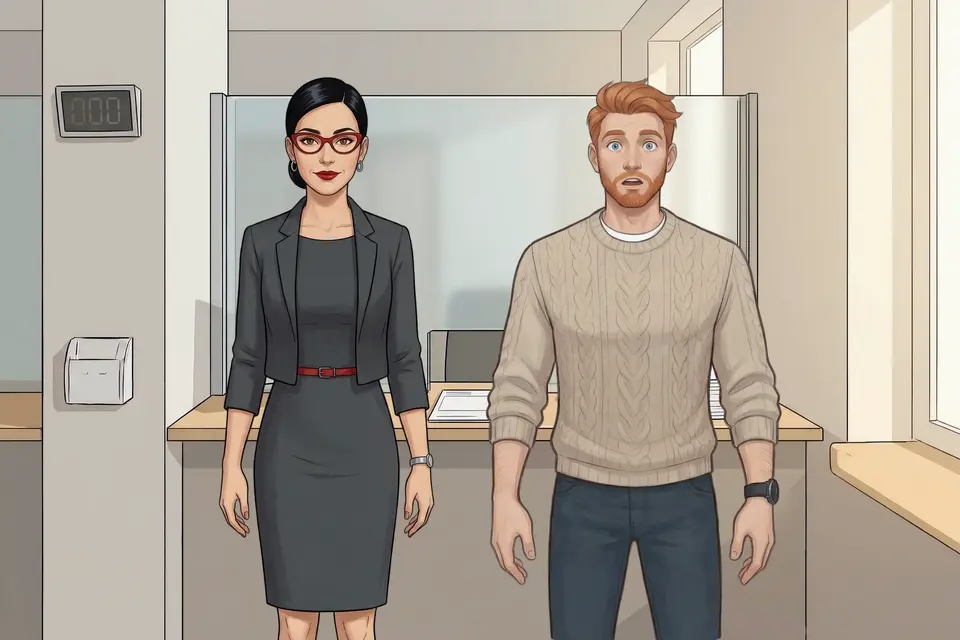
Scene: A meeting room in an office
Montag, Viertel vor neun. Heute ist dein erster Arbeitstag im Kundenservice. Frau Neumann aus der Personalabteilung holt dich am Empfang ab.
Monday, quarter to nine. Today is your first day in customer service. Frau Neumann from HR collects you at reception.
Neumann: Guten Morgen! Schön, dass Sie da sind. Wie war die Anfahrt?
Good morning! Lovely that you're here. How was your journey in?
Your answer
Good answer
Gut, danke. Ich war sogar zu früh da, weil ich so aufgeregt war.
Fine, thanks. I was even early, because I was so excited.
Neumann: Das ist am ersten Tag ganz normal.
That's completely normal on the first day.
Good answer
Gut, die U-Bahn war pünktlich.
Fine, the underground was on time.
Neumann: Das ist in Berlin ja nicht selbstverständlich!
That's not something you can take for granted in Berlin!
Mistake: with an adjective like "nervös" use sein: Ich war ein bisschen nervös
Gut, danke. Ich hatte ein bisschen nervös.
Fine, thanks. I had a bit nervous.
Neumann: Sie waren ein bisschen nervös? Das ist am ersten Tag ganz normal.
You were a bit nervous? That's completely normal on the first day.
Neumann: Hier ist Ihre Zugangskarte. Damit kommen Sie ins Gebäude, in die Büros und in die Kantine.
Here's your access card. With it you can get into the building, the offices and the canteen.
Neumann: Ihr Laptop ist schon eingerichtet, das Passwort bekommen Sie gleich von der IT. Hatten Sie schon Zeit, die Unterlagen zu lesen, die wir Ihnen geschickt haben?
Your laptop is already set up, you'll get the password from IT in a moment. Did you have time to read the documents we sent you?
Your answer
Good answer
Ja, ich hatte am Wochenende Zeit und habe alles gelesen. Ich habe nur eine Frage zur Arbeitszeit.
Yes, I had time at the weekend and read everything. I just have one question about working hours.
Neumann: Gern. Wir haben Gleitzeit: Zwischen zehn und drei sollten Sie da sein, den Rest planen Sie selbst.
Of course. We have flexitime: you should be here between ten and three, the rest you plan yourself.
Good answer
Ja, danke, es war alles klar.
Yes, thanks, everything was clear.
Neumann: Sehr gut.
Very good.
Mistake: the past of haben is "ich hatte", or in the Perfekt "ich habe … gehabt"
Ja, ich habe am Wochenende Zeit gehattet.
Yes, I had time at the weekend.
Neumann: Schön, dass Sie am Wochenende Zeit hatten. Man sagt übrigens „ich hatte“ oder „ich habe gehabt“.
Good that you had time at the weekend. By the way, you say "ich hatte" or "ich habe gehabt".
Eine Frau mit platinblondem Bob und einem Laptop unter dem Arm kommt herein.
A woman with a platinum-blonde bob and a laptop under her arm comes in.
Neumann: Ah, da ist ja Ihre Teamleiterin. Ich lasse Sie beide allein. Einen guten Start!
Ah, here's your team leader. I'll leave you two to it. Have a good start!
Petersen: Guten Morgen, Alex! Ich bin Karin Petersen, Ihre Teamleiterin. Herzlich willkommen im Team!
Good morning, Alex! I'm Karin Petersen, your team leader. A warm welcome to the team!
Your answer
Good answer
Guten Morgen, Frau Petersen! Ich freue mich sehr, dass ich hier anfangen darf.
Good morning, Frau Petersen! I'm really pleased to be starting here.
Petersen: Das freut mich.
I'm glad to hear it.
Good answer
Guten Morgen! Vielen Dank, ich freue mich auf die Arbeit.
Good morning! Thank you very much, I'm looking forward to the work.
Petersen: Das freut mich.
I'm glad to hear it.
Correct German, not the best answer here: correct German, but she's your boss and hasn't offered du: say "Frau Petersen" and use Sie
Hallo Karin, schön, dich kennenzulernen!
Hi Karin, nice to meet you!
Petersen: Oh! Na ja, bei uns duzen sich die Kollegen untereinander. Aber mich nennen alle Frau Petersen, und wir sagen Sie.
Oh! Well, here colleagues say "du" to each other. But everyone calls me Frau Petersen, and we say "Sie".
Du: Entschuldigung, Frau Petersen. Das wusste ich nicht.
Sorry, Frau Petersen. I didn't know that.
Petersen: Kein Problem, das passiert am ersten Tag.
No problem, that happens on the first day.
Petersen: In den ersten zwei Wochen arbeitet Felix Sie ein. Er ist schon vier Jahre bei uns. Wo waren Sie denn vorher?
For the first two weeks Felix will train you. He's been with us for four years. So where were you before?
Your answer
Good answer
Ich war drei Jahre an der Rezeption eines Hotels. Da hatte ich jeden Tag mit Gästen aus aller Welt zu tun.
I was on the reception of a hotel for three years. There I dealt with guests from all over the world every day.
Petersen: Perfekt, dann kennen Sie schwierige Kunden ja schon.
Perfect, then you already know about difficult customers.
Good answer
Vorher war ich in einem Hotel an der Rezeption.
Before that I was on the reception of a hotel.
Petersen: Gut, dann kennen Sie den Umgang mit Kunden.
Good, then you know how to deal with customers.
Mistake: after "da" at the start, the verb comes next: Da hatte ich …
Ich war drei Jahre an der Rezeption. Da ich hatte jeden Tag mit Gästen zu tun.
I was on reception for three years. There I dealt with guests every day.
Petersen: Da hatten Sie jeden Tag mit Gästen zu tun, sehr gut. Dann kennen Sie schwierige Kunden ja schon.
So you dealt with guests every day there, very good. Then you already know about difficult customers.
Ein Mann von etwa dreißig mit Fahrradhelm in der Hand steckt den Kopf zur Tür herein.
A man of about thirty with a bike helmet in his hand puts his head round the door.
Petersen: Ah, Felix. Das ist Alex, unser Neuzugang. Ich lasse Sie zwei dann mal arbeiten.
Ah, Felix. This is Alex, our new arrival. I'll leave you two to get to work, then.
Felix: Hi, ich bin Felix! Bei uns im Team duzen sich alle. Ist das okay für dich?
Hi, I'm Felix! Everyone in our team says "du". Is that okay with you?
Your answer
Good answer
Ja, sehr gern! Ich bin Alex. Danke, dass du mich einarbeitest.
Yes, I'd love to! I'm Alex. Thanks for training me.
Felix: Gern! Das wird schon.
My pleasure! You'll be fine.
Good answer
Klar, gern. Ich bin Alex.
Sure, of course. I'm Alex.
Felix: Super!
Great!
Mistake: "Herr" goes with the surname only, and he has offered du: just say "Ich bin Alex"
Sehr erfreut, Herr Felix.
Pleased to meet you, Mr Felix.
Felix: Herr Felix? Ha, nur Felix! „Herr“ sagt man mit dem Nachnamen, zum Beispiel Herr Müller. Aber bei mir einfach Felix und du.
Mr Felix? Ha, just Felix! You say "Herr" with the surname, for example Herr Müller. But with me it's just Felix and du.
Du: Okay, Felix. Ich bin Alex.
Okay, Felix. I'm Alex.
Felix zeigt dir deinen Platz, hilft dir mit dem Passwort und erklärt dir das Ticketsystem. Um zwölf holt ihr euch etwas in der Kantine und setzt euch damit in den Besprechungsraum.
Felix shows you your desk, helps you with the password and explains the ticket system. At twelve you get something from the canteen and sit down with it in the meeting room.
Felix: Und, wie war dein erster Vormittag?
So, how was your first morning?
Your answer
Good answer
Es war viel Neues, aber alle waren sehr nett. Nur mit dem Passwort hatte ich Probleme.
There was a lot of new stuff, but everyone was very nice. I only had problems with the password.
Felix: Ha, mit dem Passwort hat jeder Probleme. Zwölf Zeichen, Sonderzeichen, Zahlen …
Ha, everyone has problems with the password. Twelve characters, special characters, numbers …
Good answer
Super! Frau Petersen war sehr freundlich.
Great! Frau Petersen was very friendly.
Felix: Ja, sie ist eine gute Chefin. Streng, aber fair.
Yes, she's a good boss. Strict, but fair.
Mistake: questions are something you have: Ich hatte sehr viele Fragen
Gut, aber ich war sehr viele Fragen.
Good, but I was a lot of questions.
Felix: Du hattest viele Fragen? Das ist doch gut, frag einfach immer. Man sagt „Fragen haben“, also „ich hatte Fragen“.
You had lots of questions? That's good, just keep asking. You say "Fragen haben", so "ich hatte Fragen".
Felix: Kleiner Tipp: Unter Kollegen duzen wir uns. Frau Petersen und die Geschäftsführung siezen wir.
A little tip: among colleagues we say "du". Frau Petersen and the management we call "Sie".
Felix: Und das Du bietet normalerweise die ältere Person oder die Chefin an, nicht die neue Person im Team.
And it's usually the older person or the boss who offers "du", not the new person in the team.
Da öffnet sich die Tür. Frau Petersen kommt mit ihrem Kaffee herein.
Just then the door opens. Frau Petersen comes in with her coffee.
Petersen: Alex, Felix: Morgen um neun hören Sie bei Felix am Telefon mit, Alex. Passt das?
Alex, Felix: tomorrow at nine you'll listen in on Felix's calls, Alex. Does that work?
Your answer
Good answer
Ja, gern, Frau Petersen. Felix, kannst du mir vorher noch zeigen, wie das Ticketsystem funktioniert?
Yes, sure, Frau Petersen. Felix, could you show me how the ticket system works before that?
Felix: Klar, um halb neun bei mir am Platz.
Sure, at half past eight at my desk.
Good answer
Gern, Frau Petersen. Ich freue mich darauf.
Sure, Frau Petersen. I'm looking forward to it.
Felix: Ich zeige dir vorher noch das Ticketsystem.
I'll show you the ticket system before that.
Mistake: with du the verb is "kannst": Kannst du …?
Ja, gern, Frau Petersen. Felix, können du mir vorher das Ticketsystem zeigen?
Yes, sure, Frau Petersen. Felix, could you show me the ticket system before that?
Felix: Klar kann ich dir das zeigen! Mit du heißt es „kannst du“, mit Sie „können Sie“.
Of course I can show you! With du it's "kannst du", with Sie it's "können Sie".
Petersen: Perfekt. Dann einen schönen ersten Tag noch!
Perfect. Then enjoy the rest of your first day!
Um fünf fährst du nach Hause. Der erste Tag war lang, aber du hattest das Gefühl, dass du im richtigen Team bist.
At five you head home. The first day was long, but you had the feeling that you're in the right team.
Du weißt jetzt, wen du duzt und wen du siezt, und du kannst über deinen ersten Tag erzählen. Super gemacht!
Now you know who to say "du" to and who to say "Sie" to, and you can talk about your first day. Well done!