Im Hotel einchecken – ein Wochenende in Köln· Hotel check-in in German – a weekend in Cologne · A2
Click the scene or press Space to continue, use the number keys to choose an answer. Tap a word to see its translation. Want to read along? Read the whole dialogue in German with English translation below.
What happens in the story
You have come to Cologne by train for a long weekend, and your hotel is five minutes from the cathedral. At the reception desk Frau Becker finds your booking: a double room with breakfast and a view of the cathedral, from the 12th to the 15th of May. But it's only half past twelve, and your room won't be ready until three. Do you take a quieter room facing the courtyard straight away, or leave your luggage and wait for the view? Then you fill in the registration form and ask about breakfast, check-out and the Wi-Fi. In the evening you call reception for a restaurant tip.
The story is written for A2 level learners and takes about 5 minutes. Frau Becker sends you to a brewery pub for a Kölsch: see how that works in Karneval in Cologne. To get there, start with Buying a train ticket in German.
Phrases you will learn
Ich habe eine Reservierung auf den Namen Kowalczyk. – I have a reservation under the name Kowalczyk.
Drei Nächte, vom zwölften bis zum fünfzehnten Mai. – Three nights, from the 12th to the 15th of May.
ein Doppelzimmer mit Frühstück, mit Blick auf den Dom – a double room with breakfast, with a view of the cathedral
Ist das auch ein Zimmer mit einem Doppelbett? – Is that a room with a double bed too?
Kann ich mein Gepäck hier lassen? – Can I leave my luggage here?
Wann gibt es Frühstück? – When is breakfast?
Bis wann muss ich auschecken? – By what time do I have to check out?
Können Sie mir ein Restaurant in der Nähe empfehlen? – Could you recommend a restaurant nearby?
Grammar tip: Zimmer mit …, W-questions and dates
Mit always takes the dative: ein Zimmer mit einem Doppelbett (das Bett), mit einer Dusche (die Dusche), mit Frühstück.
In a W-question the verb comes straight after the question word: Wann gibt es Frühstück? Bis wann muss ich auschecken? Wo kann man gut essen?
Dates use ordinal numbers with an ending: am zwölften Mai, vom zwölften bis zum fünfzehnten (not vom zwölf).
Good to know: staying in a German hotel
Check-in is usually from 2 or 3 pm and check-out by 11 am or noon; most hotels will keep your luggage before and after. Breakfast is often a buffet and may or may not be included in the price (mit Frühstück or ohne Frühstück). Guests who are not German citizens fill in a short registration form (Meldeschein) and show their passport or ID card. Many cities, including Cologne and Berlin, add a tax on overnight stays to the bill, usually called City-Tax (in spa and holiday towns: Kurtaxe).
How to play
Click the scene or press Space to read on. When it is your turn, choose an answer with the mouse or the number keys. Natural answers earn points; a wrong answer is never a dead end, Frau Becker shows you the right form and you go on.
Tap any word to see its translation and hear it pronounced. Save the new words to your personal learn list and practise them later with flashcards.
Read the dialogue
The whole story in German with English translation, every answer you can choose
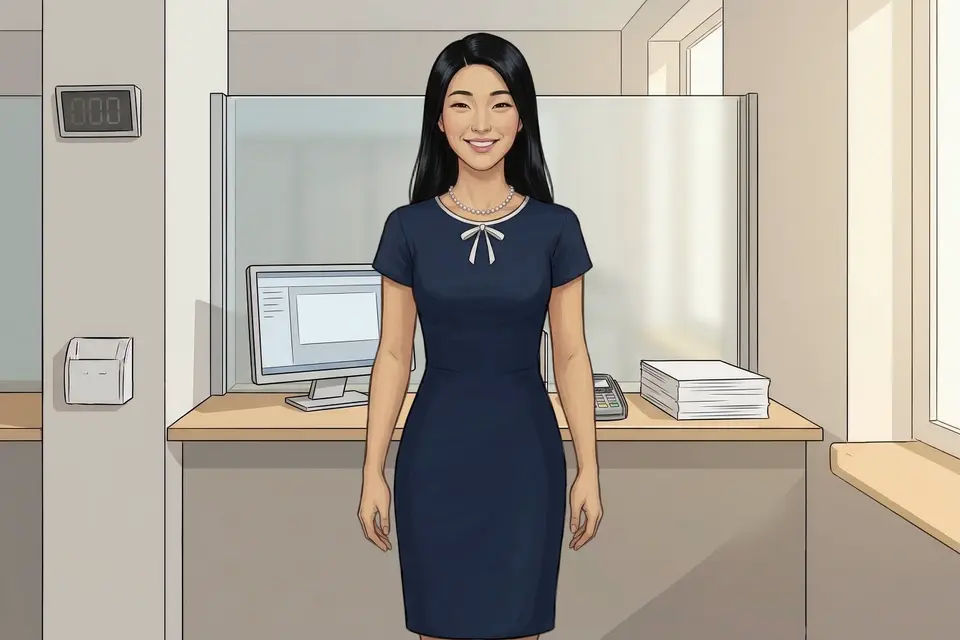
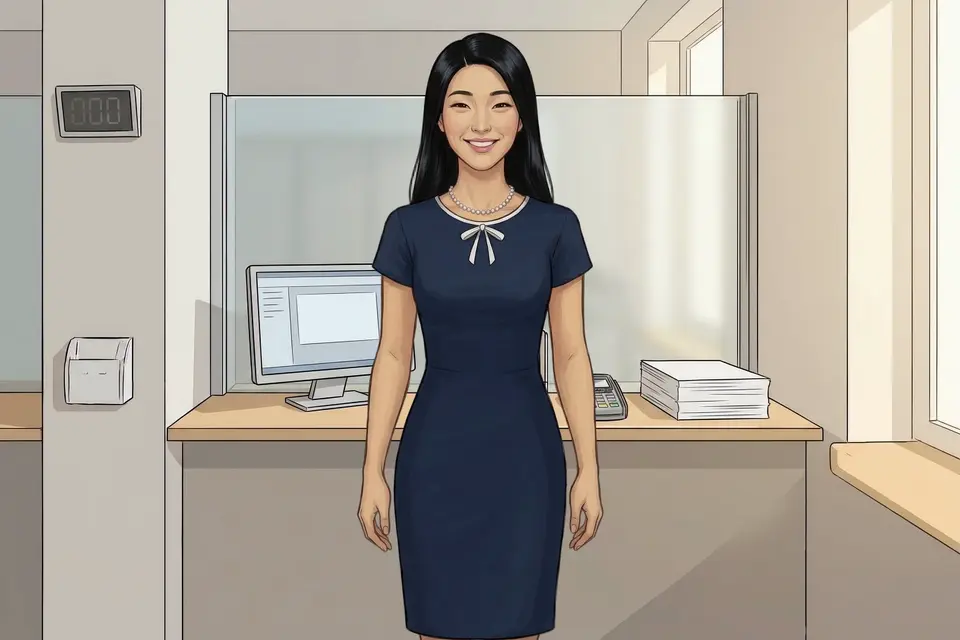
Scene: A plain service counter with a desk, a screen and a waiting number display
Es ist halb eins. Du bist mit dem Zug aus Berlin nach Köln gekommen.
It's half past twelve. You've come to Cologne by train from Berlin.
Dein Hotel ist nur fünf Minuten vom Dom entfernt. An der Rezeption steht eine junge Frau.
Your hotel is only five minutes from the cathedral. A young woman is standing at the reception desk.
Auf ihrem Namensschild steht „Becker“.
Her name badge says "Becker".
Becker: Guten Tag, herzlich willkommen! Wie kann ich Ihnen helfen?
Good afternoon, welcome! How can I help you?
Your answer
Good answer
Guten Tag! Ich habe eine Reservierung auf den Namen Kowalczyk.
Good afternoon! I have a reservation under the name Kowalczyk.
Good answer
Guten Tag! Ich habe ein Zimmer reserviert. Mein Name ist Kowalczyk.
Good afternoon! I've booked a room. My name is Kowalczyk.
Correct German, not the best answer here: correct, but "ich will" sounds pushy at a reception: say "ich möchte einchecken"
Hallo. Ich will einchecken.
Hello. I want to check in.
Becker: Sehr gern. Auf welchen Namen haben Sie reserviert?
Certainly. What name is the booking under?
Du: Auf den Namen Kowalczyk. Ich möchte bitte einchecken.
Under the name Kowalczyk. I'd like to check in, please.
Frau Becker tippt etwas in den Computer.
Frau Becker types something into the computer.
Becker: Kowalczyk … ja, hier! Wie lange bleiben Sie bei uns?
Kowalczyk … yes, here you are! How long are you staying with us?
Your answer
Good answer
Drei Nächte, vom zwölften bis zum fünfzehnten Mai.
Three nights, from the 12th to the 15th of May.
Becker: Genau, so steht es hier.
Exactly, that's what it says here.
Good answer
Drei Nächte. Ich reise am Montag ab.
Three nights. I'm leaving on Monday.
Becker: Genau, bis zum fünfzehnten Mai. So steht es hier.
Exactly, until the 15th of May. That's what it says here.
Mistake: dates use ordinal numbers: vom zwölften bis zum fünfzehnten Mai
Drei Nächte, vom zwölf bis zum fünfzehn Mai.
Three nights, from the 12th to the 15th of May.
Becker: Vom zwölften bis zum fünfzehnten, genau.
From the 12th to the 15th, exactly.
Becker: Beim Datum sagt man „am zwölften“, „vom zwölften bis zum fünfzehnten“.
With dates you say "am zwölften", "vom zwölften bis zum fünfzehnten".
Becker: Sie haben ein Doppelzimmer mit Frühstück gebucht, mit Blick auf den Dom.
You've booked a double room with breakfast, with a view of the cathedral.
Becker: Aber leider ist das Zimmer noch nicht fertig. Check-in ist erst ab 15 Uhr.
But unfortunately the room isn't ready yet. Check-in is only from 3 pm.
Becker: Ich habe aber schon ein anderes Zimmer frei, zum Hof.
But I do already have another room free, facing the courtyard.
Your answer
Good answer
Ist das auch ein Zimmer mit einem Doppelbett?
Is that a room with a double bed too?
Becker: Ja, mit einem Doppelbett und einer Dusche. Nur ohne Blick auf den Dom.
Yes, with a double bed and a shower. Just without the view of the cathedral.
Mistake: mit + dative: mit einem Doppelbett
Ist das auch ein Zimmer mit ein Doppelbett?
Is that a room with a double bed too?
Becker: Ja, mit einem Doppelbett und einer Dusche. Nach „mit“ kommt der Dativ: mit einem Bett.
Yes, with a double bed and a shower. "Mit" takes the dative: mit einem Bett.
Becker: Nur ohne Blick auf den Dom.
Just without the view of the cathedral.
Good answer
Nein danke, ich warte lieber. Kann ich mein Gepäck hier lassen?
No thanks, I'd rather wait. Can I leave my luggage here?
Your answer
Good answer
Ein Zimmer zum Hof ist super. Das ist bestimmt ruhiger.
A room facing the courtyard is great. I'm sure it's quieter.
Becker: Das stimmt. Dann nehmen Sie Zimmer 214.
That's true. Then you can have room 214.
Good answer
Danke, aber ich möchte den Blick auf den Dom. Kann ich mein Gepäck hier lassen?
Thanks, but I'd like the view of the cathedral. Can I leave my luggage here?
Becker: Natürlich. Ich stelle Ihren Koffer in den Gepäckraum. Hier ist Ihre Nummer.
Of course. I'll put your suitcase in the luggage room. Here's your number.
Du gehst zum Dom und isst am Rhein ein Eis. Um drei bist du wieder im Hotel.
You walk to the cathedral and have an ice cream by the Rhine. At three you're back at the hotel.
Becker: Willkommen zurück! Ihr Zimmer ist jetzt fertig: Zimmer 412, mit Blick auf den Dom.
Welcome back! Your room is ready now: room 412, with a view of the cathedral.
Becker: Füllen Sie bitte noch kurz den Meldeschein aus. Und ich brauche Ihren Ausweis.
Please just fill in the registration form. And I need your ID.
Du füllst das Formular aus und gibst Frau Becker deinen Ausweis.
You fill in the form and give Frau Becker your ID.
Becker: Danke. Dazu kommt noch die City-Tax. Die zahlen Sie beim Check-out.
Thank you. There's also the city tax on top. You pay that when you check out.
Becker: Haben Sie noch Fragen?
Do you have any other questions?
Your answer
Good answer
Ja, wann gibt es Frühstück?
Yes, when is breakfast?
Mistake: in a W-question the verb comes second: Wann gibt es Frühstück?
Ja, wann es gibt Frühstück?
Yes, when is breakfast?
Becker: Wann gibt es Frühstück? Gute Frage! Nach dem Fragewort kommt gleich das Verb.
When is breakfast? Good question! The verb comes straight after the question word.
Becker: Von halb sieben bis halb elf, am Wochenende bis elf. Im Erdgeschoss, gleich da links.
From half past six to half past ten, at the weekend until eleven. On the ground floor, just there on the left.
Your answer
Good answer
Und bis wann muss ich am Abreisetag auschecken?
And by what time do I have to check out on the day I leave?
Becker: Bis 11 Uhr. Danach können Sie Ihr Gepäck gern noch hier lassen.
By 11 am. After that you're welcome to leave your luggage here.
Mistake: in a W-question the verb comes second: Bis wann muss ich auschecken?
Und bis wann ich muss auschecken?
And by what time do I have to check out?
Becker: Bis wann müssen Sie auschecken? Bis 11 Uhr.
By what time do you have to check out? By 11 am.
Becker: Also: „Bis wann muss ich auschecken?“ Erst das Fragewort, dann das Verb.
So: "Bis wann muss ich auschecken?" First the question word, then the verb.
Good answer
Und wie ist das WLAN-Passwort?
And what's the Wi-Fi password?
Becker: Das steht hier auf der Karte, zusammen mit der Zimmernummer.
It's here on the card, together with the room number.
Becker: Hier ist Ihre Zimmerkarte. Der Aufzug ist da hinten rechts. Einen schönen Aufenthalt!
Here's your key card. The lift is back there on the right. Enjoy your stay!
Scene: A hotel double room with a big bed and a window
Dein Zimmer ist hell und sauber. Das Bett ist groß und bequem.
Your room is bright and clean. The bed is big and comfortable.
Aus dem Fenster siehst du die zwei Türme vom Dom.
From the window you can see the two towers of the cathedral.
Am Abend hast du Hunger. Du rufst die Rezeption an.
In the evening you're hungry. You call the reception desk.
Becker: Rezeption, Becker am Apparat.
Reception, Becker speaking.
Your answer
Good answer
Hallo, hier ist Alex Kowalczyk. Wo kann man hier in der Nähe gut essen?
Hello, this is Alex Kowalczyk. Where can you eat well near here?
Correct German, not the best answer here: correct, but too informal for a hotel: use Sie and a question, e.g. "Können Sie mir etwas empfehlen?"
Hallo, ich bin's. Gib mir mal einen Tipp fürs Abendessen.
Hi, it's me. Give me a tip for dinner.
Becker: Gern! Mit wem spreche ich, bitte?
Of course! Who am I speaking to, please?
Du: Oh, Entschuldigung! Hier ist Alex Kowalczyk. Können Sie mir ein Restaurant empfehlen?
Oh, sorry! This is Alex Kowalczyk. Could you recommend a restaurant?
Good answer
Guten Abend! Können Sie mir ein Restaurant in der Nähe empfehlen?
Good evening! Could you recommend a restaurant nearby?
Becker: Gehen Sie ins Brauhaus gleich am Dom. Da gibt es Kölsch und typisches Kölner Essen.
Go to the brewery pub right by the cathedral. They have Kölsch and typical Cologne food.
Du: Super, vielen Dank! Einen schönen Abend noch!
Great, thank you very much! Have a nice evening!
Du kannst jetzt auf Deutsch in einem Hotel einchecken und Fragen stellen. Super gemacht!
Now you can check in to a hotel in German and ask questions. Well done!