Dates in German: How to Say, Write and Ask for the Date

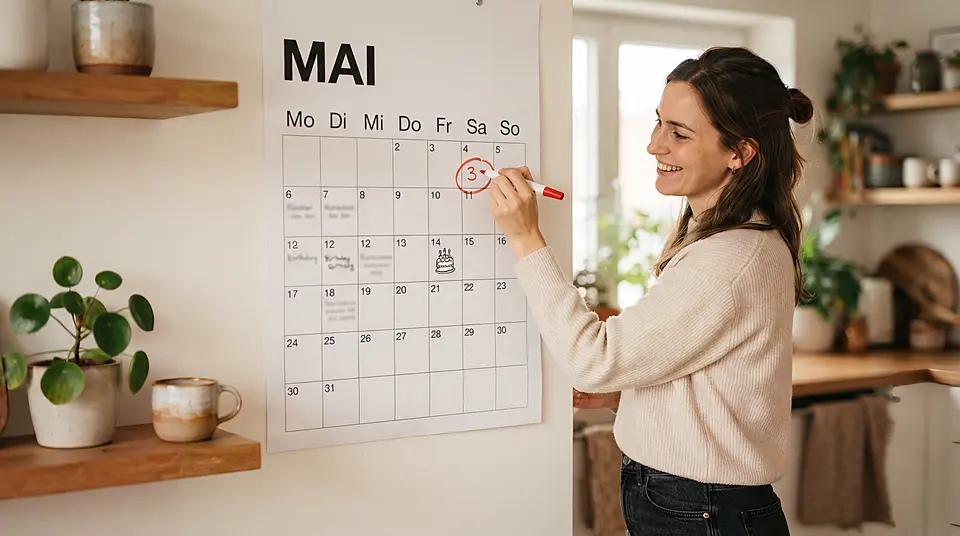
“When is your birthday?” “What’s the date today?” “Can you come on the 14th?” Questions like these come up all the time – at work, at the doctor’s, in a language course and, of course, in the A1 exam. To answer them in German, you need two things: ordinal numbers (erste, zweite, dritte …) and a few small patterns that tell you which ending to use.
The good news: dates in German follow very regular rules. Once you know that the ordinal ends in -te or -ste and that it changes to -en after am, vom and zum, you can say almost any date correctly.
In this guide you’ll learn how to build ordinal numbers, how to write them, the three key patterns for saying a date, how to ask for the date, how to read years, and how to talk about birthdays and appointments. You’ll also see how dates appear on German forms, which is important for the A1 exam. Each section has examples, and you can test yourself with exercises that have hidden answers.
Cardinal vs. ordinal numbers
German, like English, has two kinds of numbers:
Cardinal numbers (Grundzahlen) tell you how many: eins, zwei, drei – one, two, three.
Ordinal numbers (Ordnungszahlen) tell you the position in a row: der erste, der zweite, der dritte – the first, the second, the third.
For dates, German always uses ordinal numbers, just like English: “the third of May” is der dritte Mai. You never say der drei Mai.
Ordinal numbers also appear outside of dates, for example in der erste Tag (the first day), die zweite Straße links (the second street on the left) or im dritten Stock (on the third floor). In this article we focus on dates, but the same forms work everywhere.
How to form ordinal numbers
Rule 1: 1–19 → number + -te
For the numbers from 2 to 19 you simply add ‑te to the cardinal number.
Number | Cardinal | Ordinal (der …) | English |
|---|---|---|---|
1. | eins | der erste | first |
2. | zwei | der zweite | second |
3. | drei | der dritte | third |
4. | vier | der vierte | fourth |
5. | fünf | der fünfte | fifth |
6. | sechs | der sechste | sixth |
7. | sieben | der siebte | seventh |
8. | acht | der achte | eighth |
9. | neun | der neunte | ninth |
10. | zehn | der zehnte | tenth |
11. | elf | der elfte | eleventh |
12. | zwölf | der zwölfte | twelfth |
13. | dreizehn | der dreizehnte | thirteenth |
16. | sechzehn | der sechzehnte | sixteenth |
17. | siebzehn | der siebzehnte | seventeenth |
19. | neunzehn | der neunzehnte | nineteenth |
Rule 2: the four special forms
Four ordinals are irregular. Learn them by heart – they are the most common mistakes:
eins → erste (not einte)
drei → dritte (not dreite)
sieben → siebte (the -en drops; siebente also exists, but it is old-fashioned and rare)
acht → achte (only one t: not achtte)
These special forms only apply to the numbers on their own. In dreizehn or siebzehn, the regular rule applies: der dreizehnte, der siebzehnte.
Rule 3: from 20 → number + -ste
From 20 onwards, you add ‑ste. This includes all tens, and all numbers like 21, 22, 31.
Number | Cardinal | Ordinal (der …) | English |
|---|---|---|---|
20. | zwanzig | der zwanzigste | twentieth |
21. | einundzwanzig | der einundzwanzigste | twenty-first |
22. | zweiundzwanzig | der zweiundzwanzigste | twenty-second |
23. | dreiundzwanzig | der dreiundzwanzigste | twenty-third |
30. | dreißig | der dreißigste | thirtieth |
31. | einunddreißig | der einunddreißigste | thirty-first |
100. | hundert | der hundertste | hundredth |
Notice a big difference from English: in English, “twenty-first” ends in “first” and “twenty-third” ends in “third”. In German, the ending depends on the whole number. Because 21 is bigger than 19, it is einundzwanzigste – never einundzwanzigerste.
Writing ordinal numbers: the full stop
In German, you write an ordinal number as a numeral with a full stop (period) after it. The full stop replaces the English “st”, “nd”, “rd” or “th”.
You write | You say | English |
|---|---|---|
der 1. Mai | der erste Mai | May 1st |
der 3. Oktober | der dritte Oktober | October 3rd |
am 24. Dezember | am vierundzwanzigsten Dezember | on December 24th |
der 2. Stock | der zweite Stock | the 2nd floor |
In German, the day comes before the month, just like in British English: der 3. Mai = 3 May. This matters most for numeric dates: 03.05. is the 3rd of May, not March 5th.
The three key patterns for saying a date
This is the heart of the topic. The ordinal number behaves like an adjective, so its ending changes. At A1 level, you only need three patterns.
Situation | Pattern | Ending | Example |
|---|---|---|---|
What is the date? | der + ordinal | ‑e | Heute ist der dritte Mai. |
When does it happen? | am + ordinal | ‑en | Am dritten Mai habe ich Geburtstag. |
From when to when? | vom … bis zum + ordinal | ‑en | Der Kurs ist vom dritten bis zum zehnten Mai. |
Pattern 1: der + ordinal (-e) – “It’s the …”
When the date is the subject of the sentence, you use der and the ending ‑e. The word Tag (day) is understood: der dritte (Tag im) Mai.
Pattern 2: am + ordinal (-en) – “on the …”
When you say when something happens, you use am (= an dem) and the ending ‑en. This is the dative case, but you don’t need to think about grammar here: just remember am … -en.
The same day-preposition am is used with the days of the week: am Montag, am Wochenende. You can read more about this in Days of the Week in German with Prepositions. With months, however, you use im: im Mai, im Dezember. So:
im Mai – in May (the whole month)
am 3. Mai – on the 3rd of May (one day)
Pattern 3: vom … bis zum (-en) – “from … to …”
For a period of time, you use vom (= von dem) and bis zum (= bis zu dem). Both ordinals end in ‑en.
In short notes and ads you often see vom 3. bis 5. Mai (without zum) or simply 3.–5. Mai. Both are correct. When you speak, vom … bis zum is the safe choice. Ab (from … on) and bis (until) are also very useful for opening hours and appointments. For more time prepositions, see Prepositions of Time in German.
How to ask for the date
There are several ways to ask about the date. Here are the most common ones with typical answers.
Question | Answer | English |
|---|---|---|
Der Wievielte ist heute? | Heute ist der Dritte. / Heute ist der dritte Mai. | What’s the date today? – It’s the third. |
Den Wievielten haben wir heute? | Wir haben heute den dritten Mai. | What’s the date today? – Today is May 3rd. |
Welches Datum ist heute? | Heute ist der 3. Mai. | What’s today’s date? |
Welcher Tag ist heute? | Heute ist Montag. / Heute ist Montag, der 3. Mai. | What day is it today? |
Am Wievielten …? | Am zehnten. | On which date …? – On the tenth. |
Wann …? | Am 10. Mai. / Im Mai. | When …? |
Der Wievielte? is a special question word. It literally means “the how-many-th?” and it only exists as an ordinal question. Notice how it follows the same patterns as the answer:
Der Wievielte ist heute? → Heute ist der Dritte. (der + -e)
Den Wievielten haben wir heute? → Wir haben den Dritten. (with haben: den + -en, accusative)
Am Wievielten ist das Fest? → Am Dritten. (am + -en)
When the month is clear, Germans often leave it out and capitalize the ordinal because it works like a noun: Heute ist der Dritte. – Am Zehnten habe ich frei.
Wann? – asking “when?”
For birthdays, appointments and events you usually just ask Wann? The answer depends on how exact it is:
Combining dates and times is very common: am 12. April um 10 Uhr. Our guide How to Ask and Tell Time in German explains the clock time.
Short dates in speech: der Dritte Fünfte
Germans often read a numeric date with two ordinals: the day and the month as a number.
Written | Long form | Short spoken form |
|---|---|---|
3.5. | der dritte Mai | der dritte Fünfte |
12.10. | der zwölfte Oktober | der zwölfte Zehnte |
am 1.3. | am ersten März | am ersten Dritten |
am 24.12. | am vierundzwanzigsten Dezember | am vierundzwanzigsten Zwölften |
Both forms are correct. The short form is common in everyday speech, on the phone and at the doctor’s, so it’s good to understand it. For your own speaking, the long form with the month name is easier and clearer.
Years in German
How to read years
German reads years differently from normal numbers until the year 2000.
Year | How to say it | Rule |
|---|---|---|
1989 | neunzehnhundertneunundachtzig | 19 + hundert + 89 |
1999 | neunzehnhundertneunundneunzig | 19 + hundert + 99 |
2000 | zweitausend | normal number |
2008 | zweitausendacht | normal number |
2026 | zweitausendsechsundzwanzig | normal number |
For years from 1100 to 1999, you say the first two digits, then hundert, then the last two digits: 1989 = neunzehnhundert + neunundachtzig. You never say eintausendneunhundert… for a year. From 2000 onwards, you read the year like a normal number: zweitausendsechsundzwanzig.
How to use years in a sentence
This is where many English speakers make a mistake. In German, you say just the year or im Jahr + year. You don’t say in + year.
✅ Ich bin 1998 geboren.
✅ Ich bin im Jahr 1998 geboren.
The form in 1998 comes from English. Duden notes that it is not generally accepted in standard German.
The full date with a year is read like this: am 12. März 1995 = am zwölften März neunzehnhundertfünfundneunzig.
Writing the date: numbers, letters and forms
The numeric date
In Germany, Austria and Switzerland the standard everyday format is day.month.year with full stops:
03.05.2026 or 3.5.2026 = the 3rd of May 2026
24.12.2026 = December 24th, 2026
3.5.26 = a short form, common in notes
Leading zeros (03.05.) are typical on forms and in official documents. In the international ISO format, which you see in computer systems and some official papers, the order is reversed: 2026-05-03 (year-month-day, with hyphens).
The date in a letter or email
At the top of a letter, Germans write the place and the date:
Berlin, 3. Mai 2026 – modern and neutral
Berlin, 03.05.2026 – modern and neutral
Berlin, den 3. Mai 2026 – traditional, still common in private letters
Notice the case in the traditional form: den + ‑en (den dritten Mai). It’s the accusative, the same as in Wir haben den dritten Mai. You will also see weekdays with dates in invitations and emails: am Freitag, dem 9. Oktober or am Freitag, den 9. Oktober. Duden accepts both. Without am, you write Freitag, 9. Oktober or Freitag, den 9. Oktober. For full letter templates, see How to Write Formal Letters in German and German informal letters.
Dates on forms
Forms (Formulare) are part of everyday life in German-speaking countries: at the town hall, the doctor’s, the bank, the gym – and in the A1 exam. A date field often shows the expected format with letters:
On the form | Meaning | Example |
|---|---|---|
TT.MM.JJJJ | Tag (day), Monat (month), Jahr (year) | 03.05.1995 |
Geburtsdatum | date of birth | 12.03.1995 |
Geburtsort | place of birth | Madrid |
Datum | date (today’s date) | 24.11.2026 |
Datum, Unterschrift | date, signature | 24.11.2026, Anna Silva |
Anreise / Abreise | arrival / departure (hotel) | 03.05.2026 / 05.05.2026 |
gültig bis | valid until | 31.12.2027 |
Birthdays: Geburtstag and Geburtsdatum
These two words are easy to confuse:
der Geburtstag – your birthday (the day you celebrate every year): Ich habe am 8. März Geburtstag.
das Geburtsdatum – your full date of birth (with year, for forms): Geburtsdatum: 08.03.1995
Question | Answer | English |
|---|---|---|
Wann hast du Geburtstag? | Ich habe am 8. März Geburtstag. | When is your birthday? |
Wann haben Sie Geburtstag? | Am 8. März. | When is your birthday? (formal) |
Wann bist du geboren? | Ich bin am 8. März 1995 geboren. | When were you born? |
Wie ist Ihr Geburtsdatum? | Der 8. März 1995. | What is your date of birth? |
Wie alt bist du? | Ich bin 31 (Jahre alt). | How old are you? |
Note the word order: Ich habe am 8. März Geburtstag. The word Geburtstag goes to the end. You can also say Mein Geburtstag ist am 8. März.
For more simple questions about yourself, see Personal Questions in German: Simple Questions and Answers.
Appointments: making and changing a Termin
At A1 you’ll often have to make, confirm or change an appointment (einen Termin machen). These sentences are very useful – at the doctor’s, at the hairdresser’s or in the exam:
Example dialogue: at the doctor’s
Notice how the receptionist and Mr. Lee use all the patterns: am + date for the appointment, der + date for the date of birth, and just am 10. when the month is clear.
Example text: Annas Jahr
Read this short text about Anna. Pay attention to the dates and the endings.
Common mistakes with dates
Mistake | Correct | Why |
|---|---|---|
❌ Heute ist der drei Mai. | ✅ Heute ist der dritte Mai. | Dates use ordinals. |
❌ Am dritte Mai … | ✅ Am dritten Mai … | After am the ending is -en. |
❌ Heute ist der dritten Mai. | ✅ Heute ist der dritte Mai. | After der the ending is -e. |
❌ der einundzwanzigte | ✅ der einundzwanzigste | From 20: -ste. |
❌ der achtte / der siebente | ✅ der achte / der siebte | Special forms (siebente is old-fashioned). |
❌ im 3. Mai | ✅ am 3. Mai | im for months, am for days. |
❌ am Mai | ✅ im Mai | A whole month takes im. |
❌ in 1998 | ✅ 1998 / im Jahr 1998 | No in before a year. |
❌ am 3 Mai | ✅ am 3. Mai | An ordinal needs a full stop. |
❌ 05.03. for 3 May | ✅ 03.05. | Day comes before month. |
Exercises
Try each exercise first, then open the answers.
Exercise 1: Write the ordinal
Complete the sentences with the correct ordinal number. Watch the patterns: der …-e or am …-en.
Heute ist der ___ (1.) Mai.
Am ___ (3.) Oktober ist ein Feiertag.
Heute ist der ___ (7.) Juni.
Ich habe am ___ (8.) April Geburtstag.
Morgen ist der ___ (20.) Februar.
Der Kurs beginnt am ___ (21.) September.
Am ___ (31.) Dezember feiern wir Silvester.
Heute ist der ___ (13.) Juli.
Exercise 2: Read the dates aloud
Say these dates out loud as full words. Use the pattern in brackets.
1.1. (Heute ist …)
14.2. (am …)
3.10. (der …)
9.11. (am …)
24.12. (Heute ist …)
7.5. bis 19.5. (vom … bis zum …)
1999 (Ich bin … geboren.)
2026 (Im Jahr …)
30.6. (bis zum …)
12.3.1995 (am …)
Exercise 3: der, am, im, bis zum or vom … bis zum?
Choose the right word for each gap.
___ 5. Mai habe ich einen Termin.
Heute ist ___ 5. Mai.
___ Mai ist das Wetter oft schön.
Der Kurs ist ___ 2. ___ 6. März.
Ich bin ___ 1999 geboren.
Das Museum ist ___ 31. Januar geschlossen.
Exercise 4: Fill in the form
Read the text. Then write the information in the form fields in German format (TT.MM.JJJJ).
Form fields: Geburtsdatum, Geburtsort, Mitglied ab (member from), Datum.
Exercise 5: Answer the questions
Read the example text “Annas Jahr” above again and answer in full sentences.
Wann ist Anna geboren?
Wann hat Annas Freund Geburtstag?
Wie lange dauert der Deutschkurs?
Wann ist die A1-Prüfung?
Der Wievielte ist heute?
Tips for learning dates in German
Learn the four special forms first: erste, dritte, siebte, achte. Everything else is regular.
Practice with real dates every day. In the morning, say today’s date out loud: Heute ist der … Then say one plan: Am … habe ich …
Learn your own dates by heart. Your birthday, your date of birth, the birthdays of your family. In the exam and in real life, these come up first.
Think in chunks, not in grammar. Heute ist der …-e, am …-en, vom …-en bis zum …-en. Three patterns cover almost every A1 situation.
Write dates the German way. Set your phone or calendar to German (TT.MM.JJJJ) so you see day-before-month every day.
Listen for numbers. In A1 listening tasks, dates and times are often the key information. Write them down as numbers while you listen (3.10.), not as words.
Combine with days and times. Am Montag, dem 15. Juni, um 9 Uhr – this one sentence trains three topics at once.
Sophia is a certified German language expert (Goethe & telc) with over eight years of experience helping learners master German. She specializes in creating high-quality digital learning materials and writing informative articles, while teaching German and preparing students for exams – bringing practical, real-world language skills to every lesson.